Why DNA Ancestry Tests Fail Indigenous Families: The Colonial Foundation Problem
When Yamasee descendants take commercial DNA tests and receive results showing zero Indigenous ancestry, the problem is not their DNA—it is the fundamentally flawed historical foundation upon which these tests are built. Understanding why reference panels fail Indigenous families is essential to protecting your heritage.
Why DNA Ancestry Tests Fail Indigenous Families: The Colonial Foundation Problem
By Ministry of Yamasee Affairs Research Team
January 19, 2026
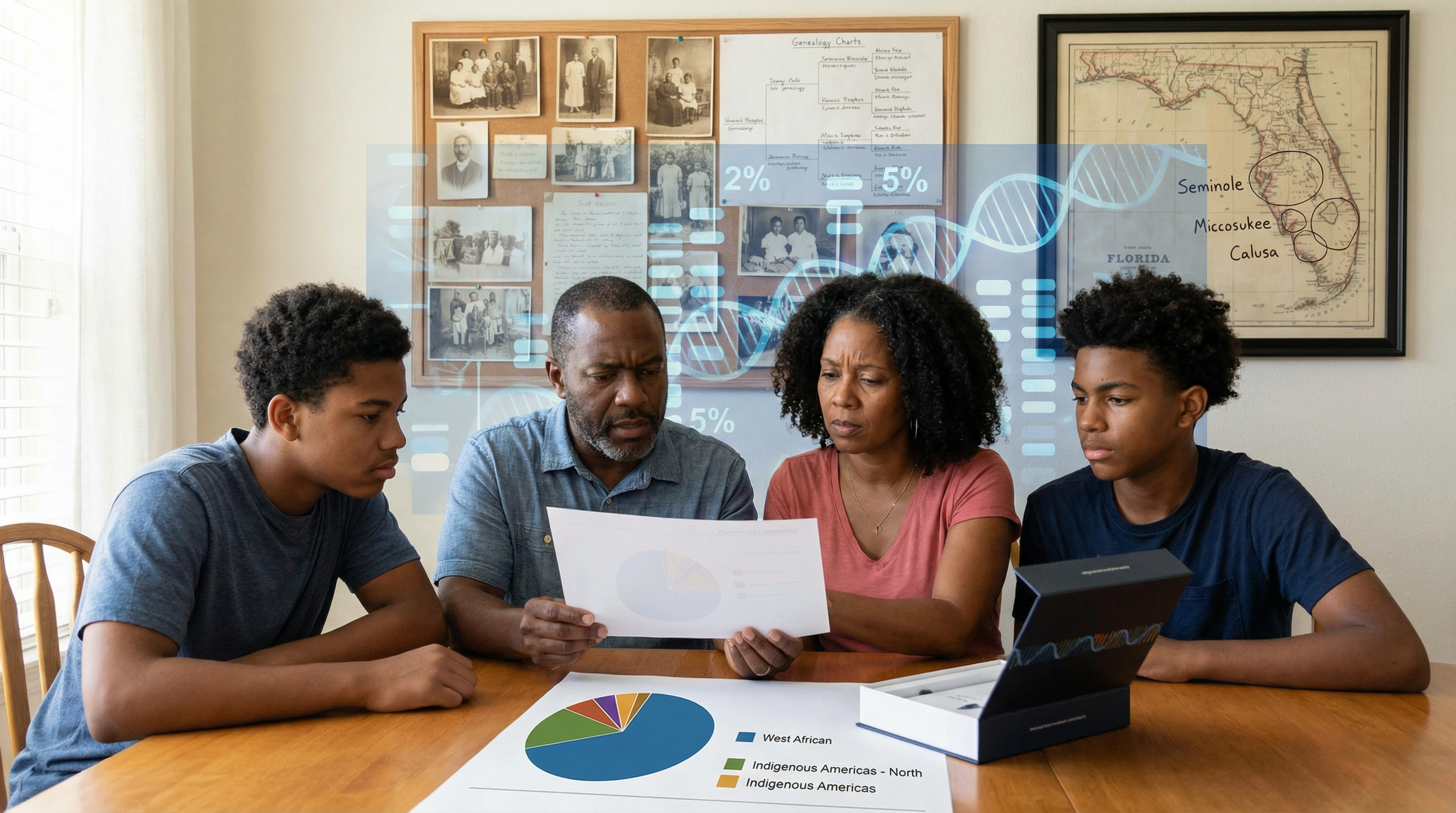
When a Yamasee descendant in Jacksonville swabs their cheek and sends it to a commercial DNA testing company, they often expect answers. Family stories passed down through generations speak of Indigenous heritage, of ancestors who survived Spanish missions, British occupation, and American expansion across Florida. Yet weeks later, the results arrive: "100% European" or perhaps "Sub-Saharan African" with no Indigenous markers at all. The disappointment is profound, but the real problem runs deeper than a single test result. The issue is not the DNA itself—it is the fundamentally flawed historical foundation upon which these tests are built.
The Reference Panel Problem: Building Science on Colonial Lies
DNA ancestry tests do not read your genetic code and magically identify your ancestors. Instead, they compare your DNA against massive reference panels—collections of samples from people whose ancestry has been "verified" through historical records such as census documents, birth certificates, and family trees. Companies like AncestryDNA maintain over 185,000 samples across 146 regions, while 23andMe operates similar databases. These panels serve as the baseline for all ethnicity estimates. If the baseline is corrupted, every result inherits that corruption.
The fundamental flaw is this: historical records in the United States, particularly in the Southeast, were systematically manipulated to erase Indigenous and African ancestry. During the Jim Crow era, during Reconstruction, and throughout the colonial period, people were forcibly reclassified on official documents. Yamasee families in Florida who maintained their Indigenous identity were often recorded as "mulatto," "free person of color," or simply "white" on census forms—not because their ancestry changed, but because survival demanded it. When DNA testing companies recruit participants for their reference panels and verify ancestry through these same corrupted historical records, they perpetuate the erasure.
Consider the mechanics of this corruption. A Yamasee descendant in Alachua County whose great-great-grandfather was recorded as "white" on the 1900 census—despite maintaining Indigenous cultural practices and community ties—might be recruited into a "European" reference panel. Their DNA, which carries genuine Indigenous American markers, now contaminates the European baseline. When another Yamasee descendant takes a DNA test, the algorithm compares their Indigenous markers to this corrupted panel and concludes: "European variation." The truth vanishes into statistical noise.
Florida's Specific Vulnerabilities: How Reclassification Poisoned the Data
Florida presents unique challenges for DNA ancestry testing because of its complex colonial history. Spanish land grants, British occupation, Seminole Wars, and aggressive American expansion created multiple layers of administrative reclassification. Yamasee families who held Spanish land patents in Escambia County were often recorded with Spanish surnames. Those who intermarried with African Americans during Reconstruction were reclassified as "Negro" or "colored" regardless of documented Indigenous lineage. Federal policies that refused to recognize Southeastern tribes as "Indian" unless they matched Plains stereotypes led to widespread administrative erasure.
The 1830 Indian Removal Act and subsequent Seminole Wars created additional documentation chaos. Families who remained in Florida—rather than being forcibly relocated to Oklahoma—often disappeared from federal Indian rolls entirely. County clerks, operating under pressure to show compliance with removal policies, simply stopped recording Indigenous identity. A family in Marion County with continuous Yamasee heritage might appear as "white" in 1840, "mulatto" in 1870, and "Negro" in 1900—not because their ancestry changed, but because the political incentives for classification shifted.
When DNA testing companies build reference panels using these documents, they inherit every layer of colonial manipulation. The result is a genetic database that reflects administrative convenience rather than biological reality. A Yamasee descendant whose ancestors survived in Florida through strategic reclassification will test as "European" or "African" because the reference panels were built on the very documents that erased them.
The Eurocentric Bias: Underrepresentation and Algorithmic Erasure
Beyond the corruption of individual records, DNA testing companies face a structural problem: their reference panels are overwhelmingly Eurocentric. Studies of major commercial databases show that European samples often comprise 60 to 70 percent of reference panels, while Indigenous American groups—particularly Southeastern tribes—are severely underrepresented. This imbalance is not accidental. It reflects historical sampling priorities, colonial restrictions on genetic research with Indigenous communities, and the simple fact that European-descended populations have been more willing to participate in commercial genetic studies.
For Yamasee descendants, this underrepresentation has direct consequences. When the algorithm encounters genetic markers common in Southeastern Indigenous populations but absent from the reference panel, it defaults to the closest available match—often "broadly Southern European" or "broadly Sub-Saharan African." The specificity disappears. A genetic signature that should read "Yamasee, Florida Gulf Coast" instead becomes "broadly West African" or "Iberian Peninsula" because the algorithm has no Yamasee baseline to compare against.
The problem compounds when companies update their reference panels. AncestryDNA's 2025 expansion to 146 regions caused thousands of results to change overnight—proof that these estimates are not reading biological truth but rather reflecting the current state of an incomplete database. A Yamasee descendant whose results showed "30% Indigenous American" in 2023 might see that percentage drop to "10% broadly Native American" in 2025, not because their DNA changed, but because the reference panel was restructured. This instability reveals the fundamental weakness of the methodology.
Why This Matters for Yamasee Families: Emotional and Legal Consequences
The consequences of these flawed tests extend far beyond disappointment. For Yamasee families seeking to document their heritage for tribal enrollment, a DNA test showing "0% Indigenous" can become a psychological weapon. Family members who doubted oral histories now have "scientific proof" that the stories were wrong. Elders who maintained cultural knowledge face accusations of fabrication. The emotional damage is real and lasting.
Legally, these tests create additional barriers. Some tribal enrollment processes require DNA evidence to supplement documentary proof. When a Yamasee descendant presents census records showing Indigenous ancestry alongside a DNA test showing "100% European," the contradiction undermines their case—even though the DNA test is measuring a corrupted baseline rather than biological reality. The test becomes evidence against them, weaponizing colonial erasure in a new form.
There is also the risk of exploitation. Individuals with no legitimate connection to Yamasee heritage can "shop" DNA tests until they find one showing a small Indigenous percentage, then use that result to claim benefits or cultural authority. Because the tests are inconsistent and the reference panels flawed, such manipulation is both easy and difficult to disprove. The result is a proliferation of false claims that dilute genuine heritage and divert resources from legitimate descendants.
The Ministry's Position: Documented Lineage Over Genetic Estimates
The Ministry of Yamasee Affairs does not accept commercial DNA ancestry tests as primary evidence of Yamasee heritage. This position is not anti-science—it is pro-accuracy. DNA testing has legitimate applications in confirming relationships between known individuals, identifying remains, and supporting medical research. But ethnicity estimates built on corrupted historical reference panels cannot provide reliable evidence of Indigenous ancestry, particularly for Southeastern tribes subjected to centuries of administrative erasure.
Instead, the Ministry prioritizes documentary research: Spanish land grants, federal land patents, Reconstruction-era census records, county vital statistics, and oral histories verified through multiple sources. These documents, while imperfect, can be cross-referenced and contextualized. A land patent showing Yamasee ownership in Levy County in 1850, combined with census records tracking that family through Reconstruction, provides far stronger evidence than a genetic estimate comparing DNA to a corrupted baseline.
The Ministry's genealogy research guide, available for free download on this website, provides detailed methodology for tracing Yamasee lineage through documentary evidence. It includes county-specific resources for major Yamasee settlement areas across Florida, templates for organizing research, and strategies for overcoming the reclassification problem. This approach sidesteps the DNA testing industry's fundamental flaw by building evidence from primary sources rather than algorithmic estimates.
What Yamasee Descendants Should Know: Protecting Your Heritage
If you are a Yamasee descendant considering DNA testing, understand these realities. First, commercial ancestry tests measure genetic similarity to reference panels, not absolute ancestry. A result showing "0% Indigenous" does not mean you have no Indigenous ancestors—it means your DNA does not match the limited Indigenous samples in the company's database, or that your Indigenous markers were absorbed into "European" or "African" categories due to panel corruption.
Second, results will change as companies update their panels. Do not treat a single test result as permanent truth. The same DNA sample can yield different ethnicity estimates from different companies, or from the same company at different times. This variability proves the estimates are interpretations, not measurements.
Third, prioritize documentary research over genetic estimates. Build your family tree using census records, vital statistics, land patents, and probate documents. The Ministry's research guide provides step-by-step instructions for accessing Florida archives and county records. Cross-reference multiple sources to establish patterns. A family consistently recorded in the same Florida county across multiple generations, with land ownership and community ties, provides stronger evidence than any DNA test.
Fourth, if you do test, use the results only as supplementary information. DNA matches with other test-takers can help identify cousins and confirm relationships within known family lines. But do not let ethnicity estimates override documented evidence or family knowledge. The algorithm does not know your family's history—you do.
The Path Forward: Demanding Better Science and Trusting Better Sources
The DNA testing industry will not fix its reference panel problem without pressure. Indigenous communities, including Yamasee descendants, must demand transparency about how panels are constructed, which historical records are used for verification, and how companies address known biases. We must insist on the inclusion of Southeastern tribal samples collected with proper consent and cultural protocols. And we must hold companies accountable when their marketing promises "99.9% accuracy" while their fine print admits results are estimates subject to change.
Until the industry addresses these fundamental flaws, Yamasee families should treat DNA ancestry tests with appropriate skepticism. They are not oracles revealing hidden truth—they are algorithms comparing your DNA to an incomplete, biased, and historically corrupted database. Your real ancestry is not hidden in a genetic pie chart. It is documented in Spanish land grants filed in Pensacola, in federal land patents recorded in Tallahassee, in Reconstruction census records from Alachua and Marion counties, and in the oral histories your elders preserved despite centuries of pressure to forget.
The Ministry of Yamasee Affairs exists to help families navigate this documentary evidence, to contextualize the reclassification that obscured Yamasee identity, and to establish verifiable connections to documented ancestors. This work is harder than swabbing your cheek and waiting for an email. It requires patience, research skills, and willingness to confront uncomfortable historical truths. But it produces results that cannot be dismissed as "algorithm quirks" or undermined by the next reference panel update.
Your Yamasee heritage is real, documented, and defensible. Do not let a flawed genetic test convince you otherwise. The colonial system tried to erase you through administrative reclassification. Do not let a modern corporation finish the job through algorithmic erasure. Trust the documents. Trust the elders. Trust the unbroken line of survival that brought you here.
About the Ministry of Yamasee Affairs
The Ministry of Yamasee Affairs is a Florida-based cultural, historical, and genealogical institution dedicated to preserving Yamasee heritage and supporting descendants in documenting their lineage. We provide research services, educational programs, and enrollment verification for qualified Yamasee descendants across Florida. Learn more at ministryofyamaseeaffairs.org.
Download Our Free Research Guide
The Ministry offers a comprehensive 50+ page genealogy research guide with Florida-specific archive locations, county resources, document templates, and step-by-step methodology for tracing Yamasee lineage. Download it free at ministryofyamaseeaffairs.org/programs.