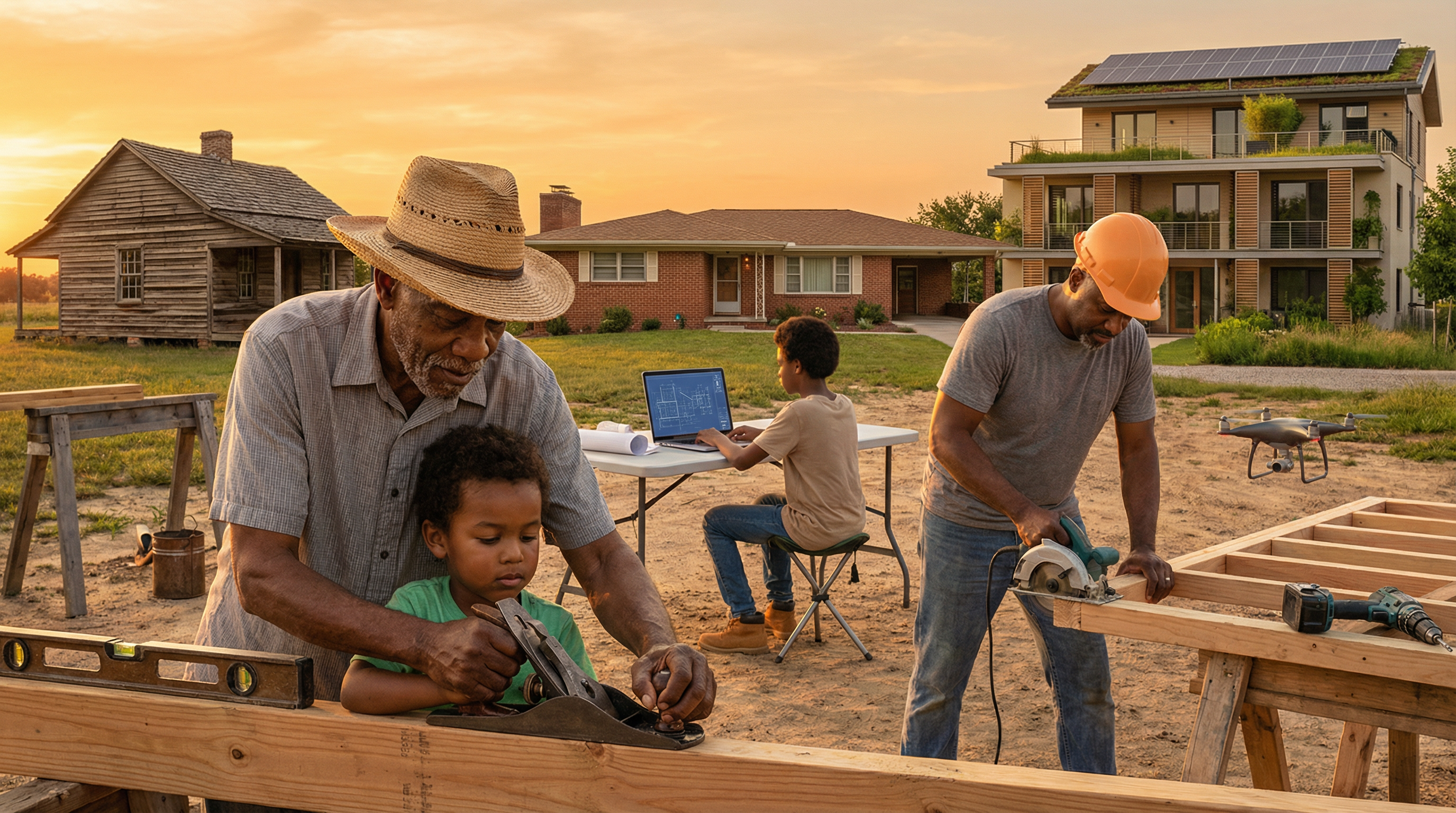
Remembering How to Build: A Florida Lineage of Skill, Land, and Order
There is a quiet strength that runs through the people of Florida and the wider Southern coast. This article explores how communities organized, how families moved, how land was worked, and how knowledge was passed hand to hand—restoring accuracy to a story of continuity, skill, and purpose.
A Quiet Strength Runs Through Southern Coastal Communities
There is a quiet strength that runs through the people of Florida and the wider Southern coast—one that doesn't announce itself, doesn't posture, and doesn't ask for permission. It shows up in how communities organized, how families moved, how land was worked, and how knowledge was passed hand to hand.
The Ministry of Yamasee Affairs exists to bring clarity back to that story—not to debate, but to document; not to dramatize, but to restore accuracy and usefulness.
This article is part of that work.
A People Shaped by Movement and Mastery
Florida was never a static place. Long before modern borders, families here were mobile, skilled, and adaptive. Fishing routes, farming cycles, trade corridors, and seasonal settlements shaped life more than fixed plantations or rigid hierarchies.
Many families were free-moving, not confined. They were land-aware, even when land was shared or stewarded communally. These communities possessed deep knowledge in navigation, healing, construction, agriculture, and diplomacy. They were self-organized, governed by kinship, councils, and custom rather than distant authority.
This matters because it reframes how we understand inheritance—not as something lost, but as something interrupted and recoverable.
Why Accuracy Restores Confidence
When history is flattened, people inherit confusion. When it is corrected with discipline, people inherit direction.
Truth correction is not about replacing one myth with another. It is about tracing who was where, understanding how people lived, and recognizing what systems sustained them.
Accuracy gives people permission to think differently about themselves—calmer, steadier, and more capable.
From Memory to Method
Restoration is most effective when it becomes practical.
That means translating history into habits: documentation over opinion, structure over speculation, and skill-building over storytelling alone.
Families that once passed down fishing calendars, herbal knowledge, land markers, and trade relationships can do something similar today—using modern tools, clearer records, and lawful structure.
What This Means Today
Many present-day challenges are not moral failures. They are systems gaps.
When people lose family records, economic structure, land continuity, or intergenerational teaching, they don't need lectures—they need frameworks.
The work of MoYA is to help rebuild those frameworks:
- How to organize family knowledge
- How to form compliant enterprises
- How to think in timelines instead of emergencies
- How to steward land, labor, and learning with intention
A Calm Return to Capacity
The past does not need defending. It needs understanding.
As people relearn how their families operated—quietly, capably, and with purpose—something shifts. Confidence returns without noise. Direction emerges without argument.
That is how continuity works.
The Ministry of Yamasee Affairs will continue publishing research, guides, and tools designed to support families who are ready to move from remembrance into application.
Not to relive history—but to use it well.