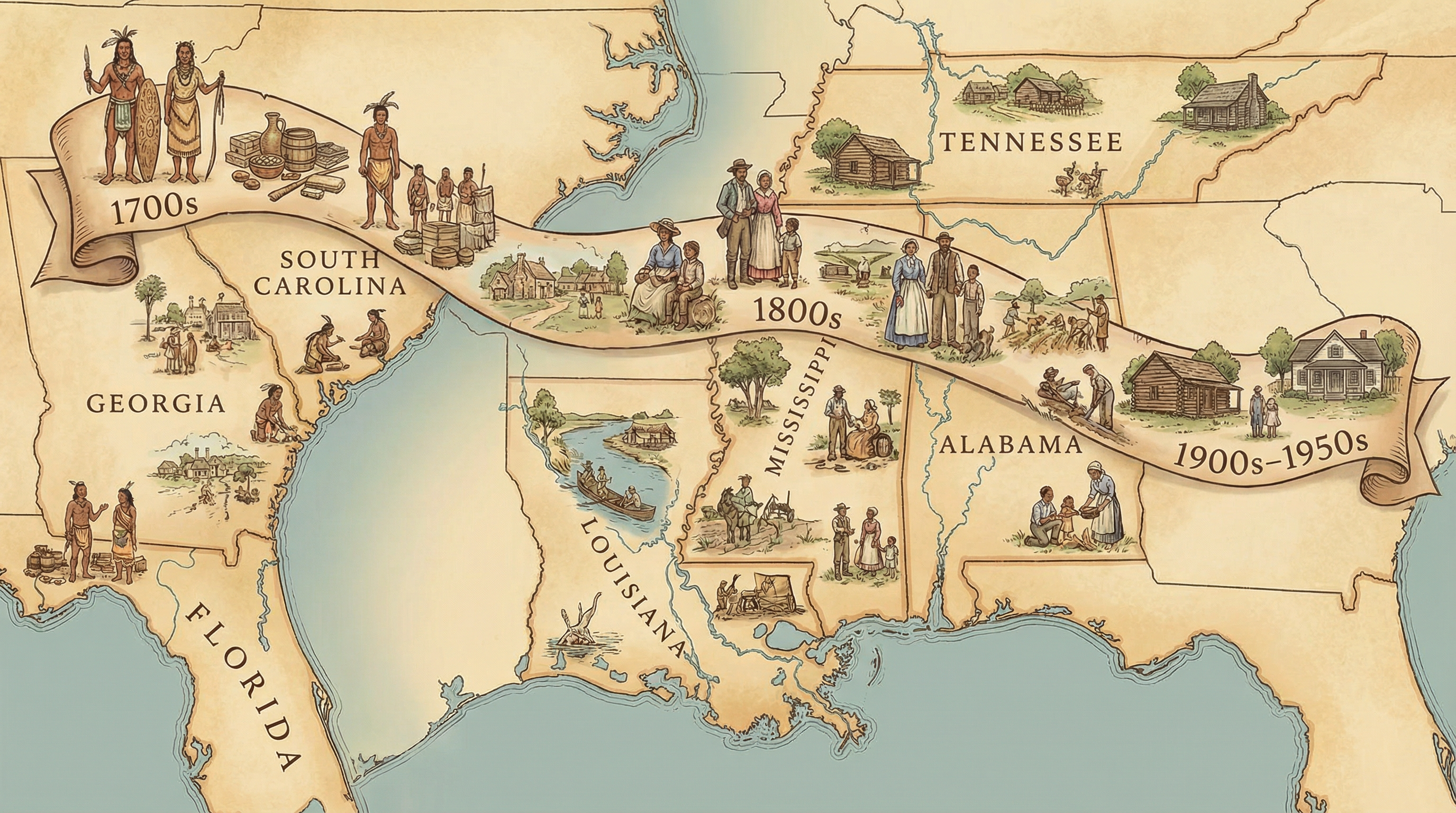
The Southeastern Chronicle: 250 Years of Yamasee Survival Across Seven States (1700-1950)
A comprehensive timeline spanning 250 years across seven states—Virginia, the Carolinas, Georgia, Alabama, Louisiana, Texas, and Florida—proving the Yamasee were never conquered. From the Yamasee War of 1715 to Mary Day's 1893 land patent, this is the documented history of strategic survival, identity preservation, and continuous presence despite systematic erasure.
The Southeastern Chronicle: 250 Years of Yamasee Survival Across Seven States (1700-1950)
Introduction: The Nation That Refused to Disappear
The conventional narrative claims the Yamasee people "disappeared" after the Yamasee War of 1715, "merged" with other tribes, and "vanished" from history. This comprehensive timeline spanning 250 years across seven states—Virginia, the Carolinas, Georgia, Alabama, Louisiana, Texas, and Florida—proves otherwise.
The laws, wars, treaties, and policies that unfolded across the Southeast were not isolated events. They formed a deliberate, coordinated system designed to dispossess Indigenous peoples of their land, reclassify their identity, and erase their presence from the historical record. Yet the Yamasee survived through strategic adaptation, geographic mobility, legal navigation, and the preservation of family networks.
The Day family connection—culminating in Mary Day's 1893 federal land patent in Columbia County, Florida—represents documented proof of continuous Yamasee presence. This is not oral tradition alone. This is federal documentation, census records, military service certificates, and land patents that prove what three centuries of policy could not erase: the Yamasee were never conquered.
Era I: The Yamasee Century (1700-1750)
The Rise of Yamasee Power
At the turn of the 18th century, the Yamasee Confederation stood at the height of its power in the Carolina Lowcountry. With over 10,000 people distributed across 10+ major towns including Pocotaligo, Altamaha, and Euhaw, the Yamasee controlled critical trade routes and maintained strategic alliances with European colonial powers.
During Queen Anne's War (1702-1706), Yamasee warriors fought alongside English forces to destroy Spanish Florida missions—paradoxically fighting for their future enemies. The 1707 Yamasee-Carolina Treaty formalized trade agreements, but it also initiated a predatory credit system that would trap Yamasee families in debt, demanding payment in captives when deerskins could not cover obligations.
The Yamasee War of 1715: A Calculated Uprising
On the morning of April 15, 1715—Good Friday—Carolina Indian Agent Thomas Nairne was awakened at Pocotaligo Town by Yamasee warriors he had called friends. What followed was not mindless violence but calculated political action. Nairne had overseen the debt system that threatened to sell Yamasee children into Caribbean slavery when families could not pay.
Nairne was burned over a slow fire for three days. His execution was both revenge and message: the era of submission was over. Within weeks, over 400 colonists lay dead, and Charleston itself trembled behind hastily built fortifications. The Yamasee War was the deadliest colonial conflict in proportion to population until the American Revolution, killing 7% of South Carolina's white population.
Strategic Flight to Spanish Florida
By 1717, the entire Yamasee nation relocated to Spanish Florida, welcomed as allies against the English. This was not defeat—it was strategic repositioning. Under Spanish colonial rule, which operated under the more flexible sistema de castas (caste system) rather than the rigid English racial binary, Yamasee communities rebuilt near St. Augustine.
In 1738, Fort Mose was established—the first legally sanctioned free Black town in the future United States. Here, Yamasee warriors and African allies formed a military buffer protecting Spanish St. Augustine. During the War of Jenkins' Ear (1739-1742), Yamasee fighters defended St. Augustine at the Battle of Bloody Mose in 1740, proving their continued military significance.
Era II: Empire's Chessboard (1750-1800)
Florida Changes Hands
The 1763 Treaty of Paris ended the French and Indian War and transferred Florida from Spain to Britain. Approximately 87 Yamasee evacuated to Cuba with Spanish officials, but others remained hidden in Florida's interior. British Florida (1763-1783) imposed new racial categories and the English plantation system, replacing Spanish mission structures.
Harry Day: Revolutionary War Patriot
During the chaos of the American Revolution, a man named Harry Day served in Colonel William Candler's Regiment of Refugees in Richmond County, Georgia. His service is documented by military certificate, establishing him as a free man—a critical legal distinction during an era when skin color could determine status.
Harry Day's service placed him among the "Patriots" who built the new nation. Yet the nation his sacrifice helped create would spend the next two centuries trying to erase people like him from the historical record. His descendants—including Henry Day Sr. of Edgefield, South Carolina—would carry the family name through the most dangerous periods of American history.
The Day Family Lineage Begins:
Harry Day (1780s) → Henry Day Sr. (Edgefield SC) → Henry Day Jr. (SC to FL migration) → Mary Day (1893 Land Patent) → Virginia "Jenny" Day → present generation.
The Second Spanish Florida Period (1783-1821)
When Britain returned Florida to Spain in 1783 after the American Revolution, Yamasee descendants had a third chance under more tolerant Spanish racial policies. Some Yamasee descendants fought alongside Spanish General Bernardo de Gálvez to recapture Pensacola from the British in 1781, demonstrating continued Indigenous military participation in colonial conflicts.
Era III: The Age of Removal (1800-1850)
The Louisiana Purchase and Territorial Expansion
The 1803 Louisiana Purchase doubled American territory, acquiring 828,000 square miles—without consulting a single Indigenous nation whose lands were being transferred. Spanish and French racial categories clashed with the American binary system of "white" and "colored," beginning the systematic reclassification that would define the next century.
Andrew Jackson and the Indian Removal Act
Andrew Jackson's rise to power as an "Indian fighter" assured the implementation of removal policy. The 1814 Treaty of Fort Jackson forced the Creek Nation to cede 23 million acres after the Red Stick War. In 1816, U.S. gunboats destroyed Negro Fort on the Apalachicola River, annihilating a Maroon-Native fortress and killing hundreds.
The First Seminole War (1817-1818) saw Jackson invade Spanish Florida and attack Yamasee-Seminole villages. When the United States acquired Florida through the 1819 Adams-Onís Treaty (taking effect in 1821), American racial categories replaced the Spanish sistema de castas, and systematic reclassification began.
The 1830 Indian Removal Act authorized the forced relocation of ALL Indigenous peoples east of the Mississippi River. The Supreme Court cases Cherokee Nation v. Georgia (1831) and Worcester v. Georgia (1832) affirmed Cherokee sovereignty, but President Jackson refused to enforce the rulings, reportedly saying, "John Marshall has made his decision; now let him enforce it."
The Trail of Tears and Seminole Resistance
The 1838 Trail of Tears force-marched 16,000 Cherokee to Indian Territory (Oklahoma), with over 4,000 dying during the journey. In 1836, 15,000 Creek were similarly removed from Alabama and Georgia, with thousands perishing.
But the Seminole Wars told a different story.
Osceola's Defiance and the Unconquered
When U.S. officials demanded that Seminole leaders sign a removal treaty in 1835, a young warrior named Osceola—whose mother was believed to be of Yamasee-Creek descent—drove his knife through the document on the table. "This is the only treaty I will sign," he declared.
The Second Seminole War (1835-1842) cost the United States $40 million and 1,500 soldiers—more than any other Indian War. Yamasee descendants joined the Seminole resistance, fighting at the Battle of Okeechobee in 1840, the bloodiest day of the war.
The war ended in 1842 with NO TREATY SIGNED. Approximately 300 Seminole-Yamasee remained unconquered in the Everglades. The United States never achieved military victory. The Yamasee-Seminole coalition never officially surrendered.
The Day Family in Edgefield, South Carolina
By 1832, Henry Day Sr. was documented in Edgefield, South Carolina, as a substantial landowner with $800 in real estate—significant wealth in the heart of former Yamasee territory. The 1850 census shows the Day family with substantial property, and family migration from South Carolina to Florida begins during this period.
Era IV: War, Reconstruction, and Erasure (1850-1900)
The Civil War and Confederate-Tribal Treaties
The Civil War presented impossible choices for Indigenous nations. Between July and October 1861, the Creek, Choctaw, Chickasaw, Cherokee, and Seminole nations signed treaties with the Confederate States of America. On July 1, 1861, these nations formed their own Grand Council within the CSA alliance through the Intertribal Articles of Confederation.
Creek leader Opothleyahola led thousands fleeing to Kansas during the winter of 1861-62 in what became known as the Trail of Blood on Ice, as refugees were devastated by winter conditions. Cherokee General Stand Watie became the last Confederate officer to surrender on June 23, 1865, proving the significant Native military role in the conflict.
The Freedmen's Bureau and Systematic Reclassification
The 1865 establishment of the Freedmen's Bureau—supposedly created to help freed people—actually facilitated Indigenous reclassification. Between 1870 and 1890, census instructions systematically reclassified Indigenous peoples as "Negro," "Mulatto," or "Colored" regardless of ancestry.
Consider the case of a man born in 1870 in Columbia County, Florida. His grandmother was Yamasee; his mother was born free before the Civil War. He speaks Hitchiti phrases learned from elders; he knows the old planting ways and the meaning of the Green Corn ceremony.
A census taker arrives. He looks at the man's skin. He writes "B" for Black in the race column. In one stroke of a pen, three generations of Indigenous identity are erased. The man's children will be classified as "Colored." His grandchildren will be "Negro." His great-grandchildren will be told they are "African American" and that any Indigenous heritage is imagination.
This was not accident. It was policy. And it happened to thousands of Yamasee descendants across the Southeast.
The Day Family in Columbia County, Florida
The 1870 census documents Henry Day (38) and Mary Day (35) in Columbia County, Florida, with children, farming 100 acres. By 1880, the family is still documented in Precinct 5 with 14+ children maintaining the landholding.
Mary Day's 1893 Federal Land Patent: Documentary Proof
On January 7, 1893, Mary Day received a federal land patent for 80.09 acres in Columbia County, Florida. This document represents far more than property ownership—it is permanent documentary evidence of Yamasee presence in Florida at a time when official narratives claimed Indigenous peoples had been completely removed.
By securing federal land recognition, Mary Day created proof that Yamasee descendants remained in Florida, owned land, and navigated American legal systems successfully. Her patent connects the Day family lineage from Harry Day's Revolutionary War service through to present generations.
The Dawes Act and Land Theft
The 1887 Dawes Allotment Act destroyed communal landholding systems, forcing individual allotments and selling "surplus" land to white settlers. Over 90 million acres were stolen from Indigenous nations through this policy. The 1890 Wounded Knee Massacre killed 300 Lakota and marked the end of armed resistance in the West.
The 1896 Plessy v. Ferguson decision enshrined "separate but equal" segregation as law, and the 1898 Curtis Act abolished tribal courts and governments, forcing allotment on the Five Tribes.
Era V: Jim Crow and Survival (1900-1950)
Systematic Disenfranchisement
The 1901 Alabama Constitution systematically disenfranchised Black voters through poll taxes and literacy tests. Its president openly declared the goal was to "eliminate the Negro from politics." The convict leasing system (1875-1928) re-enslaved thousands through arbitrary arrest, with 73% of Alabama state revenue coming from leased convict labor by 1898.
Luke Baugh's Migration from Alabama to Florida
Around 1901, a man named Luke Baugh left Butler County, Alabama, heading south to Florida. Understanding WHY requires understanding what Alabama had become: a state where violence against people of color was endemic, unpunished, and escalating.
Luke Baugh's destination—Astor, Florida, on the St. Johns River—was not random. It was a historic Timucuan Indian crossroads, an area where mixed communities had existed for centuries. His migration followed the same route Yamasee refugees had taken 180 years earlier: from danger in the Carolinas/Georgia/Alabama, south into the Florida sanctuary.
The pattern repeats: Flight from Alabama to Florida in 1901 echoed flight from Carolina to Florida in 1717. The Yamasee survival strategy—strategic relocation to more tolerant jurisdictions while maintaining family networks—persisted across two centuries.
The Day Family Network Expands
In 1902, Henry Day died in Florida at age 70, his life spanning the journey from South Carolina to Florida. His children carried the legacy forward. In 1911, Willie Ingram Sr. was born in Volusia County, Florida—the great-grandson of Mary Day, proving the family network remained intact.
In 1939, Willie Ingram Sr. married Reatha Hayes in Volusia County, consolidating the Day-Ingram-Hayes lines. They would have 11 children. In 1942, Ella Day died—born in 1870 in Lake City (Columbia County), she connected the Day family to present generations.
The 1950 census shows the Ingram, Day, and Hayes families documented across Volusia County, proving generational continuity.
World Wars and Citizenship
Despite being denied citizenship, 12,000+ Indigenous peoples served in World War I (1914-1918). The 1924 Indian Citizenship Act finally granted citizenship to all Indigenous peoples born in the United States—209 years after the Yamasee War.
During World War II (1941-1945), 44,000 Indigenous peoples served in the military, with 25,000 working in war industries. The 1948 desegregation of the military by President Truman (Executive Order 9981) marked the beginning of federal civil rights action.
Synthesis: What This Timeline Proves
1. The Coordinated Attack
Laws, treaties, and policies across Virginia, the Carolinas, Georgia, Alabama, Louisiana, and Texas were not isolated. They formed an interlocking system: land theft through treaties, identity erasure through census manipulation, wealth extraction through convict leasing, and cultural destruction through boarding schools. Each state's actions reinforced the others.
2. The Florida Exception
Florida repeatedly served as sanctuary—under Spanish rule (1717-1763, 1783-1821), during the Seminole Wars (1817-1858), and during the Jim Crow era. Yamasee survival strategy consistently involved strategic relocation to Florida when conditions became intolerable elsewhere. The Day family's presence in Columbia County from the 1860s through 1893 (and beyond) demonstrates this pattern.
3. The Reclassification Mechanism
Between 1865 and 1920, census instructions systematically reclassified Indigenous peoples as "Negro," "Mulatto," or "Colored." This was not neutral documentation—it was deliberate policy to eliminate treaty obligations, deny land claims, and erase sovereignty. The Day family's classification as "Black" in 1870 despite maintained Indigenous identity exemplifies this process.
4. The Survival Network
Across all seven states, Yamasee descendants survived through family networks that transcended official categories. The Day-Jones-Ingram-Hayes connections in Florida demonstrate how kinship systems preserved knowledge and identity even when official records denied it.
5. The Documentary Evidence
Despite systematic erasure, documents survive:
- Harry Day's military service certificate (1780s)
- Henry Day Sr.'s Edgefield property records (1850)
- Mary Day's federal land patent (1893)
- Census records showing continuous family presence
- Marriage records connecting lineages
- Church records documenting community continuity
This timeline has connected those dots.
Conclusion: The Yamasee Never Left
The Yamasee:
Did Not Disappear – They relocated strategically, first to Spanish Florida, then throughout the Southeast as circumstances demanded.
Were Not Conquered – The Seminole Wars ended without surrender. The Yamasee-Seminole coalition in the Everglades NEVER signed a removal treaty.
Were Not Erased – They were RECLASSIFIED. Census categories changed; families did not. Oral traditions preserved truth that documents denied.
Are Not Extinct – They continue today, maintaining family networks, preserving cultural knowledge, and asserting sovereignty claims supported by documentary evidence.
The Mary Day land patent of 1893 is not an isolated document—it is the culmination of 200 years of survival strategy. It proves what this timeline demonstrates: that Yamasee descendants remained in the Southeast, acquired property, navigated legal systems, and maintained presence despite every effort to remove, reclassify, and erase them.
From the Yamasee War of 1715 to the present day, one truth stands clear: The Yamasee were never conquered. They adapted, they persisted, they survived. And they remain.
The Ministry of Yamasee Affairs continues what our families have protected since before Florida became a state: our truth, our land, our continuity. Learn more about Yamasee history, explore the evidence, or discover if you are Yamasee.
Related Reading
Dive deeper into the stories and evidence from this timeline:
The Homestead Act Reclamation: Mary Day's 1893 Land Patent and Yamasee Sovereignty
In 1893, Mary Day reclaimed ancestral Yamasee land through the Homestead Act. Her federal patent proves continuous occupation, legal recognition, and a living foundation for sovereignty.
The Yamasee War and the Great Migration to Spanish Florida (1715-1720)
On Good Friday in 1715, the Yamasee chose resistance over enslavement. Their strategic migration to Spanish Florida preserved sovereignty, land claims, and identity for centuries.
James Washington Wright Sr.: The Citrus King Who Named a Neighborhood After His Ancestors
He arrived with $1.50 in his pocket. Within three decades, he owned 250 acres and stood on stage in Boston alongside Booker T. Washington. But his greatest legacy was the name he gave his neighborhood: Yamassee.
Continue exploring Yamasee history, examine the evidence, or discover if you are Yamasee.