DeLand Florida Black History: The Untold Story of Economic Power and Systematic Erasure
DeLand, Florida, is known for its historic downtown and charming atmosphere. What it is not known for—what has been deliberately obscured—is its history as a center of Black economic power, Indigenous survival, and one of the most sophisticated campaigns of racial dispossession in the American South.
DeLand Florida Black History: The Untold Story of Economic Power and Systematic Erasure
DeLand, Florida, is known for its historic downtown, its Spanish moss-draped oaks, and its reputation as a charming small city in Central Florida. What it is not known for—what has been deliberately obscured—is its history as a center of Black economic power, Indigenous survival, and one of the most sophisticated campaigns of racial dispossession in the American South.
The Black history of DeLand, Florida, is not a story of victimhood. It is a story of achievement, resistance, and systematic theft. It is a story that has been buried for over a century, and it is time to unearth it.
DeLand Florida Black History: The Foundation (1870s-1890s)
The roots of Black DeLand stretch back to the Reconstruction era, when newly freed African Americans and long-established Indigenous families began building economic and social infrastructure in Central Florida. DeLand, founded in 1876, quickly became a hub for Black economic activity, drawing families who saw opportunity in Florida's developing agricultural and commercial economy.
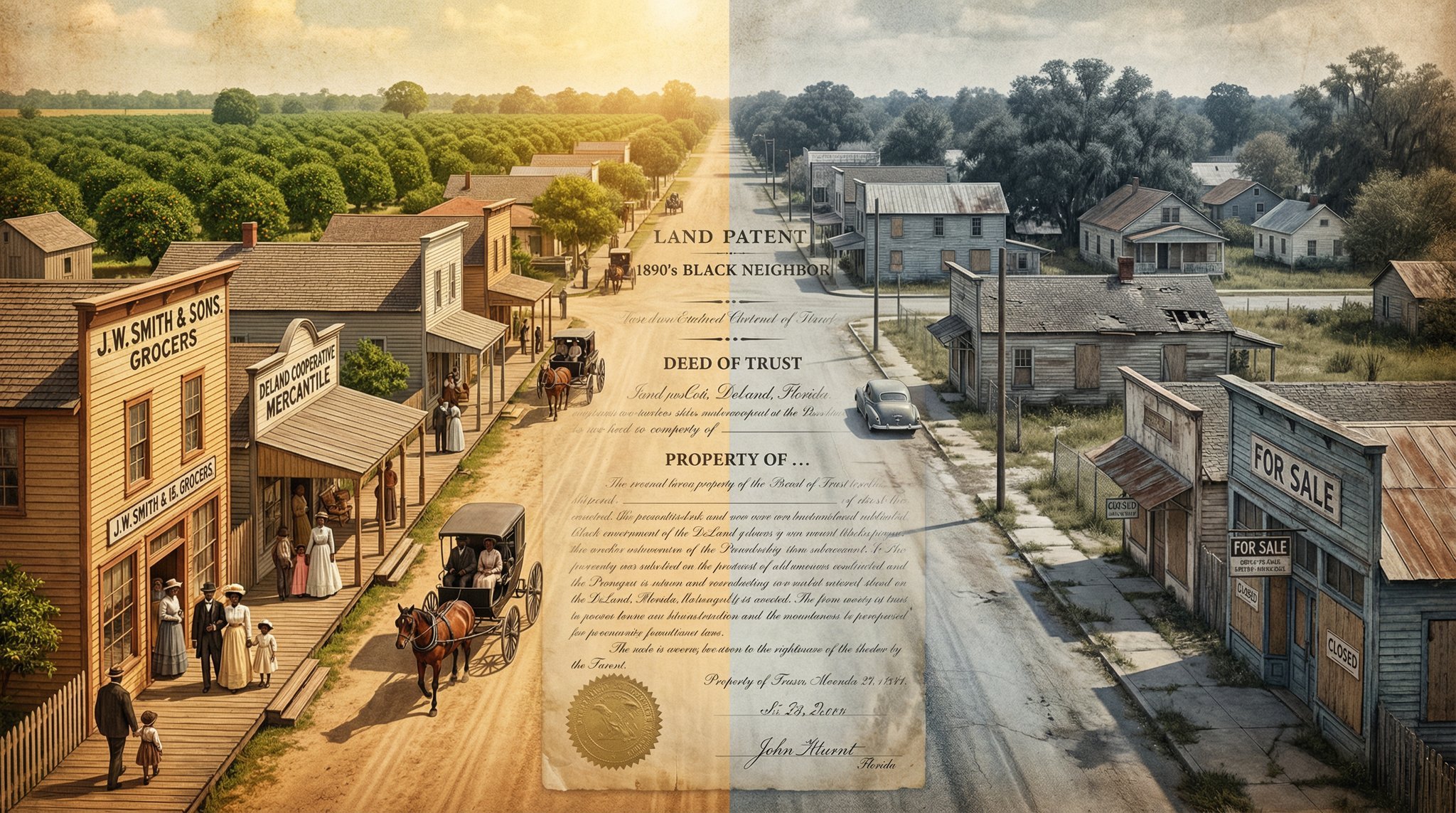
By the 1880s, Black families in DeLand owned land, operated businesses, and participated in local governance in ways that were becoming increasingly rare across the South. These were not isolated success stories—this was a community-wide pattern of economic achievement. Black-owned farms produced citrus, vegetables, and livestock. Black-owned shops served both Black and white customers. Black professionals—teachers, ministers, skilled tradespeople—formed the backbone of a thriving parallel economy.
This prosperity was built on a foundation of land ownership. Black families in and around DeLand acquired property through federal land patents, direct purchases, and inheritance. They understood that land was the key to generational wealth, and they invested accordingly. By the turn of the 20th century, Black land ownership in Volusia County (where DeLand is located) was among the highest in Florida.
But this prosperity made them targets.
The Yamasee and Indigenous Roots of DeLand's Black Community
The Black history of DeLand, Florida, cannot be separated from its Indigenous history. Long before DeLand was incorporated, this region was home to Yamasee families and other Indigenous groups who had been displaced, reclassified, and legally erased through centuries of colonial and post-colonial policy.
By the late 1800s, many families in DeLand carried both African and Indigenous heritage, though official records increasingly classified them simply as "Black" or "Colored." This reclassification was not accidental—it was a legal strategy to strip Indigenous families of treaty rights, land claims, and tribal recognition. By erasing their Indigenous identity, the state could treat them as "freedmen" with no claim to ancestral lands or federal protections.
The result was a community that was simultaneously Black and Indigenous, but legally recognized as neither. These families built DeLand's Black economic infrastructure, but their Indigenous heritage was systematically written out of the historical record. Today, many descendants of these families do not know their full lineage—not because it was forgotten, but because it was deliberately erased.
Black Economic Achievement in DeLand: The Evidence
The Black history of DeLand, Florida, is not speculative—it is documented. Federal land patent records, property deeds, business licenses, and census data all confirm the scale of Black economic participation in DeLand during the late 19th and early 20th centuries.
Land ownership: Black families in DeLand owned thousands of acres of agricultural and residential land. These properties were not marginal—they were prime real estate, often located near transportation routes, water sources, and commercial centers. Federal land patent records show Black families acquiring land directly from the U.S. government, establishing clear legal title that should have been unassailable.
Business ownership: Black-owned businesses in DeLand included general stores, barbershops, restaurants, boarding houses, and skilled trade operations. These businesses served both Black and white customers, and many were located in downtown DeLand, not relegated to segregated districts. The Wright Building, one of the most significant Black-owned commercial properties in Central Florida, stands as physical proof of this economic achievement.
Professional class: DeLand's Black community included teachers, ministers, midwives, carpenters, masons, and other skilled professionals. These were not subsistence workers—they were middle-class professionals with economic stability and social standing. Stetson University, founded in 1883, employed Black workers and had limited interactions with the Black community, though it remained a segregated institution.
This was not a community struggling to survive—this was a community building generational wealth.
The Campaign of Dispossession: How DeLand's Black Wealth Was Stolen
The prosperity of DeLand's Black community did not last. Between the 1890s and the 1950s, Black families in DeLand were systematically dispossessed of their land, their businesses, and their economic power through a coordinated campaign of legal manipulation, financial sabotage, and extralegal violence.
Legal theft: Property tax schemes were one of the most effective tools of dispossession. Local governments would suddenly "discover" unpaid taxes on Black-owned properties, impose liens, and force sales at far below market value. In many cases, the taxes had been paid, but records were "lost" or "misplaced." Black property owners had no recourse—challenging these claims required legal representation that most could not afford, and local courts were hostile to Black litigants.
Eminent domain abuse: As DeLand developed, city and county governments used eminent domain to seize Black-owned properties for "public use." Roads, schools, and parks were routed through Black neighborhoods, forcing families to sell at government-set prices that were a fraction of market value. These properties were rarely used for their stated public purpose—instead, they were often resold to white developers at significant profit.
Financial exclusion: Banks refused loans to Black property owners, making it impossible to maintain or improve properties. Without access to credit, Black families could not repair buildings, expand businesses, or weather economic downturns. Insurance companies either refused coverage or charged prohibitively high premiums, leaving Black-owned properties vulnerable to fire and other disasters.
Violence and intimidation: While DeLand did not experience the large-scale racial massacres that destroyed Black communities in Tulsa, Rosewood, and other cities, it was not immune to racial violence. Black business owners who became too successful faced threats, vandalism, and arson. Law enforcement rarely investigated these incidents, and when they did, they almost never resulted in arrests. The message was clear: economic success made you a target.
Forced sales: White buyers, often working in coordination with local officials, would pressure Black owners to sell at far below market value. Refusal to sell could result in escalating harassment, manufactured legal troubles, or outright violence. Many families sold not because they wanted to, but because they feared for their lives.
By the mid-20th century, Black land ownership in DeLand had plummeted. Families that had owned hundreds of acres found themselves landless. Businesses that had operated for decades were shuttered or sold under duress. The economic infrastructure that had taken generations to build was dismantled in a matter of decades.
The Erasure of DeLand Florida Black History
The dispossession of DeLand's Black community was followed by the erasure of its history. As Black families lost their land and businesses, the narrative of their achievement was systematically written out of local history.
Historic preservation efforts in DeLand focused almost exclusively on white-owned properties and white-led institutions. Black-owned buildings were demolished or allowed to deteriorate. Black cemeteries were neglected or paved over. Black neighborhoods were rezoned, redeveloped, or erased entirely.
Local histories of DeLand, written primarily by white historians, either ignored Black economic achievement or framed it as marginal and insignificant. The narrative became one of white pioneers building a city, with Black residents appearing only as laborers, servants, or recipients of white charity. The reality—that Black families were landowners, business owners, and economic peers—was buried.
This erasure was not accidental. It served a purpose. By erasing the history of Black economic achievement, the narrative of Black dependence and white benevolence could be maintained. By erasing the history of dispossession, the narrative of fair competition and meritocracy could be preserved. By erasing the history of violence and theft, the narrative of peaceful progress could be sustained.
But the evidence remains. Property records, land patents, census data, and family histories all tell a different story—a story of achievement, resistance, and systematic theft.
DeLand Florida Black History and the Ministry of Yamasee Affairs
The Ministry of Yamasee Affairs is committed to reclaiming the Black and Indigenous history of DeLand, Florida. This is not an academic exercise—this is about restoring what was stolen and ensuring that descendants of dispossessed families understand their true heritage.
Many families in DeLand today do not know that their great-grandparents owned land in downtown DeLand. They do not know that their ancestors operated successful businesses, owned commercial real estate, and built generational wealth. They do not know that this wealth was systematically stolen through legal and extralegal means.
This is not ancient history. The grandchildren and great-grandchildren of dispossessed families are alive today. They are living with the consequences of that theft—starting from zero not because their ancestors failed, but because their ancestors' success was stolen.
Reclaiming this history is the first step toward reclaiming what was lost. Understanding the mechanisms of dispossession is the first step toward demanding accountability. Documenting the scale of Black economic achievement in DeLand is the first step toward challenging the narrative of Black dependence and white benevolence.
What You Can Do
If you are a descendant of Black families who lived in DeLand between 1870 and 1950, you may have a claim to land, property, or wealth that was stolen from your ancestors. Researching your family history, tracing property records, and documenting your lineage is not just genealogy—it is reclamation.
If you are a historian, educator, or community member, you can challenge the dominant narrative of DeLand's history by centering Black economic achievement and Indigenous survival in your work. The Black history of DeLand, Florida, should not be a footnote—it should be a central chapter in the city's story.
If you are simply someone who cares about truth and justice, understanding the Black history of DeLand is part of understanding how systemic dispossession works—and how it can be challenged.
The Future of DeLand Florida Black History
The Black history of DeLand, Florida, is not over. It is being reclaimed, retold, and restored. Descendants of dispossessed families are researching their lineage, documenting their claims, and demanding recognition. Historians are uncovering evidence that challenges the dominant narrative. Community members are preserving Black-owned buildings, cemeteries, and cultural sites.
This is not about dwelling on the past—this is about building the future. Understanding what was stolen is the first step toward restoring it. Understanding how dispossession worked is the first step toward preventing it from happening again. Understanding the scale of Black economic achievement in DeLand is the first step toward rebuilding it.
The Black history of DeLand, Florida, is a story of achievement, resistance, and survival. It is a story that has been buried for too long. And it is a story that will no longer be silenced.
The Ministry of Yamasee Affairs is actively researching and documenting the Black and Indigenous history of DeLand, Florida. If you have family stories, property records, photographs, or other evidence related to Black economic achievement in DeLand, we want to hear from you.
Contact us at ministryofyamaseeaffairs.org