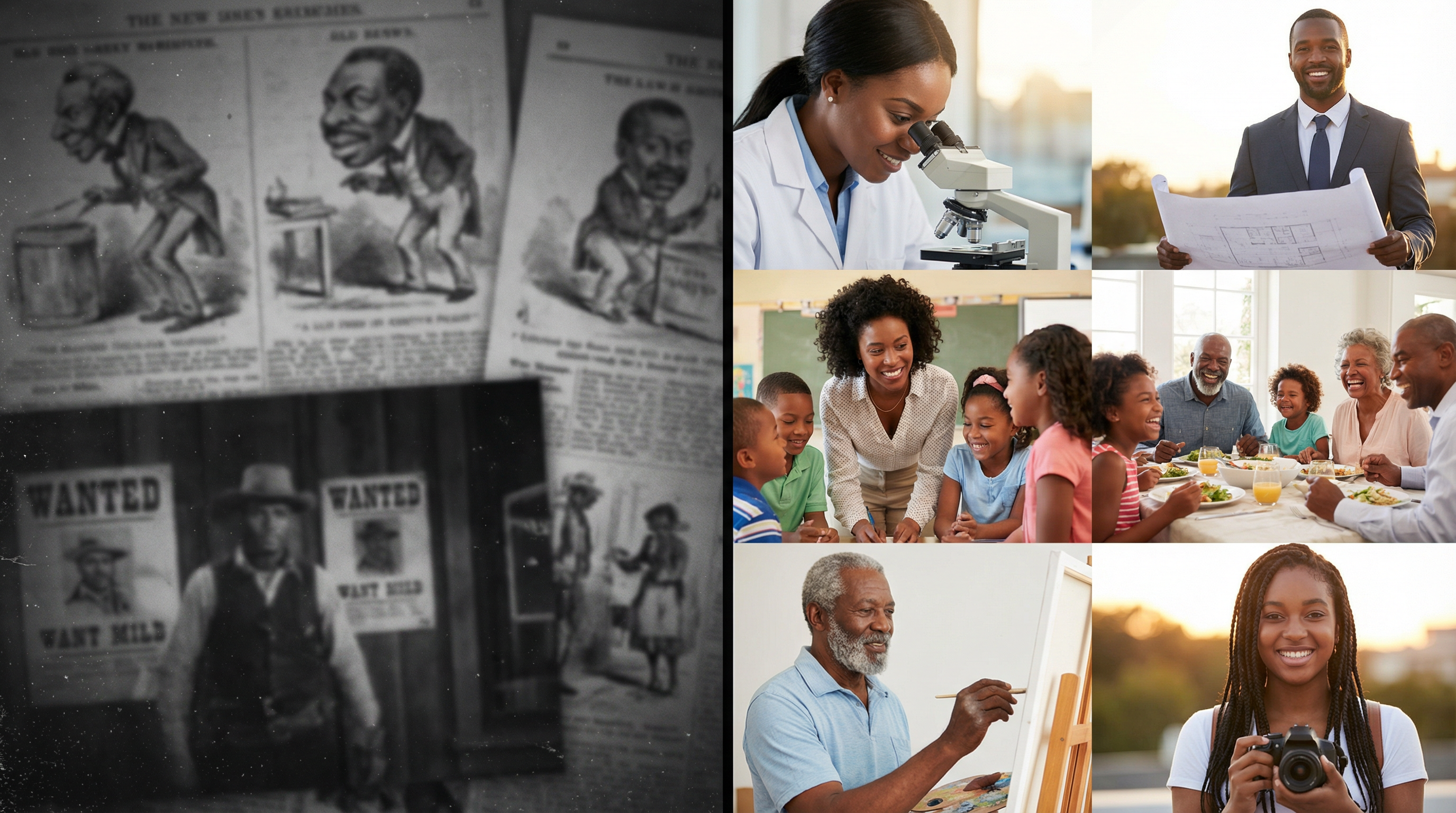
Misunderstood, Misrepresented, and Misjudged: Debunking Harmful Stereotypes About Black Americans
Examining harmful stereotypes about Black Americans and the historical resistance, armed self-defense, and community building that mainstream narratives often erase. From the Yamasee War to the Ocoee Massacre, discover the untold history of Black freedom fighters.
Misunderstood, Misrepresented, and Misjudged: Debunking Harmful Stereotypes About Black Americans
Across the world—in the Caribbean, Africa, Europe, and beyond—there are common assumptions about Black Americans that are often repeated without historical grounding. Some stem from incomplete histories; others from stereotypes deliberately constructed or unconsciously absorbed through media and culture. Understanding these misconceptions is essential if we are going to talk with each other instead of about each other.
This article examines widespread statements people make about Black Americans and provides the historical contexts that explain why they are misleading at best and destructive at worst.
Common Stereotypes and the Historical Truth
Stereotype #1: "Black Americans Didn't Fight for Freedom"
This is one of the most repeated misconceptions from people who have never engaged deeply with U.S. history. The historical record tells a dramatically different story.
The Historical Reality:
Long before the United States existed, African and Indigenous-African communities fought colonial powers on the front lines—resisting British, Spanish, and French imperialism throughout the Southeast. Groups like the Yamasee did not "submit" to colonists. They went on offense, burned forts, and forced colonial retreat in multiple campaigns during the Yamasee War of 1715-1716, one of the most significant Indigenous uprisings in colonial American history.
Even mainstream U.S. history acknowledges lesser-known but powerful resistance figures and events. For example, Barbara Pope refused to give up her seat on a segregated train in 1906—decades before Rosa Parks—yet her legacy was largely erased until recently. This pattern of erasure extends across centuries of documented resistance.
This stereotype ignores organized resistance movements, legal challenges, armed self-defense networks, and strategic cultural preservation that spanned centuries. From the Stono Rebellion of 1739 to the Civil Rights Movement of the 1960s, Black Americans have consistently fought for freedom through every available means.
Stereotype #2: "Black Americans Are Inherently Violent or Criminal"
This harmful idea did not emerge from fact—it was constructed through centuries of racist imagery used to justify oppression. Social science research demonstrates that stereotypes portraying Black people as violent, uncivilized, or criminal were deliberately manufactured in the 19th and 20th centuries to justify discriminatory laws and policing policies.
The Real Consequences:
This stereotype has contributed to discriminatory policing and incarceration policies that disproportionately targeted Black communities, creating the foundation for mass incarceration. It pressures Black boys and men into narrowly defined roles in media and culture, reinforcing bias even when individuals have no connection to crime. The truth is stark: these images were constructed to make resistance look like a threat and Black agency look like danger.
When Black communities organized for self-defense—such as the Deacons for Defense and Justice protecting civil rights workers in the 1960s—they were often labeled as violent or extremist, despite simply exercising the same right to self-protection that other communities took for granted.
Stereotype #3: "Black Americans Are Lazy, Uneducated, or Dependent"
From the Sambo caricature to the "welfare queen" trope, negative stereotypes about work ethic or intelligence have been used historically to justify exclusion from power and opportunity. These narratives deliberately ignore documented achievement and innovation.
Grounding Ourselves in Real History:
Black inventors and scientists created life-changing innovations even when barred from equal schooling and opportunity. Garrett Morgan invented the traffic signal and gas mask. Lewis Latimer improved the light bulb and worked with Thomas Edison and Alexander Graham Bell. Dr. Charles Drew pioneered blood plasma storage, saving countless lives.
Black entrepreneurs like Madam C.J. Walker became the first self-made female millionaire in U.S. history through skill and business acumen. Black travel guides like The Negro Motorist Green Book were created to help entire communities navigate systemic danger safely—not because of dependence, but because of survival instincts and extraordinary community building.
Shocking Historical Moments That Reveal the Truth
Many events that explain the resilience, strategy, and agency of Black Americans are not widely taught outside academic history. These are not isolated incidents—they represent systematic patterns of resistance and reprisal.
Massacres of Black Communities: Strategic Acts of Terror
These were not "local events"—they were strategic acts of terror that reshaped entire communities and regions:
The Ocoee Massacre (1920) — Possibly the single bloodiest day of political violence in modern American history. A white mob attacked Black residents in Ocoee, Florida, killing dozens and eliminating the Black population of an entire town. The massacre was triggered by Black citizens attempting to vote. Survivors fled, and the town remained all-white for decades.
The Rosewood Massacre (1923) — A predominantly Black town in Florida was attacked and destroyed by white mobs over the course of several days. Survivors hid in swamps while their homes, churches, and businesses were burned. The town ceased to exist for decades, and the state of Florida did not acknowledge the massacre until 1994.
The Memphis Massacre (1866) — After the Civil War, returning Black soldiers and freed people were attacked by police and white mobs in Memphis, Tennessee. Dozens were killed, and the violence helped galvanize support for the 14th Amendment.
The Thibodaux Massacre (1887) — Black sugar workers striking for labor rights in Louisiana were attacked by paramilitary forces and white vigilantes. Hundreds were killed, and labor organizing in the region was crushed for decades.
These events remind us that Black resistance was met with organized, systematic violence—not passive acceptance.
Black Armed Self-Defense and Freedom Fighters
Contrary to the myth that freedom was only won through non-violence, armed resistance and self-defense have been consistent threads throughout Black American history:
Negro Fort (1816) — Before the Civil War, many enslaved people escaped to build fortified communities like Negro Fort in Spanish Florida. This armed settlement of Black and Indigenous freedom fighters represented organized resistance until it was destroyed by U.S. forces in one of the first military actions of what would become the Seminole Wars.
The Deacons for Defense and Justice (1960s) — This armed self-defense organization arose to protect civil rights workers and Black communities in Louisiana and Mississippi when police could not or would not provide protection. They successfully deterred Ku Klux Klan violence and enabled the Civil Rights Movement to operate more safely.
Robert F. Williams and the Monroe, NC NAACP (1950s-60s) — Williams advocated for armed self-defense and organized Black veterans to protect their community from Klan violence, demonstrating that non-violence was a tactic, not the only strategy for survival.
Global Misunderstandings That Spread Stereotypes
Globally, stereotypes often conflate diverse Black experiences into one narrative—that of trauma without agency—ignoring complexity, resistance, and leadership. This is why you hear phrases like "Black Americans didn't build anything" or "they just accepted slavery."
These statements are not based on history. They reflect a narrative that grew out of colonialism and racism, not lived experience. They erase:
- The economic infrastructure Black Americans built despite systematic exclusion
- The cultural innovations that shaped global music, art, and literature
- The political organizing that transformed American democracy
- The intellectual contributions that advanced science, medicine, and technology
What These Misunderstandings Reveal
Stereotypes are not accidental. They are:
Constructed to justify oppression — Creating narratives that make exploitation seem natural or deserved
Perpetuated to maintain power — Keeping certain groups marginalized by controlling how their history is told
Internalized when history is erased — When people don't know the full story, they accept the distorted version
Historical events—resistance wars, violent reprisals, economic exclusion, cultural erasure—all shaped the conditions Black Americans navigated. But those same conditions created adaptive genius, community building, and cultural resilience that is too often overlooked or deliberately minimized.
Reframing the Narrative: From Stereotypes to Historical Truth
So when someone says:
- "Black Americans didn't fight."
- "They were just enslaved."
- "They just came later."
You now have context—not excuses. You have history—not stereotypes.
You have proof that:
- We organized in ways both peaceful and militant
- We built communities under constant threat
- We preserved culture despite intentional erasure
- We died so others could live free
And that is the truth.
Further Reading
- Yamasee History: The War That Changed the Southeast
- Documentary Evidence of Yamasee Continuity in Florida
- The Southeastern Chronicle: Yamasee Timeline 1700-1950
- Fort Mose: America's First Free Black Settlement
Ministry of Yamasee Affairs | Restoring the historical record, one document at a time.