Fort Mose: America's First Free Black Settlement and the Yamasee Connection
Two miles north of St. Augustine stands the site of Fort Mose—America's first legally sanctioned free Black settlement. Discover its deep connection to Yamasee migration and Afro-Indigenous identity.
Fort Mose: America's First Free Black Settlement and the Yamasee Connection
Author: Ministry of Yamasee Affairs
Published: January 21, 2026
Reading Time: 9 minutes
Two miles north of St. Augustine, Florida, stands the site of Fort Mose (pronounced "Moh-say")—a place that challenges everything most Americans think they know about freedom, race, and resistance in colonial America. Established in 1738, Fort Mose became the first legally sanctioned free Black settlement in what would become the United States, predating the American Revolution by nearly four decades. But the story of Fort Mose is incomplete without understanding its deep connection to Yamasee migration, Spanish colonial policy, and the complex realities of Afro-Indigenous identity in the 18th-century Southeast.
Spanish Florida: A Different Colonial System
To understand Fort Mose, we must first understand how Spanish colonial policy differed fundamentally from British approaches to race, slavery, and Indigenous peoples. While British colonies developed increasingly rigid racial categories that classified people as either "white" or "not white," Spanish colonial administration recognized a spectrum of racial and social categories with corresponding legal rights and obligations.
Spanish law, rooted in medieval Iberian traditions and influenced by centuries of Moorish presence in Spain, provided mechanisms for enslaved people to gain freedom through self-purchase, military service, or religious conversion. The Spanish concept of coartación allowed enslaved individuals to negotiate their purchase price and make installment payments toward freedom—a practice unthinkable in British colonies where enslaved status was increasingly defined as permanent and hereditary.
More significantly for our story, Spanish authorities in Florida actively encouraged British colonial slaves to escape to Spanish territory, offering freedom and land in exchange for conversion to Catholicism and military service. This policy served multiple strategic purposes: it weakened British colonies economically, provided Spain with loyal military forces to defend Florida's northern frontier, and demonstrated Spanish religious and moral superiority over Protestant British rivals.
The Yamasee Migration to Florida
Following the Yamasee War of 1715-1717, Yamasee communities faced an impossible situation in British Carolina. Despite their military effectiveness and the devastating impact of their resistance, continued warfare against British colonial expansion was unsustainable. British reinforcements, the collapse of some Indigenous alliances, and the systematic destruction of Yamasee agricultural resources made remaining in Carolina untenable.
Yamasee leaders executed a strategic withdrawal to Spanish Florida, where they knew Spanish colonial policy offered greater autonomy and protection. This migration was not desperate flight but calculated relocation to more favorable political circumstances. Spanish authorities in St. Augustine welcomed Yamasee refugees as valuable military allies, agricultural laborers, and buffer populations against British expansion.
The Yamasee brought with them not only military expertise but also agricultural knowledge, diplomatic experience, and cultural practices that would profoundly influence the development of Spanish Florida. More importantly, they brought relationships with African-descended peoples that had developed through generations of interaction, intermarriage, and shared resistance to British colonial exploitation.
The Afro-Indigenous Reality
One of the most persistent myths in American history is the rigid separation between Indigenous and African-descended peoples. This myth serves the interests of those who benefit from racial division, but it obscures the complex reality of 18th-century Florida, where Indigenous and African identities often overlapped and intertwined.
Many Yamasee families included members of African descent through intermarriage, adoption, or the incorporation of escaped slaves into Indigenous communities. British colonial authorities deliberately obscured these connections, reclassifying Afro-Indigenous people as simply "Black" or "Mulatto" to deny them Indigenous land rights and political status. Spanish colonial records, by contrast, often acknowledged mixed ancestry and provided legal categories that recognized complex identities.
When Yamasee communities migrated to Florida, they brought with them African-descended family members, allies, and community members. These relationships formed the foundation for what would become Fort Mose—a community that was simultaneously Indigenous, African, and Spanish in its cultural composition and political identity.
The Establishment of Fort Mose
In 1738, Spanish Governor Manuel de Montiano formally established Gracia Real de Santa Teresa de Mose (Fort Mose) as a free Black settlement two miles north of St. Augustine. The fort's residents included escaped slaves from British colonies, free Black militia members, and Afro-Indigenous families with Yamasee connections. The community's leader, Francisco Menéndez, was himself of African and Indigenous heritage—a man whose identity embodied the complex realities that British racial categories sought to erase.
Fort Mose served multiple functions in Spanish Florida's defensive system. As the northernmost settlement in Spanish territory, it provided early warning of British attacks and served as the first line of defense for St. Augustine. Its residents, organized as the Milicia de Morenos Libres (Free Black Militia), proved to be fierce and effective fighters with intimate knowledge of both British military tactics and the Florida landscape.
The fort's establishment represented a radical challenge to British colonial assumptions about race, freedom, and social organization. Here was a community of free Black people, legally recognized by European colonial authority, bearing arms and owning land—everything that British colonial society insisted was impossible and dangerous. The very existence of Fort Mose undermined the ideological foundations of British slavery and provided a beacon of hope for enslaved people throughout the Southeast.
Life at Fort Mose
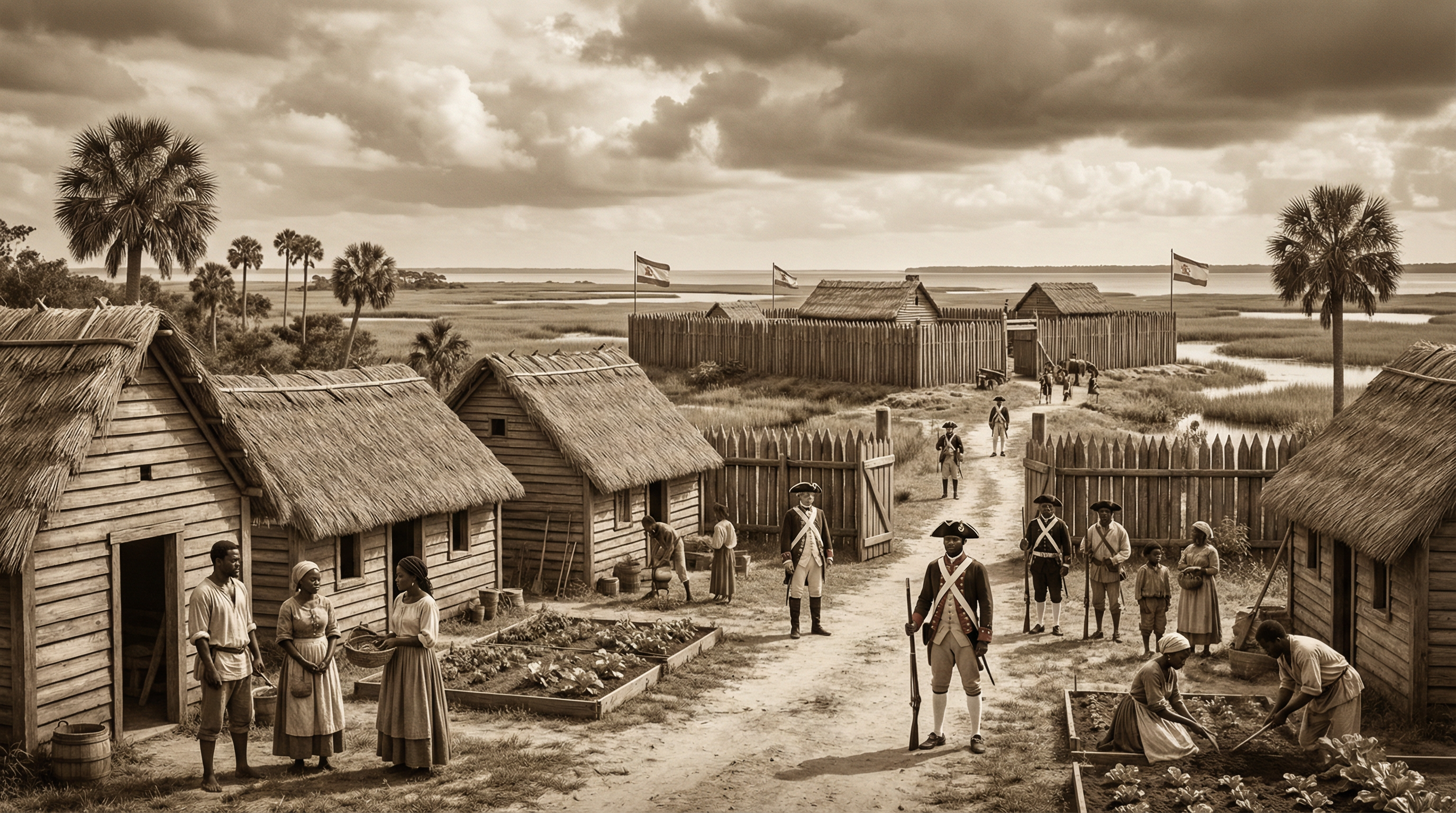
Documentary evidence from Spanish colonial archives provides glimpses of daily life at Fort Mose. The community included farmers, craftsmen, soldiers, and their families. Residents cultivated crops, raised livestock, and participated in St. Augustine's economic life while maintaining military readiness. The fort itself was a wooden palisade with a stone watchtower, surrounded by agricultural fields and residential structures.
Religious life centered on the Catholic Church, with residents attending mass at a chapel within the fort or traveling to St. Augustine for major religious celebrations. Baptismal records from St. Augustine's parish church document marriages, births, and deaths among Fort Mose residents, providing invaluable genealogical evidence for descendants seeking to trace their ancestry.
Cultural practices at Fort Mose blended African, Indigenous, and Spanish elements in ways that reflected the community's diverse origins. Music, foodways, agricultural techniques, and spiritual practices drew from multiple traditions, creating a unique Afro-Indigenous-Spanish culture that defied simple categorization.
The British Threat and Fort Mose's Destruction
Fort Mose's strategic importance and symbolic challenge to British colonialism made it a primary target during conflicts between Spanish and British forces. In 1740, British General James Oglethorpe launched a major assault on Spanish Florida, and Fort Mose became a key battlefield. British forces initially captured and occupied the fort, but Spanish and Fort Mose militia forces launched a counterattack that recaptured the position and inflicted heavy casualties on British troops.
The battle demonstrated Fort Mose residents' military effectiveness and their commitment to defending their freedom and community. British forces, frustrated by their defeat and recognizing Fort Mose's strategic importance, destroyed the fort during their retreat. For several years, Fort Mose residents lived within St. Augustine's walls, but in 1752, Spanish authorities rebuilt the fort, and the community returned to its strategic position as Florida's northern sentinel.
The End of Spanish Florida and Fort Mose's Legacy
The 1763 Treaty of Paris, which ended the Seven Years' War, transferred Florida from Spanish to British control. This transfer created an impossible situation for Fort Mose residents, who knew that British rule meant the loss of their freedom and likely re-enslavement. Faced with this existential threat, the entire Fort Mose community chose to evacuate to Cuba with Spanish authorities rather than submit to British rule.
This mass migration demonstrated Fort Mose residents' commitment to freedom over homeland—a choice that echoed Yamasee decisions to migrate to Florida rather than submit to British exploitation. The community's willingness to abandon homes, fields, and familiar territory rather than accept enslavement speaks to the value they placed on liberty and self-determination.
Fort Mose's physical structures disappeared, but its legacy endured. The community proved that free Black settlements could thrive when supported by appropriate legal and political structures. It demonstrated that Afro-Indigenous alliances could create effective resistance to colonial oppression. And it provided a model of multiracial community that challenged the rigid racial hierarchies that would come to dominate American society.
Recovering the Fort Mose Story
For most of American history, Fort Mose's story remained buried in Spanish colonial archives, unknown to English-speaking historians and absent from American history textbooks. This erasure was not accidental but reflected deliberate choices about which stories to tell and which to suppress. A free Black settlement that predated the American Revolution by decades did not fit comfortable narratives about American progress toward freedom and equality.
Archaeological excavations beginning in the 1980s rediscovered Fort Mose's physical location and material culture. Spanish colonial documents provided detailed information about the community's residents, governance, and daily life. Together, these sources have allowed historians to reconstruct Fort Mose's story and recognize its significance in American history.
Today, Fort Mose is a Florida State Park and National Historic Landmark, with a visitor center that tells the community's story to thousands of visitors annually. But the full story—particularly the Yamasee connections and Afro-Indigenous realities that shaped Fort Mose's creation and character—remains incompletely understood by most Americans.
Discover the Complete Story
This article draws from Keepers of Florida: The Hidden Yamasee Legacy, which provides comprehensive documentation of Yamasee migration to Florida, the establishment of Fort Mose, and the complex Afro-Indigenous relationships that shaped colonial Florida. The book includes analysis of Spanish colonial records, genealogical evidence, and the long-term impact of these communities on Florida's development.
About the Ministry of Yamasee Affairs
The Ministry of Yamasee Affairs is dedicated to documenting, preserving, and sharing the true history of Yamasee people in Florida. Through rigorous historical research and genealogical documentation, we work to correct the historical record and support Yamasee descendants in reclaiming their heritage.
Learn more about our mission | Join our community | Support our work