Fort Mose Florida: The First Free Black Settlement in North America
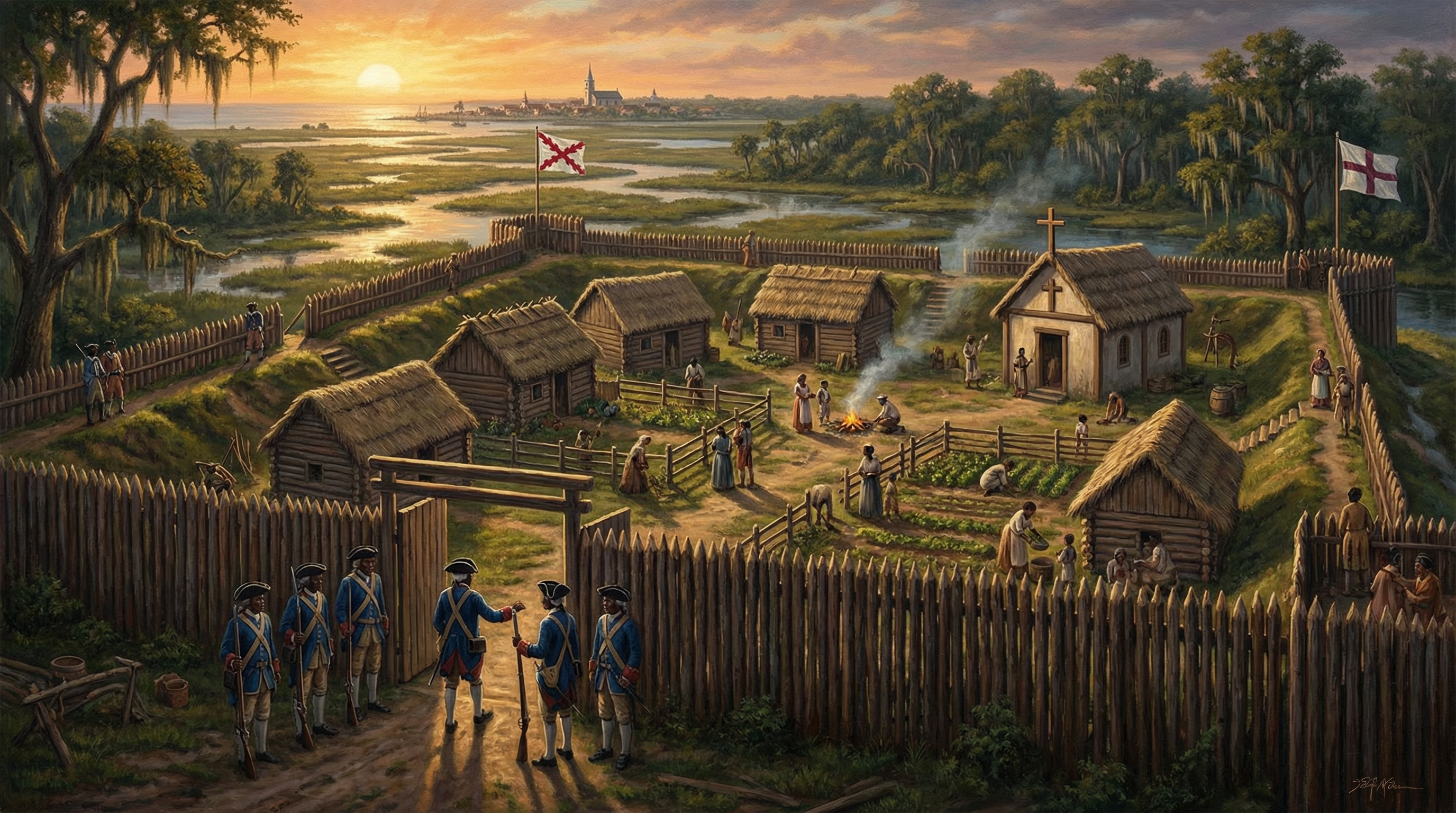
Fort Mose, Florida, represents one of the most significant and least understood chapters in American history. Established in 1738, Fort Mose was the first legally sanctioned free Black settlement in what would become the United States—a full century before the Emancipation Proclamation.
Fort Mose Florida: The First Free Black Settlement in North America
Fort Mose, Florida, represents one of the most significant and least understood chapters in American history. Established in 1738, Fort Mose was the first legally sanctioned free Black settlement in what would become the United States—a full century before the Emancipation Proclamation, and decades before the American Revolution.
But Fort Mose was more than a settlement. It was a strategic military outpost, a beacon of freedom for enslaved Africans fleeing British colonies, and a direct challenge to the racial order that would define American slavery for the next 130 years. Its story has been buried, minimized, and misunderstood—and it is time to set the record straight.
Fort Mose Florida: Origins and Strategic Importance
Fort Mose (pronounced "Moh-say") was established by Spanish colonial authorities in 1738, approximately two miles north of St. Augustine, Florida. Its official name was Gracia Real de Santa Teresa de Mose, and it was built to serve a dual purpose: provide a home for formerly enslaved Africans who had fled British colonies to the north, and create a defensive buffer to protect St. Augustine from British attack.
The Spanish policy that led to Fort Mose's creation was radical for its time. In 1693, Spain's King Charles II issued a royal decree promising freedom to any enslaved person who escaped from British colonies and converted to Catholicism. This was not an act of moral enlightenment—it was strategic warfare. By offering freedom to enslaved Africans, Spain undermined the economic foundation of British colonies while simultaneously gaining experienced soldiers and laborers for its own colonial projects.
Enslaved Africans in South Carolina, Georgia, and other British territories heard about this decree, and they fled south in increasing numbers. By the 1730s, the population of free Black refugees in St. Augustine had grown large enough that Spanish authorities decided to establish a separate settlement for them. That settlement became Fort Mose.
Who Built Fort Mose? The African and Indigenous Founders
The residents of Fort Mose were not passive recipients of Spanish charity—they were active agents in their own liberation. The majority were formerly enslaved Africans who had risked their lives to escape British plantations. Many had military experience, either from service in African conflicts before their enslavement or from militia service in the colonies. They were skilled laborers, farmers, craftsmen, and soldiers.
But Fort Mose was not exclusively African. Indigenous people—including members of the Yamasee, Creek, and other Southeastern tribes—also lived in and around Fort Mose. These Indigenous communities had their own complex relationships with Spanish and British colonial powers, and many had intermarried with African refugees. The result was a multi-ethnic community bound together by a shared commitment to freedom and survival.
The first leader of Fort Mose was Francisco Menéndez, a formerly enslaved African who had escaped from South Carolina and risen to the rank of captain in the Spanish militia. Menéndez was a skilled military strategist and a respected leader within the free Black community. Under his leadership, Fort Mose became not just a settlement, but a fortified military outpost capable of defending itself and St. Augustine from British attack.
Fort Mose Florida and the Stono Rebellion
Fort Mose's existence had profound implications for slavery in British North America. The promise of freedom in Spanish Florida inspired one of the largest slave rebellions in colonial American history: the Stono Rebellion of 1739.
In September 1739, a group of enslaved Africans in South Carolina rose up, killed several white plantation owners, and began marching south toward St. Augustine and Fort Mose. They carried banners proclaiming "Liberty!" and hoped to reach Spanish Florida, where they believed they would be granted freedom. The rebellion was brutally suppressed by colonial militias, and most of the rebels were killed or captured. But the fact that they were marching toward Fort Mose reveals the settlement's significance as a symbol of freedom and resistance.
The Stono Rebellion terrified British colonial authorities. It demonstrated that enslaved Africans were willing to risk death for freedom, and that the existence of Fort Mose posed a direct threat to the stability of slavery in British colonies. In response, South Carolina and other colonies enacted harsher slave codes, increased patrols, and pressured Britain to take military action against Spanish Florida.
Fort Mose was not just a settlement—it was a threat to the entire system of racial slavery in North America.
The Destruction and Rebuilding of Fort Mose
Fort Mose's strategic importance made it a target. In 1740, British forces under General James Oglethorpe invaded Spanish Florida in an attempt to capture St. Augustine. Fort Mose was overrun and destroyed, and its residents fled to St. Augustine for safety. The British occupied the fort briefly, but Spanish and free Black forces launched a surprise counterattack, retaking Fort Mose and inflicting significant casualties on the British.
The victory at Fort Mose was a turning point in the conflict. British forces failed to capture St. Augustine and eventually withdrew. But Fort Mose itself had been destroyed, and its residents were left without homes. For several years, the free Black community lived within St. Augustine, but in 1752, Fort Mose was rebuilt. The new settlement was larger and more heavily fortified, reflecting both the community's growth and the ongoing threat of British attack.
Fort Mose continued to function as a free Black settlement and military outpost until 1763, when Spain ceded Florida to Britain as part of the Treaty of Paris. Faced with the prospect of re-enslavement under British rule, the residents of Fort Mose evacuated to Cuba, where Spain had promised them land and freedom. The settlement was abandoned, and over time, its physical structures disappeared.
For over two centuries, Fort Mose was forgotten.
The Rediscovery of Fort Mose Florida
Fort Mose's location was lost for over 200 years. The settlement had been built on marshy, low-lying land that was prone to flooding, and over time, the site was reclaimed by wetlands. By the 20th century, most historians believed that Fort Mose had been located somewhere near St. Augustine, but its exact location was unknown.
In the 1980s, archaeologist Kathleen Deagan and historian Jane Landers began researching Fort Mose, using Spanish colonial records, maps, and oral histories to narrow down its location. In 1994, archaeological excavations confirmed the site of Fort Mose approximately two miles north of St. Augustine. The discovery was a major breakthrough in understanding the history of Black freedom in North America.
Today, Fort Mose is a National Historic Landmark and a Florida State Park. The Fort Mose Historic State Park includes a museum, interpretive exhibits, and a boardwalk trail through the wetlands where the settlement once stood. But despite its designation as a historic landmark, Fort Mose remains largely unknown outside of academic circles and local history communities.
This obscurity is not accidental—it is the result of a broader pattern of erasing Black and Indigenous history from the American narrative.
Why Fort Mose Florida Matters
Fort Mose challenges fundamental assumptions about American history. The dominant narrative of Black freedom in America begins with the Emancipation Proclamation in 1863, or at best, with the gradual abolition of slavery in Northern states in the late 18th and early 19th centuries. Fort Mose reveals that free Black communities existed in North America more than a century before the Civil War, and that these communities were not marginal or dependent—they were militarily significant, economically viable, and politically strategic.
Fort Mose also challenges the narrative of Black passivity. The residents of Fort Mose were not granted freedom out of benevolence—they seized it. They risked their lives to escape slavery, fought to defend their freedom, and built a community that lasted for over two decades. They were not victims waiting to be rescued—they were agents of their own liberation.
Finally, Fort Mose reveals the complex relationship between African and Indigenous communities in colonial America. The settlement was not exclusively African—it was a multi-ethnic community that included Indigenous people who had their own reasons for resisting British colonial expansion. This history of Black-Indigenous solidarity has been systematically erased from American history, but it is essential to understanding the full story of resistance and survival in the colonial South.
Fort Mose and the Yamasee Connection
The Yamasee people have a direct connection to Fort Mose. After the Yamasee War of 1715-1717, many Yamasee families fled to Spanish Florida, where they were granted refuge and land. Some settled in and around St. Augustine, and some lived in or near Fort Mose. By the mid-18th century, the boundaries between African and Indigenous communities in Spanish Florida were fluid—intermarriage was common, and many families carried both African and Indigenous heritage.
This blending of African and Indigenous communities was not unique to Fort Mose, but Fort Mose represents one of the clearest examples of Black-Indigenous solidarity in colonial America. The residents of Fort Mose understood that their survival depended on cooperation, mutual defense, and shared resistance to British colonial expansion.
Today, many descendants of Fort Mose residents do not know their full heritage. Census records, legal documents, and historical narratives have classified them simply as "Black" or "African American," erasing their Indigenous ancestry. Reclaiming this history is essential to understanding the full story of Fort Mose and the communities that built it.
The Legacy of Fort Mose Florida
Fort Mose's legacy extends far beyond its 25-year existence. It demonstrated that free Black communities could survive and thrive in North America, even in the face of hostile colonial powers. It inspired enslaved Africans across British colonies to resist, flee, and fight for their freedom. And it challenged the racial order that would define American slavery for the next century.
But Fort Mose's legacy has been systematically erased. Most Americans do not know that Fort Mose existed. Most history textbooks do not mention it. Most discussions of Black freedom in America begin with the Civil War, ignoring the centuries of resistance, escape, and community-building that preceded it.
This erasure serves a purpose. By erasing Fort Mose, the narrative of Black dependence and white benevolence can be maintained. By erasing Fort Mose, the narrative of gradual, peaceful progress toward freedom can be preserved. By erasing Fort Mose, the narrative of Black agency, resistance, and self-determination can be suppressed.
But the evidence remains. Fort Mose existed. Its residents fought for their freedom, built a community, and defended it against overwhelming odds. Their story is part of American history, and it will no longer be silenced.
What You Can Do
If you are a descendant of families who lived in Spanish Florida, St. Augustine, or the Southeastern United States during the 18th century, you may have a connection to Fort Mose. Researching your family history, tracing your lineage, and documenting your ancestry is not just genealogy—it is reclamation.
If you are a historian, educator, or community member, you can challenge the dominant narrative of American history by centering Fort Mose in your work. Fort Mose should not be a footnote—it should be a central chapter in the story of Black freedom in North America.
If you are simply someone who cares about truth and justice, understanding Fort Mose is part of understanding how systemic erasure works—and how it can be challenged.
Visit Fort Mose Historic State Park
Fort Mose Historic State Park is located at 15 Fort Mose Trail, St. Augustine, Florida. The park includes a museum, interpretive exhibits, and a boardwalk trail through the wetlands where the settlement once stood. Visiting Fort Mose is an opportunity to connect with a history that has been buried for too long.
But visiting is not enough. Fort Mose's story must be told, taught, and integrated into the broader narrative of American history. The residents of Fort Mose fought for their freedom, built a community, and defended it against overwhelming odds. Their legacy deserves recognition, preservation, and honor.
The Ministry of Yamasee Affairs is committed to preserving and promoting the history of Fort Mose and its connection to Yamasee and African-descended communities in Florida. If you have family stories, research, or connections to Fort Mose, we want to hear from you.
Contact us at ministryofyamaseeaffairs.org