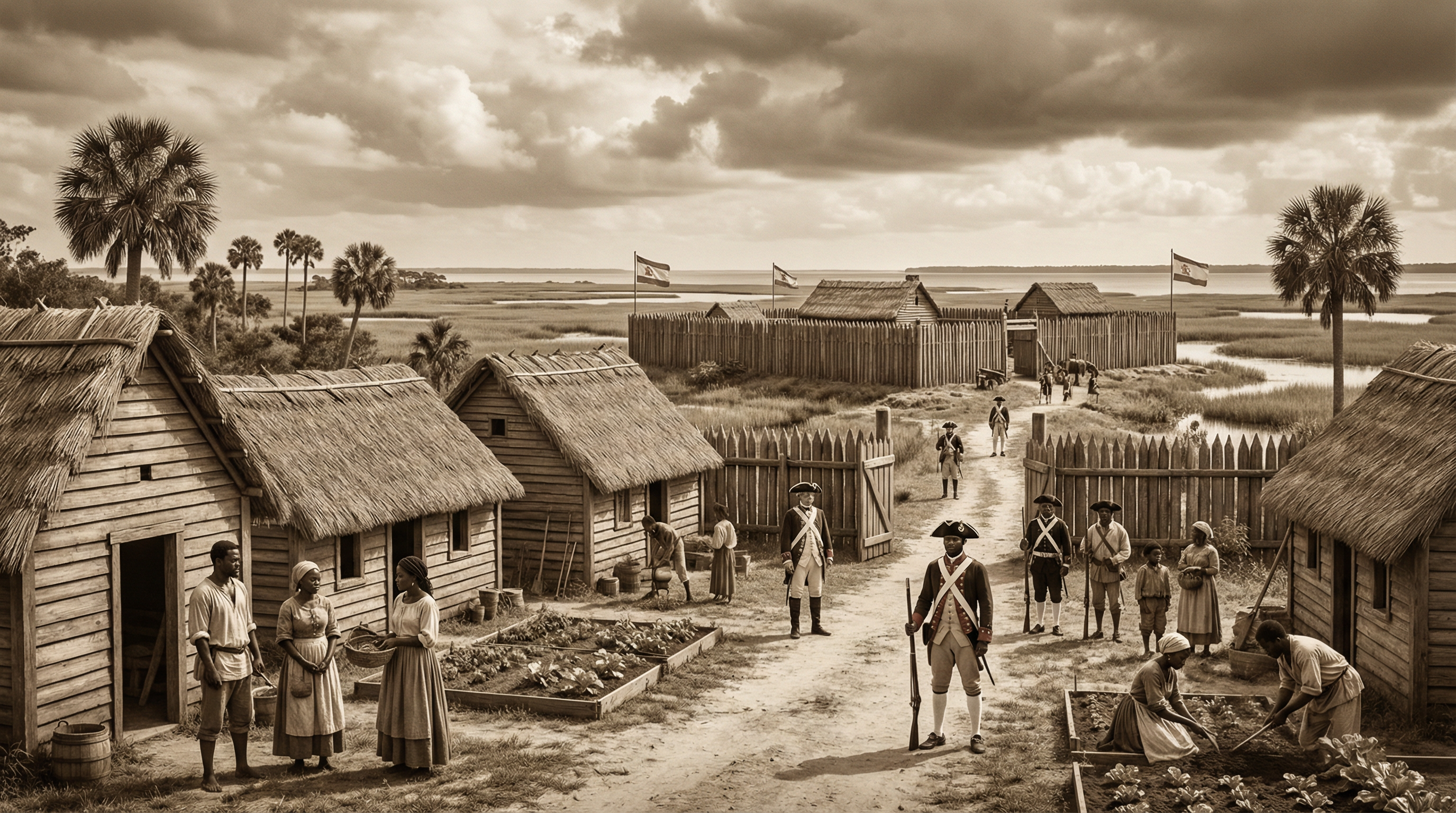
Fort Mose and the Yamasee Presence in Spanish Florida: Uncovering Hidden Indigenous History
Fort Mose is celebrated as the first free Black settlement in America, but the standard narrative obscures Indigenous presence. Discover how Yamasee people used Spanish Florida as a refuge and survival strategy.
Fort Mose and the Yamasee Presence in Spanish Florida: Uncovering Hidden Indigenous History
Author: Ministry of Yamasee Affairs Research Team
Date: January 27, 2026
Category: Florida History Discoveries
Keywords: Fort Mose, Spanish Florida, Yamasee history, Gracia Real de Santa Teresa de Mose, Indigenous Florida, Black Seminoles
Fort Mose—officially Gracia Real de Santa Teresa de Mose—stands as one of the most significant yet misunderstood sites in Florida history. Established in 1738 just north of St. Augustine, it is celebrated as the first legally sanctioned free Black settlement in what would become the United States. However, the standard narrative of Fort Mose as exclusively an African refuge obscures a more complex reality: many residents were Indigenous people, including Yamasee, who had been reclassified through Spanish colonial racial categories.
Understanding Fort Mose's true demographic composition—and its role in Yamasee survival strategies during the colonial period—reveals how Indigenous people navigated European power structures, maintained community networks, and established territorial claims that would persist long after Spanish rule ended.
The Standard Narrative (and What It Misses)
The conventional story of Fort Mose focuses on enslaved Africans who escaped from British Carolina plantations and sought freedom in Spanish Florida. Spanish colonial policy, designed to destabilize British settlements, offered sanctuary to runaways who converted to Catholicism and pledged loyalty to the Spanish Crown. Fort Mose, established as a defensive outpost protecting St. Augustine from British attack, became home to these freedom-seekers.
This narrative is accurate—but incomplete. It treats Fort Mose as a purely African diaspora story while ignoring the Indigenous presence that Spanish records themselves document. Colonial administrators used racial categories like "Negro" and "mulatto" to classify Fort Mose residents, but these terms often concealed Indigenous identity rather than reflecting biological ancestry.
As Dr. Anthony E. Dixon notes in Florida's Negro War: Black Seminoles and the Second Seminole War, the colonial category "Negro" frequently obscured Indigenous peoples who had been captured, enslaved, or displaced during conflicts like the Yamasee War of 1715. Many Fort Mose residents were Indigenous people reclassified through Spanish bureaucratic systems that prioritized religious conversion and political loyalty over accurate ethnic documentation.
Yamasee Presence at Fort Mose: The Evidence
Several lines of evidence suggest significant Yamasee presence at Fort Mose:
1. Geographic Proximity to Yamasee Territory
Fort Mose was located in the heart of traditional Yamasee territory. Before the Yamasee War (1715-1717), Yamasee communities extended throughout coastal South Carolina, Georgia, and northern Florida. After the war, many Yamasee people fled south into Spanish Florida, where they sought protection from British retaliation.
St. Augustine and its surrounding missions had long served as refuges for Indigenous peoples displaced by British expansion. Fort Mose, established two decades after the Yamasee War, would have been a logical destination for Yamasee survivors and their descendants.
2. Spanish Racial Categories and Indigenous Reclassification
Spanish colonial records from Fort Mose list residents as "Negro," "mulatto," or "pardo" (brown), but these categories were administrative tools, not precise ethnic identifiers. Indigenous people who converted to Catholicism, spoke Spanish, and integrated into colonial society were often classified using African-derived terms, especially if they had intermarried with African populations or adopted cultural practices associated with enslaved communities.
Jane Landers, in Black Society in Spanish Florida, documents how Spanish administrators prioritized religious and political categories over racial precision. A Yamasee individual who converted to Catholicism and pledged loyalty to Spain might be recorded as "Negro" or "mulatto" simply because those were the available bureaucratic categories for non-white, non-Spanish subjects.
3. Surnames and Family Networks
Some Fort Mose residents bore surnames that appear in later Yamasee genealogical records. While direct documentary links are difficult to establish (Spanish records often used only first names or patronymics), the presence of certain family names in both Fort Mose records and 19th-century Florida Yamasee communities suggests continuity.
Researchers tracing Yamasee ancestry should examine Fort Mose records for surnames that match their own family lines. The connection may not be immediately obvious—Spanish baptismal records, for example, often assigned Christian names that replaced Indigenous names—but patterns of residence, marriage, and godparentage can reveal family networks that persisted across generations.
4. Military Service and Defensive Roles
Fort Mose residents served as militia defending St. Augustine from British attack. This military role aligns with Yamasee traditions of strategic alliance and defensive warfare. Yamasee people had long experience negotiating with European powers, forming alliances when advantageous and resisting when necessary.
The 1740 Battle of Bloody Mose, in which Fort Mose defenders repelled a British assault, demonstrates the military capacity of the settlement's residents. Indigenous warriors with experience in frontier warfare would have been valuable assets in Spanish Florida's defensive strategy.
5. Post-Spanish Florida Continuity
When Spain ceded Florida to the United States in 1821, many Fort Mose descendants remained in the region rather than relocating to Cuba with Spanish loyalists. These families appear in early American census records, land patents, and church registers—often classified as "mulatto" or "free people of color," but maintaining residence in areas with documented Yamasee presence.
Tracing Fort Mose families forward into the American period reveals connections to 19th-century Yamasee communities in Hernando, Pasco, and Hillsborough counties. The geographic continuity—from Spanish St. Augustine to American central Florida—suggests that Fort Mose was not an isolated refuge but part of a broader Yamasee survival strategy.
Why Fort Mose Matters for Yamasee Genealogy
If your Yamasee ancestors lived in northern Florida during the Spanish colonial period (1565-1821), Fort Mose records may contain critical genealogical information. Spanish baptismal, marriage, and burial records from St. Augustine and its missions document thousands of individuals who might otherwise be invisible in historical archives.
Where to Find Fort Mose Records:
-
St. Augustine Historical Society
Maintains microfilm copies of Spanish colonial church records, including baptisms, marriages, and burials from St. Augustine parishes. -
University of Florida P.K. Yonge Library of Florida History
Houses extensive Spanish Florida collections, including translated documents and genealogical indexes. -
National Park Service Fort Mose Historic State Park
Provides interpretive materials and research resources related to Fort Mose history. -
Archivo General de Indias (Seville, Spain)
The primary repository for Spanish colonial records, including administrative documents related to Florida missions and settlements. Many records have been digitized and are accessible online.
Research Strategies:
- Search baptismal records for children born at Fort Mose or nearby missions. Godparents listed in these records often reveal family networks.
- Examine marriage records to identify family connections and trace surname patterns across generations.
- Look for military service records documenting Fort Mose militia members.
- Cross-reference with post-1821 American records to track families who remained in Florida after Spanish withdrawal.
The Broader Significance: Indigenous Survival Through Reclassification
Fort Mose represents a survival strategy that Yamasee people employed throughout the colonial and early American periods: strategic reclassification. By accepting Spanish (or later American) racial categories, Indigenous people could access resources, legal protections, and territorial claims that might otherwise be denied to them.
This was not assimilation or cultural erasure—it was adaptation. Yamasee people maintained family networks, preserved oral traditions, and retained connections to ancestral territories even while navigating colonial bureaucratic systems that sought to categorize them in ways that denied their Indigenous identity.
Fort Mose is not a story of disappearance. It is a story of persistence—of Indigenous people using every available tool to survive, maintain community, and pass their heritage to the next generation.
Connecting Fort Mose to Your Family History
If you are researching Yamasee ancestry and your family has roots in northern Florida, consider the possibility that your ancestors passed through Fort Mose or its surrounding missions. Look for:
- Families documented in St. Augustine area during the Spanish period (1565-1821)
- Surnames that appear in both Spanish records and later American census data
- Geographic continuity from northern Florida (St. Augustine area) to central Florida (Hernando, Pasco, Marion counties)
- Catholic baptismal or marriage records that might indicate Spanish-era presence
The Ministry of Yamasee Affairs can assist with Spanish colonial record research. Our team has experience navigating archival collections, translating Spanish documents, and connecting colonial-era records to later American genealogical sources.
Reclaiming the Full Story
Fort Mose's history belongs to both African diaspora and Indigenous communities. Recognizing the Yamasee presence at Fort Mose does not diminish the significance of African freedom-seekers—it enriches our understanding of how marginalized peoples created spaces of autonomy, resistance, and survival in colonial Florida.
For Yamasee descendants, Fort Mose represents a chapter in a much longer story: the story of a people who never left Florida, who adapted to survive, and who maintained their identity across centuries of colonial violence, legal erasure, and systematic reclassification.
Your ancestors may be in Fort Mose records, waiting to be found.
Download our free Genealogy Research Guide for Spanish colonial research strategies and Florida archive locations: Yamasee Genealogy Research Guide (PDF)
This article is part of our weekly Florida history discovery series. Subscribe to receive new research, genealogy tips, and exclusive updates delivered to your inbox.