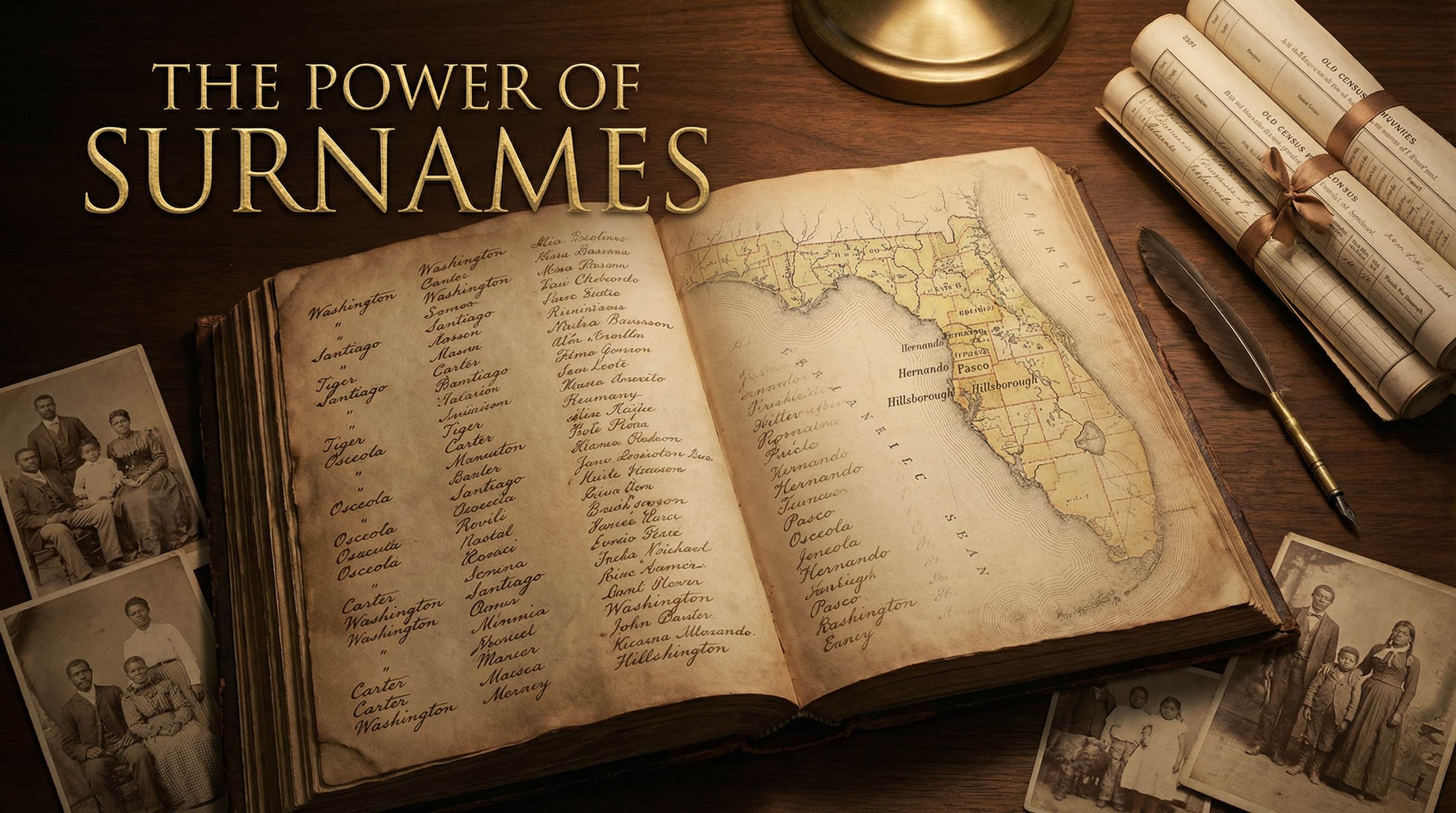
The Power of Surnames: How Family Names Reveal Yamasee Heritage in Florida
Your surname may be the most powerful clue to Yamasee ancestry. Learn which family names carry documented Yamasee connections and how to research your surname's Indigenous heritage.
The Power of Surnames: How Family Names Reveal Yamasee Heritage in Florida
Author: Ministry of Yamasee Affairs Research Team
Date: January 28, 2026
Category: Genealogy Research Tips
Keywords: Yamasee surnames, Florida family names, genealogy research, Indigenous surnames, surname research
Your surname may be the most powerful clue you have to Yamasee ancestry. While census records reclassified Indigenous people and land patents documented property ownership, surnames persisted across generations—carried forward by families who maintained their identity even when official records denied it.
Certain family names appear repeatedly in Yamasee genealogical research: in Spanish colonial records from St. Augustine, in 19th-century land patents from Hernando County, in census enumerations across central Florida, and in oral traditions passed down through generations. These surnames are not coincidental. They represent documented Yamasee families who remained in Florida, adapted to survive, and preserved their heritage through centuries of colonial violence and systematic erasure.
This guide will help you understand which surnames carry Yamasee connections, how to research your family name, and what to do when you find a match.
The Yamasee Surname Tiers: From Core Families to Extended Networks
Not all Yamasee surnames carry equal weight in genealogical research. Some family names appear in the earliest Spanish records, in documented Yamasee War accounts, and in continuous Florida presence across three centuries. Others represent later connections, intermarriage, or regional variations.
The Ministry of Yamasee Affairs has organized documented Yamasee surnames into ten tiers, ranked by the strength and continuity of evidence:
Tier 1: Core Yamasee Families (Strongest Documentation)
These surnames appear in Spanish colonial records (1500s-1700s), Yamasee War documentation (1715-1717), and continuous Florida presence through the 19th and 20th centuries:
- Day / Daye / Dayes – The Mary Day land patent (1857, Hernando County) provides federal documentation of Yamasee presence
- Brooks / Brookes – Documented in Spanish Florida and continuous central Florida residence
- Jones / Johns – Appears in colonial records and later Florida land patents
- Williams / Williamson – Widespread in Yamasee communities across Florida counties
If your surname is in Tier 1, you have the strongest starting point for documented Yamasee ancestry. These families have verifiable presence in Florida across multiple centuries and appear in primary source documents including land patents, census records, and church registers.
Tier 2: Colonial-Era Documented Families
These surnames appear in Spanish colonial records, early American Florida documents, and show geographic continuity in Yamasee settlement areas:
- Brown / Browne
- Davis / Davies
- Johnson / Johnston
- Thomas / Tomas
- Jackson
Tier 2 surnames require more research to establish Yamasee connections, but they appear frequently enough in documented Yamasee communities to warrant serious investigation.
Tier 3: Hernando-Pasco-Hillsborough Cluster
These surnames concentrate in central Florida counties (Hernando, Pasco, Hillsborough) where Yamasee presence is well-documented:
- Smith
- Wilson
- Green / Greene
- White
- Martin / Martinez
While common surnames like "Smith" and "Wilson" appear in many populations, their concentration in specific Florida counties—combined with other evidence like land ownership patterns and census clustering—can indicate Yamasee connections.
Tier 4-10: Extended Networks and Regional Variations
Additional tiers include surnames with documented connections to:
- Seminole War period families (1835-1842)
- Spanish-era surnames (Garcia, Rodriguez, Fernandez)
- Intermarriage networks (families connected through marriage to core Yamasee lines)
- Regional variations (surnames specific to certain Florida counties)
- Occupational surnames (names associated with traditional Yamasee economic activities)
The complete surname list, with detailed tier explanations and research guidance, is available in our free Genealogy Research Guide.
How to Research Your Yamasee Surname
If your family name appears in the Yamasee surname tiers, follow these steps to build your case:
Step 1: Identify Your Florida Connection
Yamasee surnames matter most when combined with Florida geographic presence. Ask yourself:
- Did my ancestors live in Florida during the 19th or early 20th century?
- Which Florida counties did they inhabit? (Hernando, Pasco, Hillsborough, Marion, Alachua, Levy, Citrus are key areas)
- How many generations can I trace in Florida?
A Tier 1 surname like "Day" or "Brooks" is significant—but it becomes powerful evidence when combined with documented presence in Hernando County, land ownership, and multi-generational Florida residence.
Step 2: Search Census Records for Surname Clusters
Use FamilySearch or Ancestry.com to search for your surname in Florida census records from 1850 to 1950. Look for:
- Multiple families with the same surname in the same county (indicating community networks)
- Families listed as "mulatto," "colored," or "Black" (common reclassification categories for Indigenous people)
- Consistent residence in the same county across multiple census decades (suggesting territorial continuity)
- Property ownership (families who owned land, consistent with Indigenous territorial claims)
Step 3: Search BLM Land Patents
Visit glorecords.blm.gov and search for your surname in Florida. Land patents provide federal documentation of property ownership and can establish your ancestor's legal presence in documented Yamasee settlement areas.
If you find a land patent for your surname in Hernando, Pasco, or Hillsborough County, you have strong evidence of Yamasee connection—especially if the patent was issued under the Armed Occupation Act of 1842, which encouraged settlement during the Seminole Wars period.
Step 4: Cross-Reference with Church Records
Catholic church records from St. Augustine and later Protestant church records from central Florida counties often contain baptismal, marriage, and burial information for families who appear in census and land records.
Search for your surname in:
- St. Augustine Catholic Church records (Spanish colonial period, 1565-1821)
- County historical societies (many have digitized church records)
- FamilySearch catalog (extensive church record collections)
Step 5: Connect with Other Researchers
You are not the first person researching your surname. Connect with:
- Genealogy forums (Ancestry.com, FamilySearch, RootsWeb)
- Florida genealogical societies (county-level organizations often have surname research files)
- The Ministry of Yamasee Affairs (our research team tracks surname networks and can connect you with other researchers)
Case Study: The Day Surname and Mary Day's Legacy
The Day surname provides a model for how family names reveal Yamasee heritage:
1857: Mary Day receives 160-acre land patent in Hernando County
This federal document establishes her as a documented Yamasee woman with legal claim to Florida land during a period when official policy promoted Indigenous removal.
1860-1900: Day families appear in Hernando County census records
Multiple Day households are enumerated across several census decades, often listed as "mulatto" or "colored" but maintaining consistent residence in the same geographic area.
1900-2000: Day descendants maintain oral traditions
Families carrying the Day surname preserve stories of Indigenous heritage, land ownership, and resistance to removal—traditions that align with documented historical evidence.
Today: Day surname research connects hundreds of descendants
Researchers tracing the Day surname have identified extensive family networks across Florida, connecting modern descendants to Mary Day's documented Yamasee lineage.
If your surname is Day, you have a direct connection to one of the most well-documented Yamasee families in Florida. The Ministry can help you establish your specific family line and verify your descent from Mary Day or related Day family members.
What If Your Surname Isn't on the List?
Not every Yamasee family carried a surname that appears in our documented tiers. Some families:
- Adopted new surnames during the American period to avoid persecution
- Used variant spellings that don't match standardized lists
- Intermarried with other Indigenous or non-Indigenous families, creating new surname combinations
- Appear in records under first names only, especially in Spanish colonial documents
If your surname doesn't appear in the Yamasee surname tiers, don't give up. Instead:
- Research your family's Florida geographic presence (location matters as much as surname)
- Look for maternal lines (Yamasee heritage often passes through female ancestors whose surnames changed through marriage)
- Examine oral traditions (family stories about Indigenous heritage, land ownership, or resistance to removal)
- Consult with professional genealogists who specialize in Indigenous research
The Ministry of Yamasee Affairs offers ancestral research services for families whose surnames don't appear in standard lists but who have other indicators of Yamasee heritage.
The Power of Persistence
Your surname is a clue, not a conclusion. It opens doors to research, suggests geographic areas to investigate, and connects you with other families tracing similar lines. But surnames alone don't prove Yamasee ancestry—they must be combined with census records, land patents, church records, and oral traditions to build a comprehensive case.
Every surname search you conduct, every census record you examine, every land patent you download adds another piece to the puzzle. The work is challenging, but the result—a documented connection to your Yamasee heritage—is worth the effort.
Download our free Genealogy Research Guide for the complete Yamasee surname list (all 10 tiers), county-specific research strategies, and document templates: Yamasee Genealogy Research Guide (PDF)
This article is part of our weekly genealogy research series. Subscribe to receive new tips, surname research updates, and exclusive Florida history discoveries delivered to your inbox.