How to Trace Your Yamasee Ancestry Through Florida Land Patents: A Step-by-Step Guide
For Yamasee descendants researching their family history in Florida, land patents represent one of the most powerful and often overlooked genealogical resources. Learn how to use BLM records to find your ancestors.
How to Trace Your Yamasee Ancestry Through Florida Land Patents: A Step-by-Step Guide
Author: Ministry of Yamasee Affairs Research Team
Date: January 25, 2026
Category: Genealogy Research Tips
Keywords: Yamasee genealogy, Florida land patents, BLM land records, genealogy research, Indigenous ancestry
For Yamasee descendants researching their family history in Florida, land patents represent one of the most powerful and often overlooked genealogical resources. These federal documents—issued when the United States government transferred public land to private ownership—contain names, dates, locations, and legal descriptions that can break through brick walls in your research and establish documented connections to Yamasee ancestors.
The Mary Day land patent of 1857, referenced extensively in Keepers of Florida, demonstrates exactly why these records matter. Mary Day, a documented Yamasee woman, received 160 acres in Hernando County under the Armed Occupation Act of 1842. This single document establishes her presence, her legal status, her geographic location, and her connection to a specific piece of Florida land—all verifiable facts that census records alone cannot provide.
Why Land Patents Matter for Yamasee Research
Land patents are federal documents, meaning they exist independently of state and county records that may have been lost, destroyed, or deliberately altered. When courthouse fires eliminated local records—a common occurrence in 19th-century Florida—land patents survived in Washington, D.C. archives. This makes them uniquely reliable for establishing Indigenous presence in Florida during periods when official records systematically reclassified or erased Yamasee identity.
Unlike census records, which categorized people using colonial racial terminology that obscured Indigenous identity, land patents simply recorded names and legal transactions. A Yamasee person might appear as "mulatto," "colored," or "Black" in census records, but their land patent shows them as a landowner with a documented claim to Florida territory—a status that contradicts narratives of Indigenous removal and disappearance.
Where to Find Florida Land Patents
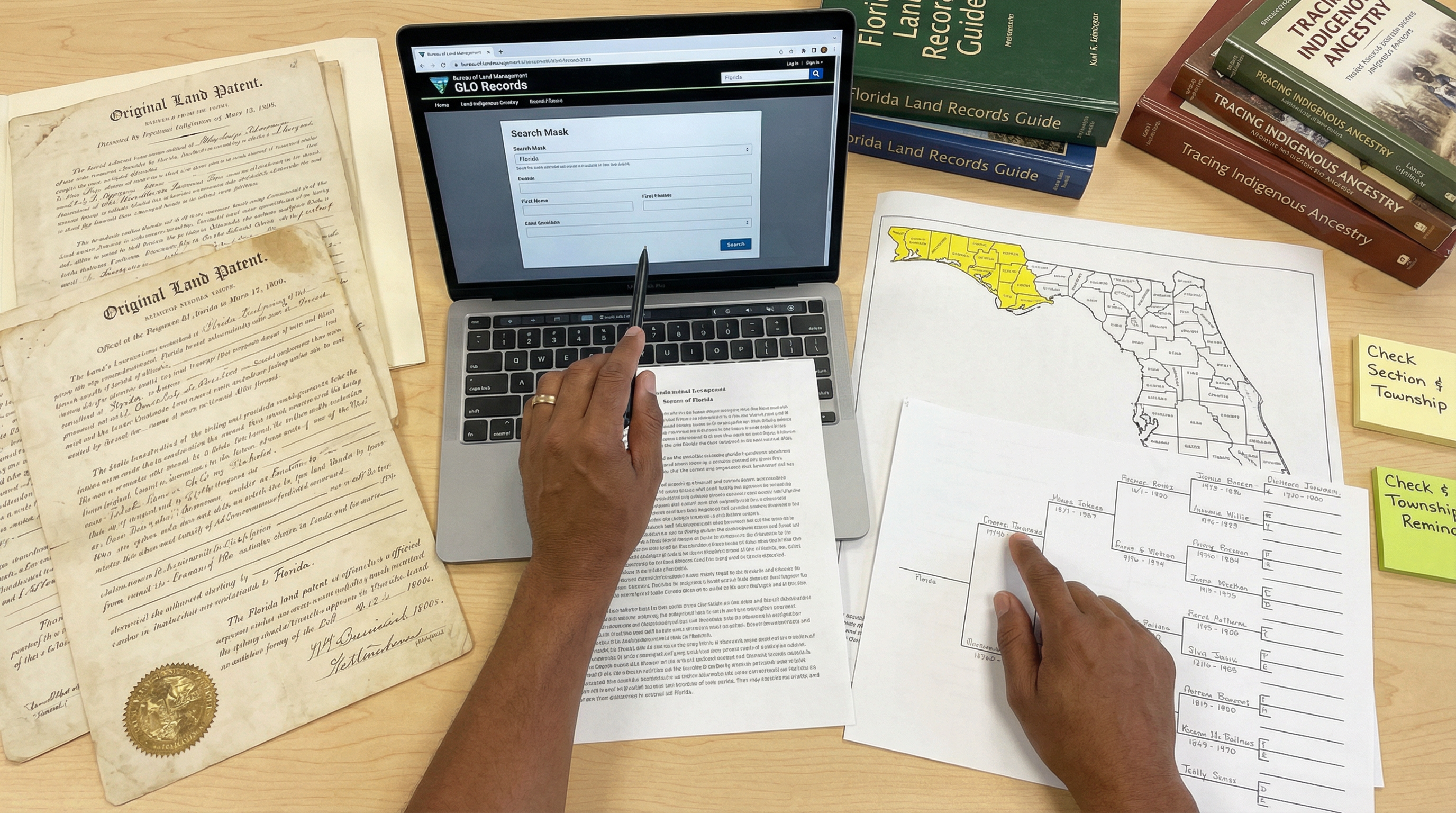
The Bureau of Land Management (BLM) maintains the General Land Office Records database at glorecords.blm.gov, which includes digitized land patents for Florida and other public land states. This free, searchable database allows you to search by name, location, or land description.
Step 1: Start with a Known Ancestor's Name
Begin your search with the most complete name you have for an ancestor who lived in Florida between 1820 and 1900. Land patents were issued throughout this period as the federal government transferred public lands to settlers, homesteaders, and claimants under various acts.
Enter the surname in the "Last Name" field and the state as "Florida." If you know the approximate time period, use the date range filter to narrow results. The database will return all matching patents, which you can review individually.
Step 2: Examine the Patent Details
Each patent record includes:
- Patentee name (the person receiving the land)
- Issue date (when the patent was granted)
- Land description (township, range, section using the Public Land Survey System)
- Acreage (amount of land granted)
- Authority (the law under which the land was granted, such as the Homestead Act or Armed Occupation Act)
- Document number (unique identifier for the patent)
Pay special attention to the authority under which the land was granted. The Armed Occupation Act of 1842, for example, was specifically designed to encourage settlement in Florida during the Second Seminole War period—a time when Yamasee people were actively resisting removal and maintaining their presence in the state.
Step 3: Download the Patent Image
The BLM database provides access to scanned images of the original patent documents. Download the high-resolution image and save it to your genealogy files. This document serves as primary source evidence of your ancestor's presence and legal status.
The patent image will show the official federal seal, the signature of the President of the United States (or an authorized official), and the legal description of the land. This is a federal document with the full authority of the U.S. government—far more powerful than secondary sources or family tradition.
Step 4: Locate the Land on Modern Maps
Use the township, range, and section information from the patent to locate the exact land on modern maps. The BLM website includes a land survey mapping tool, and county property appraiser websites often allow you to search by legal description.
Identifying the modern location of your ancestor's land can reveal:
- Proximity to other Yamasee families (clustering patterns suggest community networks)
- Geographic features (rivers, wetlands, forests that supported traditional lifeways)
- Historical context (proximity to forts, settlements, or conflict zones during the Seminole Wars)
Common Florida Counties for Yamasee Land Patents
Based on documented Yamasee presence and land patent records, focus your research on these Florida counties:
- Hernando County (where Mary Day received her 160-acre patent)
- Pasco County (formed from Hernando County in 1887)
- Hillsborough County (Tampa Bay area with significant Yamasee presence)
- Marion County (Ocala area, central Florida)
- Alachua County (Gainesville area, north-central Florida)
- Levy County (Gulf Coast region)
- Citrus County (formed from Hernando County in 1887)
These counties represent areas where Yamasee people maintained continuous presence despite official narratives of removal. Land patents in these regions often reveal Indigenous landowners who were reclassified in census records but retained their connection to Florida territory.
What to Do When You Find a Match
When you locate a land patent for a potential ancestor:
-
Cross-reference with census records from the same time period and location. Look for the same name in the county where the land was located.
-
Search for probate records in the county courthouse. Land patents often appear in probate files when property was transferred to heirs.
-
Check deed records at the county level. Your ancestor may have sold the land, and the deed will reference the original patent.
-
Look for adjacent landowners. Yamasee families often settled near each other. Identifying neighbors can reveal community networks and additional family connections.
-
Research the legal authority under which the patent was granted. Understanding the Armed Occupation Act, Homestead Act, or other land laws provides historical context for your ancestor's claim.
Beyond the Patent: Building Your Case
A land patent is a starting point, not an endpoint. Once you've identified a potential ancestor through land records, build a comprehensive case by:
- Documenting the family line from the patent holder to yourself using birth certificates, marriage records, and death certificates
- Researching the surname to identify other family members in the same county and time period
- Examining church records for baptisms, marriages, and burials that may not appear in civil records
- Consulting local histories and county genealogical societies for additional context
The Ministry of Yamasee Affairs offers ancestral research services to help families navigate this process. Our research team has access to specialized databases, archival collections, and genealogical expertise that can accelerate your search and verify your findings.
The Mary Day Example: A Case Study
Mary Day's 1857 land patent in Hernando County provides a model for how land records establish Yamasee continuity in Florida:
- Federal recognition: The patent proves the U.S. government recognized her claim to Florida land during a period when official policy promoted Indigenous removal.
- Geographic specificity: The exact location (Township 23 South, Range 18 East) places her in a documented Yamasee settlement area.
- Legal status: The Armed Occupation Act required claimants to occupy and improve the land, proving active presence and agricultural activity.
- Family connections: Descendants of Mary Day can trace their lineage directly to a documented Yamasee ancestor with federal recognition.
Your ancestor's land patent may provide similar evidence. The key is to search systematically, document thoroughly, and understand the historical context in which these records were created.
Start Your Search Today
The BLM General Land Office Records database is free and accessible to anyone. Begin with your known ancestors' names and work backward through time. Every land patent you discover adds another piece to the puzzle of your family's Yamasee heritage.
For assistance with your research, contact the Ministry of Yamasee Affairs. Our genealogy research services include comprehensive land patent searches, document analysis, and verification of family connections to documented Yamasee ancestors.
Download our free Genealogy Research Guide for step-by-step instructions, county-specific resources, and document templates: Yamasee Genealogy Research Guide (PDF)
This article is part of our weekly genealogy research series. Subscribe to receive new tips, Florida history discoveries, and exclusive research updates delivered to your inbox.