Decoding Florida Census Records: Finding Your Yamasee Ancestors Hidden in Plain Sight
Census records present both an opportunity and a challenge for Yamasee research. Learn how to decode racial reclassification and find your Indigenous ancestors in federal census data.
Decoding Florida Census Records: Finding Your Yamasee Ancestors Hidden in Plain Sight
Author: Ministry of Yamasee Affairs Research Team
Date: January 26, 2026
Category: Genealogy Research Tips
Keywords: Florida census records, Yamasee genealogy, racial reclassification, Indigenous ancestry research, census enumeration
If you're researching Yamasee ancestry in Florida, census records present both an opportunity and a challenge. These federal documents—created every ten years from 1790 to the present—contain invaluable genealogical information including names, ages, family relationships, and geographic locations. However, they also reflect the systematic reclassification of Indigenous people through colonial racial categories that obscured Yamasee identity and created the false impression of disappearance.
Understanding how to read census records critically—recognizing what they reveal and what they conceal—is essential for tracing Yamasee lineage in Florida. This guide will show you how to decode these documents, identify reclassified ancestors, and build a documented case for Yamasee heritage despite the limitations of official enumeration.
The Problem: Racial Reclassification in Census Records
Census enumerators in 19th and early 20th century Florida used racial categories that did not include "Yamasee" or even "Indian" for many Indigenous people who remained in the state after the Seminole Wars. Instead, Yamasee individuals and families were systematically recorded as:
- "Mulatto" (a colonial term for mixed African and European ancestry)
- "Colored" or "Black" (broad categories that included anyone not classified as white)
- "Free Person of Color" (in pre-Civil War censuses)
- Occasionally "Indian," but only in specific contexts or locations
This reclassification was not accidental. Federal Indian policy in the 19th century promoted removal of Indigenous peoples to western territories. Enumerators had little incentive to document Indigenous presence in Florida, and local officials often preferred to categorize remaining Native people using existing racial frameworks rather than acknowledging continued Indigenous occupation of land the government claimed to have cleared.
The result: Your Yamasee ancestor may appear in census records under a racial designation that obscures their Indigenous identity—but they are still there, documented and traceable, if you know what to look for.
What Census Records Reveal (Despite Their Limitations)
Even with racial reclassification, census records provide critical genealogical information:
-
Names and Family Structures
Census records list household members by name, age, and relationship to the head of household. This allows you to identify family units, trace children through multiple census years, and establish generational connections. -
Geographic Locations
Census records specify the county, township, and sometimes the specific enumeration district where a family lived. This geographic information is crucial for connecting families to documented Yamasee settlement areas in Florida. -
Occupations and Property Ownership
Later censuses (1850 onward) include occupation and property value. Yamasee families often appear as farmers, laborers, or landowners—occupations consistent with Indigenous lifeways adapted to post-removal Florida. -
Birthplaces
Census records note the state or country of birth for each individual. A family listed as "mulatto" but born in Florida across multiple generations suggests Indigenous continuity, not recent migration. -
Literacy and Education
Census records indicate whether individuals could read or write. Patterns of literacy (or lack thereof) can reveal families who maintained oral traditions rather than adopting Euro-American educational systems.
How to Search Florida Census Records for Yamasee Ancestors
Step 1: Start with FamilySearch or Ancestry.com
Both platforms provide free or subscription-based access to digitized U.S. census records from 1790 to 1950. Begin with the most recent census available (1950) and work backward through time.
Enter your known ancestor's name and Florida as the location. If you know the specific county, include that to narrow results.
Step 2: Look for Surname Clusters
Yamasee families often lived near each other, creating surname clusters in specific Florida counties. If you find one potential ancestor, search the same enumeration district for other families with the same surname or related surnames.
Common Yamasee surnames to watch for include:
- Day, Daye, Dayes
- Brooks, Brookes
- Jones, Johns
- Williams, Williamson
- Brown, Browne
- Davis, Davies
- Johnson, Johnston
- And many others documented in the Ministry's surname research
Step 3: Examine Racial Designations Critically
Do not assume that a "mulatto" or "colored" designation means your ancestor was not Indigenous. Instead, ask:
- Is this family documented in a known Yamasee settlement area? (Hernando, Pasco, Hillsborough, Marion, Alachua counties)
- Do they appear across multiple generations in the same Florida location? (suggesting long-term Indigenous presence, not recent migration)
- Are there other families with similar surnames in the same area? (indicating community networks)
- Do land records, church records, or other documents provide additional context? (cross-referencing strengthens your case)
Step 4: Track Families Across Multiple Census Years
Follow your ancestor's family through multiple census decades (1850, 1860, 1870, 1880, 1900, 1910, etc.). Look for:
- Consistency in location (families remaining in the same county across generations)
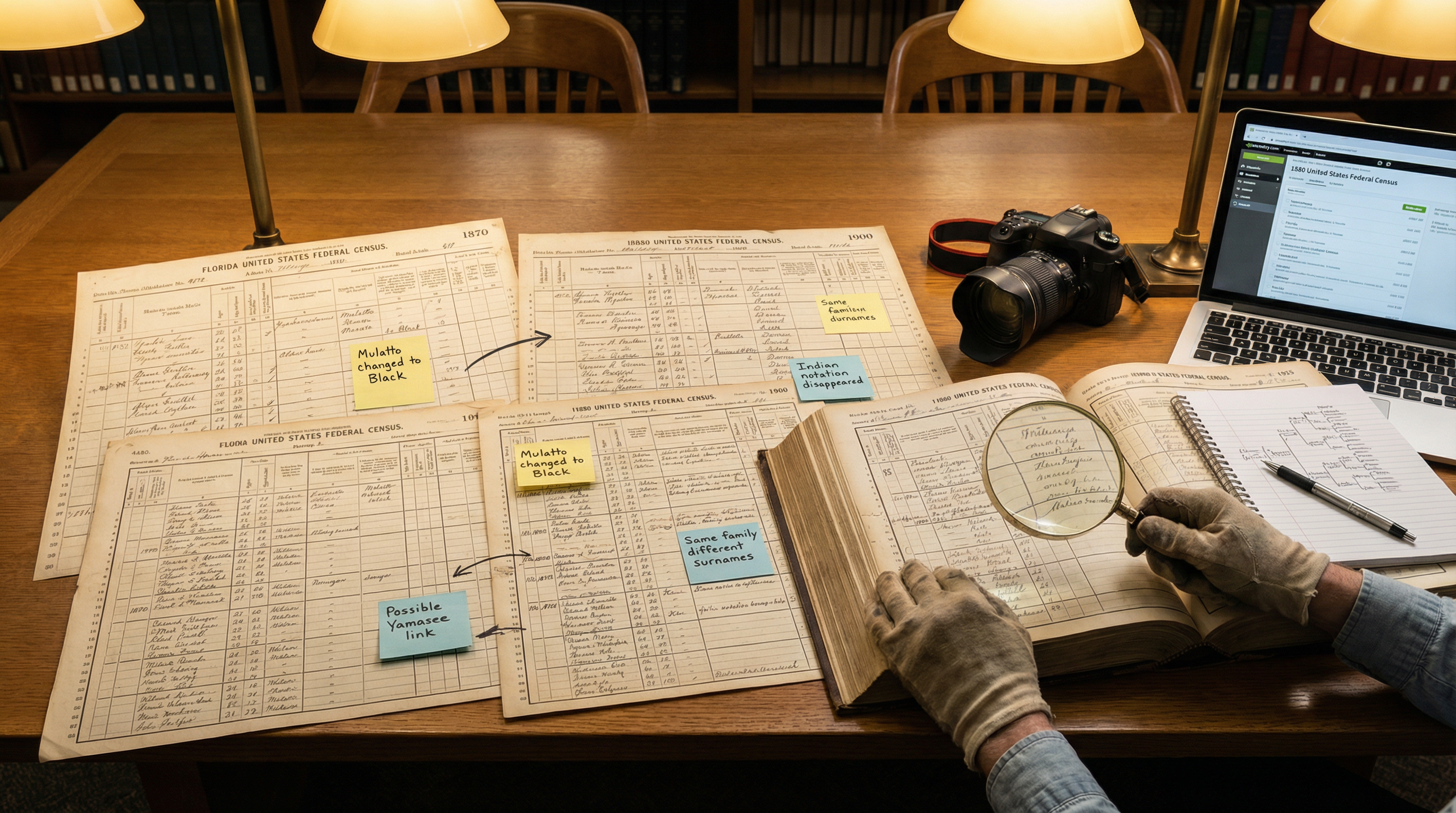
- Changes in racial designation (a family listed as "mulatto" in 1870 might appear as "Black" in 1880 or "Indian" in 1900, reflecting enumerator inconsistency)
- Aging patterns (children in one census becoming heads of household in later censuses)
- Property ownership (families acquiring land, consistent with Indigenous territorial claims)
Step 5: Cross-Reference with Other Records
Census records alone cannot prove Yamasee ancestry, but they provide a framework for further research. Once you've identified a potential ancestor in the census, cross-reference with:
- Land patents (see our previous article on BLM land records)
- Probate records (wills, estate inventories, land transfers)
- Church records (baptisms, marriages, burials)
- Military records (service in Seminole Wars, Civil War, or later conflicts)
- Newspaper archives (mentions of family members in local news)
Case Study: Tracing a Reclassified Yamasee Family
Consider a hypothetical example based on real research patterns:
1850 Census, Hernando County, Florida:
- John Brooks, age 35, "mulatto," farmer, born in Florida
- Mary Brooks, age 30, "mulatto," born in Florida
- Children: Sarah (10), James (8), William (5), all born in Florida
1860 Census, Hernando County, Florida:
- John Brooks, age 45, "mulatto," farmer, owns land valued at $500
- Mary Brooks, age 40, "mulatto"
- Children: Sarah (20), James (18), William (15), Elizabeth (8), all born in Florida
1870 Census, Hernando County, Florida:
- John Brooks, age 55, "colored," farmer, owns land
- Mary Brooks, age 50, "colored"
- Children: William (25), Elizabeth (18), both born in Florida
Analysis:
This family appears consistently in Hernando County across three census decades, always listed with a racial designation other than "Indian." However:
- Geographic continuity: They remain in Hernando County, a documented Yamasee settlement area.
- Property ownership: John Brooks owns land, suggesting he may have received a land patent (which would be verifiable through BLM records).
- Multi-generational Florida birth: All family members were born in Florida, indicating long-term presence, not recent migration.
- Surname: "Brooks" is a documented Yamasee surname.
Further research would involve:
- Searching BLM land patents for John Brooks in Hernando County
- Checking probate records for John Brooks's estate
- Looking for Brooks family members in church records
- Identifying other Brooks families in the same enumeration district
This pattern—consistent location, property ownership, documented surname, and multi-generational Florida presence—builds a strong case for Yamasee ancestry despite the "mulatto" and "colored" designations.
Common Pitfalls to Avoid
1. Assuming racial designations are accurate
Census categories reflect enumerator bias, not biological reality. A "mulatto" designation does not disprove Indigenous ancestry.
2. Ignoring families that don't appear as "Indian"
Most Yamasee families in Florida were reclassified. If you only search for "Indian" designations, you will miss the majority of your ancestors.
3. Failing to cross-reference with other records
Census records provide clues, not proof. Always verify census findings with land records, probate files, and other primary sources.
4. Giving up when records seem inconsistent
Enumerators made errors, spelled names phonetically, and used inconsistent racial categories. A family might appear as "Brooks" in one census and "Brookes" in another, or shift from "mulatto" to "colored" to "Black" across decades.
Next Steps: Building Your Yamasee Family Tree
Once you've identified potential Yamasee ancestors in census records:
- Document every census appearance across all available years (1850-1950)
- Create a timeline showing geographic locations, property ownership, and family structure
- Search for land patents, deeds, and probate records to verify census information
- Connect with other researchers who may be tracing the same surname or family line
- Contact the Ministry of Yamasee Affairs for professional genealogy research assistance
Our research team specializes in decoding census records, identifying reclassified Indigenous families, and building documented cases for Yamasee ancestry. We have access to specialized databases, archival collections, and surname research that can accelerate your search.
The Power of Persistence
Tracing Yamasee ancestry through census records requires patience, critical thinking, and a willingness to look beyond official racial categories. Your ancestors are in these records—hidden in plain sight, reclassified but not erased, documented but obscured.
Every census entry you find adds another piece to the puzzle. Every geographic location, every surname cluster, every property record strengthens your case. The work is challenging, but the result—a documented connection to your Yamasee heritage—is worth the effort.
Download our free Genealogy Research Guide for detailed census research strategies, county-specific resources, and document templates: Yamasee Genealogy Research Guide (PDF)
This article is part of our weekly genealogy research series. Subscribe to receive new tips, Florida history discoveries, and exclusive research updates delivered to your inbox.