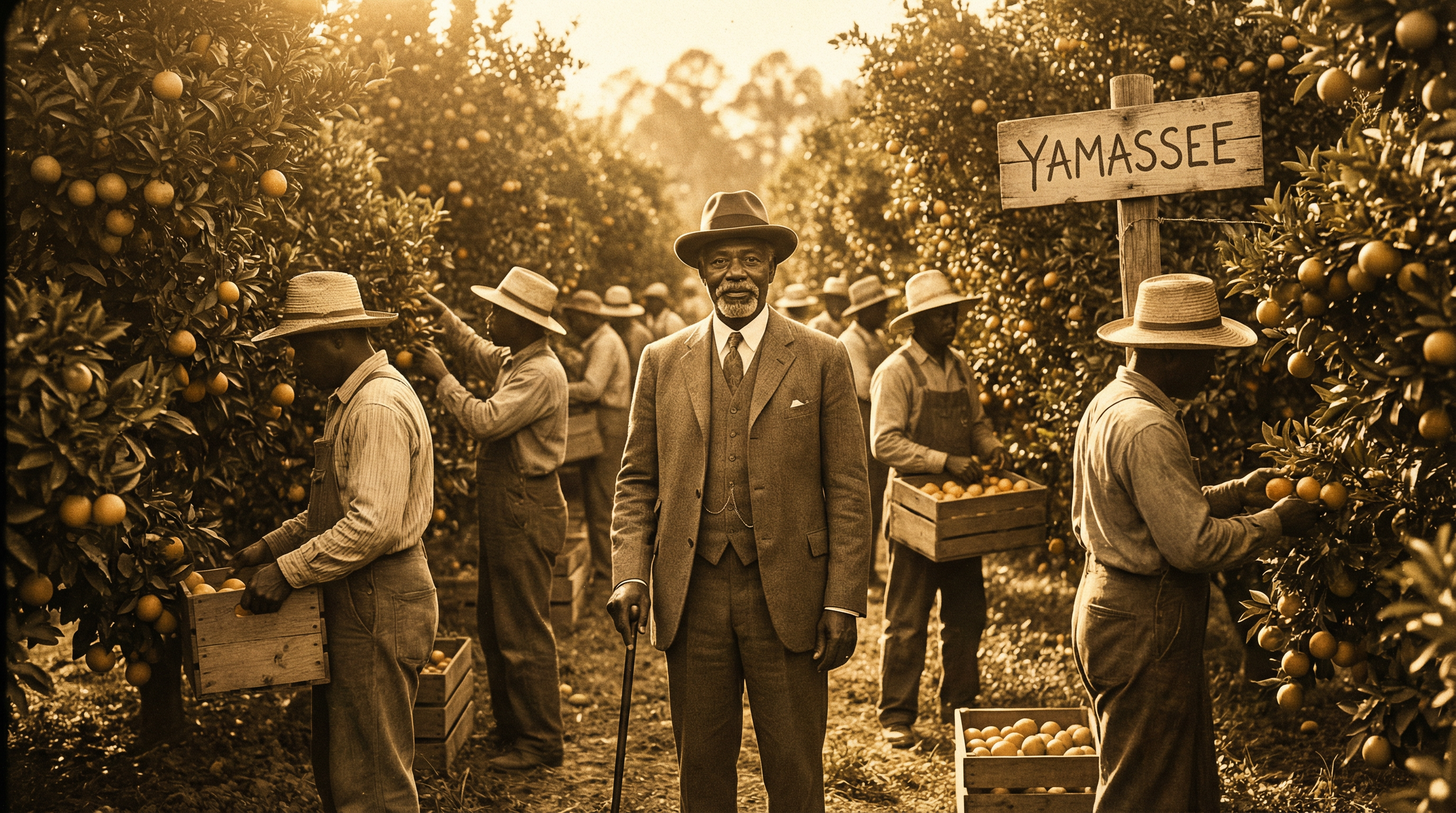
James Washington Wright Sr.: The Citrus King Who Named a Neighborhood After His Ancestors
He arrived with $1.50 in his pocket. Within three decades, he owned 250 acres and stood on stage in Boston alongside Booker T. Washington. But his greatest legacy was the name he gave his neighborhood: Yamassee.
James Washington Wright Sr.: The Citrus King Who Named a Neighborhood After His Ancestors
Category: Ancestor Honors
Author: Ministry of Yamasee Affairs
Featured Image: /historical-images/jw-wright-portrait.jpg
He arrived in Volusia County, Florida, with $1.50 in his pocket. Within three decades, he owned 250 acres, shipped 12,000 boxes of citrus annually to northern markets, and stood on stage in Boston alongside Booker T. Washington as one of America's most successful Black entrepreneurs. But James Washington Wright Sr.'s greatest legacy was not his wealth—it was the name he gave to the neighborhood he built: Yamassee.
In an era when asserting Indigenous identity could cost you land, livelihood, and life, Wright publicly declared his community's connection to the Yamasee Nation—the Indigenous people who had fought the British in 1715 and allied with African freedom seekers in Spanish Florida. This was not nostalgia. This was reclamation.
From $1.50 to a Citrus Empire
James Washington Wright Sr. was born on September 28, 1875, in Florida, according to his tombstone at DeLand's Union Cemetery. The details of his birthplace and parentage remain scarce—his personal papers do not survive, according to the DeLand Historical Society—but Wright himself often recounted that he arrived in Volusia County with "$1.50 in his pocket," likely in the 1880s or early 1890s.
He came of age during Reconstruction's collapse and the rise of Jim Crow segregation. Yet Wright seized an opportunity in Florida's booming citrus industry. Working alongside his older brother, Anthony "Tony" Wright, he acquired land and planted orange groves. One anecdote says he initially purchased a 5-acre orange grove and, by careful cultivation and savvy marketing, turned it profitable.
By 1913, Wright was shipping 12,000 boxes of oranges annually to wholesalers in New York and Boston, earning about $15,000 per season—a considerable sum, roughly $400,000 today. By 1915, Wright owned 250 acres of land, with 60 acres planted in citrus orchards. He had become one of Volusia County's top orange growers.
What set Wright apart was his vertical integration. Most Black growers in the Jim Crow South were forced to rely on white-controlled packing firms, which often cheated them on prices. Wright built his own citrus packinghouse on West Minnesota Avenue, allowing him to process and ship not only his fruit but also the harvests of neighboring Black and white growers. This was an extraordinary act of economic independence.
The 1915 National Negro Business League Convention
Wright's achievements did not go unnoticed. In summer 1915, Dr. Booker T. Washington—the famed educator and founder of Tuskegee Institute—personally invited James W. Wright to speak at the National Negro Business League (NNBL) convention in Boston. This was a tremendous honor. The NNBL, founded by Washington in 1900, was the premier gathering of Black entrepreneurs and professionals across the United States.
At the convention, held in Convention Hall near Copley Square, Wright was given the coveted slot as the first speaker in the sessions highlighting successful Black-owned businesses. He shared the podium with luminaries like:
- Abraham Lincoln Lewis, Florida's first Black millionaire and insurance magnate
- Joseph Haygood Blodgett, a Jacksonville contractor and builder
- R.C. Calhoun, educator and founder of the Robert Hungerford Normal and Industrial School in Eatonville
In his address, Wright "regaled" the audience with stories of buying land and experimenting with fertilizers, illustrating the challenges of citrus farming. When Booker T. Washington playfully asked if oranges grown by a Black man were as good as those grown by whites, Wright humorously replied:
"The consumers don't know the difference. We use the same fertilizer, the same methods, we get the same air, moisture, sunshine and rain that the good Lord sends—and they don't know black oranges from white oranges."
The witty retort drew laughter and applause, and encapsulated Wright's philosophy: that given equal resources, Black farmers could compete with anyone. He also cautioned that citrus growing "requires a whole lot of attention and care"—tempering any romantic notions of easy success.
Perhaps most strikingly, Wright publicly revealed at this meeting that when he first arrived in Volusia he had "only $1.50," but was now worth "between $35,000 and $40,000" (equivalent to nearly $900,000 today). Such transparency about his modest start and substantial wealth served to inspire other Black entrepreneurs.
This Boston trip broadened Wright's horizons. He became a Life Member of the Negro Business League and gained a network of peers nationwide. Back home in DeLand, it "propelled him onto a national stage" and likely emboldened him to invest in even more ambitious projects. Indeed, within a few years he would embark on building the grandest Black-owned structure his town had ever seen.
The J.W. Wright Building: A Monument to Sovereignty
In 1920, flush with profits and confidence, Wright undertook the construction of a two-story masonry commercial building at 258 West Voorhis Avenue, on the corner of Voorhis and Clara (diagonally across from Greater Union Church). This building—often called "Wright's Corner"—stands as the crowning achievement of his career.
Construction and Design
Wright did not compromise on quality. He hired Francis Miller, a prominent white architect in DeLand, and Rufus Knight, a white contractor, to ensure his building would be sound and modern. The structure was made of locally-produced sand-lime brick from the Bond Sandstone Brick Company yard in nearby Lake Helen, which Black laborers had a major hand in manufacturing.
The final cost was about $15,000 in 1920—a huge investment for a Black man at that time. The Wright Building is a robust masonry vernacular structure with some early 20th-century commercial style elements. It featured three storefronts on the ground floor (with large display windows) and apartments upstairs. Ghost signage is still visible on a steel beam.
Businesses and Tenants
Wright operated four businesses himself:
- Grocery store
- Confectionary
- Bar/Tavern
- Restaurant
He also leased space to at least 17 other merchants, including:
- Dry goods store
- Meat market
- Shoeshine business
- Dr. Samuel W. Poole's dental office (from 1931, serving both Black and white patients)
Upstairs, Wright rented apartments to at least three families. The building became the hub of Black business life in DeLand, a vibrant enclave where the community could shop, socialize, and conduct business.
Remarkably, despite segregation, Wright rented space to both African American and white business owners. This was an extraordinary act of economic power and a subtle challenge to Jim Crow norms.
Defying Jim Crow: Suing White Debtors
Wright's defiance of racial hierarchies extended beyond his building. During the 1920s Florida Land Boom, he extended mortgages to white real estate investors. When the boom collapsed, many of these investors defaulted. Wright did what few Black men dared: he sued white debtors for unpaid mortgages and won payment in court.
This was an extraordinary act of legal and economic power in the Jim Crow South, where Black people were routinely denied justice in white-controlled courts. Wright's willingness to assert his rights—and his success in doing so—speaks to his stature, his legal acumen, and perhaps the respect (or fear) he commanded in DeLand.
Wright owned the building until his death in 1956.
Partnership with Mary McLeod Bethune
Wright's influence extended beyond DeLand. He regularly collaborated with Mary McLeod Bethune, the legendary educator and civil rights leader who founded Bethune-Cookman College in nearby Daytona Beach. In the 1920s and 1930s, Wright and Bethune joined forces to create exhibits on Black successes for display at Volusia County fairs.
This partnership underscores Wright's stature in the regional Black community. Bethune was one of the most significant Black leaders in American history—an advisor to President Franklin D. Roosevelt and founder of the National Council of Negro Women. That she regularly worked with Wright demonstrates his standing as a peer and community leader.
The Wright Brothers: A Family Enterprise
James Washington Wright did not build his empire alone. He worked closely with his brother, Anthony "Tony" Wright, who helped make the orange grove profitable and was instrumental in building the Black hospital at the Old DeLand Memorial Hospital, working with white benefactor Elizabeth Burgess.
The Wright brothers represented a powerful family enterprise that built both economic and civic infrastructure for DeLand's Black community. Their collaboration exemplifies the mutual aid and kinship networks that sustained Black communities in the Jim Crow South.
The Yamassee Naming: Asserting Indigenous Identity
Wright's most significant legacy, however, was not his wealth or his building. It was the name he gave to the neighborhood he developed: Yamassee (also spelled Yemassee).
By the 1920s, several newspaper reports explicitly referred to the Wright Building as located "in the larger African American neighborhood known as Yemassee." The DeLand Historical Society confirms that this naming was deliberate, championed by Wright and his peers as they developed the area.
The choice of this name was profound. The Yamasee were not a distant, romanticized tribe from textbooks. They were a living memory—a people who had allied with escaped African slaves in Spanish Florida, fought the British in 1715, and established free Black-Indigenous communities like Fort Mose near St. Augustine in 1738.
For Wright to name his neighborhood "Yamassee" in the 1890s-1920s was to say: "We are the Yamasee people, returned."
This bold assertion of dual heritage (Black and Native) is remarkable, occurring at a time when Jim Crow laws and the "one-drop rule" often forced people to hide or downplay Native ancestry. The Yamassee Settlement stands as a rare instance where a Black community publicly celebrated its Indian roots as a source of pride and legitimacy.
As one historical analysis notes, the residents were saying, in effect: "We are the Yamasee people, returned. We were always more than just freedmen—we are the land's original people."
The Research Question: Did Wright Come from Yamasee Country?
One critical question remains unanswered: Where was James Washington Wright born, and who were his people?
Wright's tombstone at DeLand's Union Cemetery confirms he was born September 28, 1875, in Florida. However, details of his birthplace and parentage remain scarce. Given the era and his later claims, it is possible Wright's family had come to Florida from elsewhere in the South during Reconstruction.
If Wright migrated from South Carolina—specifically from the Yamasee country near the Savannah River—then the naming choice suggests deep familiarity with Yamasee identity and history. The Ministry of Yamasee Affairs is actively researching:
- 1900 and 1910 U.S. Census records for James W. Wright in Volusia County
- 1870 and 1880 Census records for Wright family in South Carolina and Georgia
- Volusia County death certificate (1956)
- National Register nomination documents prepared by Sidney Johnston at Stetson University
- National Negro Business League archives at the Library of Congress
If Wright came from South Carolina Yamasee country, then the "Yemassee Settlement" in DeLand represents a deliberate reconstruction of Yamasee community in Florida—a continuation of the same migration pattern that brought Yamasee survivors to Spanish Florida after the 1715 war.
The Legacy: A Building and a Name
James Washington Wright Sr. died in 1956, having lived through Reconstruction, Jim Crow, two World Wars, and the beginnings of the Civil Rights Movement. He witnessed the Great Freeze of 1894-1895 that destroyed many citrus groves (including Henry DeLand's fortune), yet he survived and thrived. He saw DeLand transform from a frontier citrus town to a modern city.
Today, the J.W. Wright Building stands as a monument to his legacy. On February 1, 2021, the building was listed on the National Register of Historic Places, recognized as the oldest surviving African American commercial building in DeLand. It is now owned by Greater Union Life Center, the charitable arm of Greater Union Baptist Church—the same church founded in 1882 in the Yamassee Settlement.
The building is undergoing restoration with $600,000 in funding, including a $100,000 grant from the National Trust for Historic Preservation. The restoration is led by Sidney Johnston of Stetson University and restoration expert Mark Shuttleworth of Florida Victorian Architectural Antiques.
But Wright's true legacy is not bricks and mortar. It is the name he gave to a neighborhood—a name that asserted Indigenous identity at a time when such claims were being systematically erased. It is the example he set of economic independence, legal defiance, and community building. It is the proof that Black families in the late 1800s were consciously asserting Yamasee identity through the names they gave their neighborhoods, the churches they built, and the land they claimed.
James Washington Wright may have been building exactly what the Ministry of Yamasee Affairs is now seeking to restore: a deliberate reconstruction of Yamasee community, identity, and sovereignty in Florida.
Learn More:
- The Yamassee Settlement: How DeLand, Florida Became a Beacon of Black-Indigenous Identity (Related Article)
- From the Yamasee War to Florida's Freedom: Tracing 300 Years of Continuity (Coming Soon)
- Keepers of Florida: The Hidden Yamasee Legacy (Available Now)
References:
- DeLand Historical Society, "James W. Wright, Pioneer DeLand Businessman" (November 28, 2025)
- West Volusia Beacon, "DeLand's famous Wright Building has a rich history" (February 28, 2021)
- Florida Division of Historical Resources, "James W. Wright Building" National Register listing (February 1, 2021)
- Daytona Times, "Business district part of DeLand's rich Black heritage" (February 15, 2018)
- Yahoo News/Daytona Beach News-Journal, "10 things to know: J.W. Wright, the DeLand building and the restoration effort" (March 22, 2022)
- National Negro Business League, 1915 Convention Proceedings (Library of Congress)
- DeLand House Museum, "JW Wright Building Restoration & Revitalization Project"