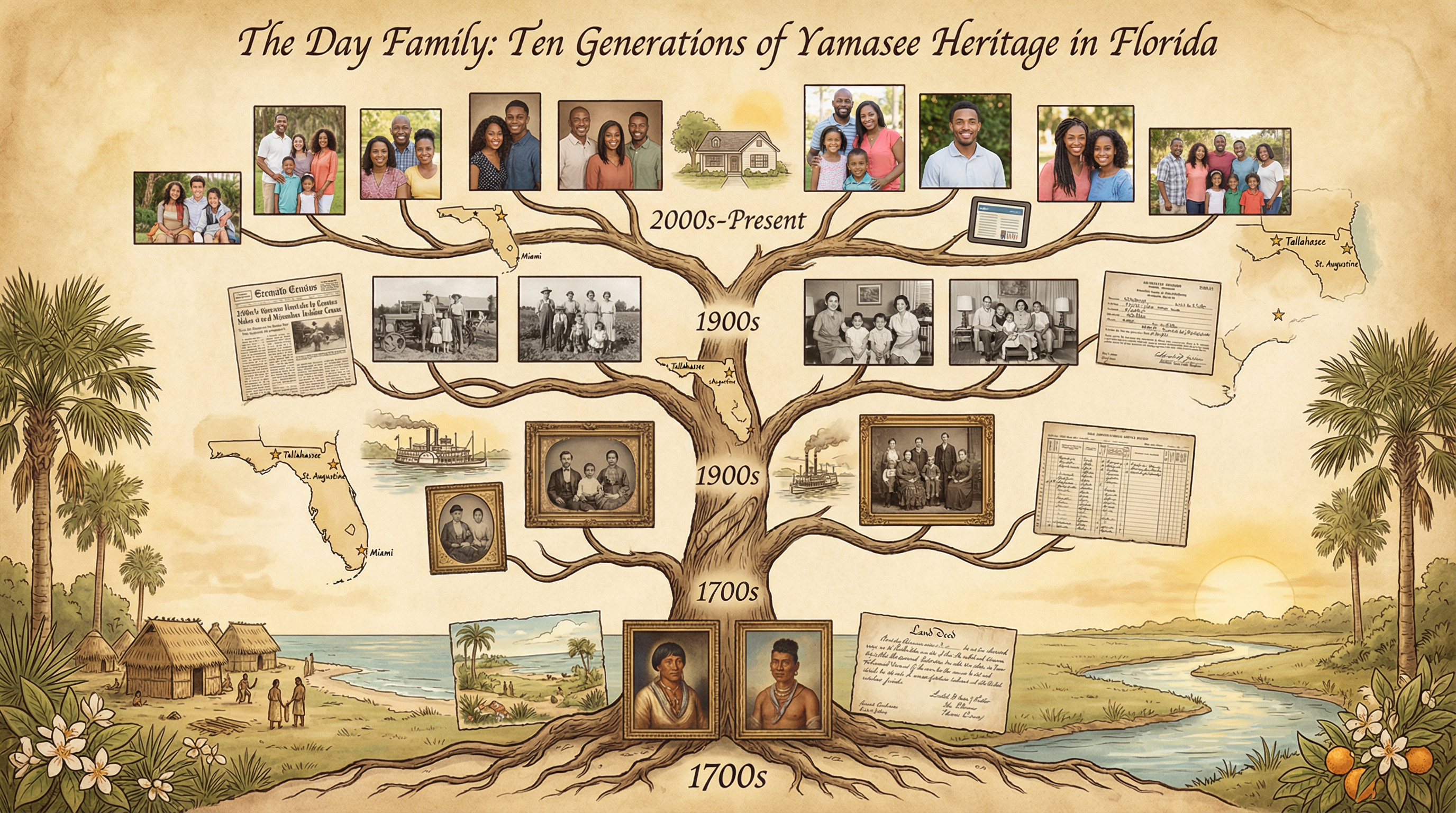
The Day Family: 10 Generations of Documented Yamasee Presence in Florida
Through ten generations of federal land patents, census records, and vital statistics, the Day family provides irrefutable evidence of Yamasee presence in Florida. Discover how one family navigated systematic erasure.
The Day Family: 10 Generations of Documented Yamasee Presence in Florida
Author: Ministry of Yamasee Affairs
Published: January 21, 2026
Reading Time: 10 minutes
In the tangled web of American genealogy, where Indigenous identity was systematically erased through legal reclassification and administrative manipulation, the Day family stands as a beacon of documented continuity. Through ten generations of federal land patents, census records, military service documents, and vital statistics, the Day lineage provides irrefutable evidence of Yamasee presence and persistence in Florida from the early 19th century to the present day.
This is not a story of mythical ancestors or oral tradition alone—though those remain valuable—but of paper trails that survive in federal archives, county courthouses, and state repositories. It is a story of how one family navigated the treacherous waters of American racial classification while maintaining connection to their Yamasee heritage, and how careful genealogical research can recover identities that official systems sought to erase.
Harry Day: Revolutionary War Veteran and Patriarch
The documented Day family lineage begins with Harry Day, a Revolutionary War veteran whose military service is recorded in federal pension records and whose land claims in Florida are documented in territorial and early statehood records. Harry Day's presence in Florida during the transition from Spanish to American control (1821) places him at a pivotal moment in the state's history, when racial and ethnic identities were being redefined under American administrative systems.
Harry Day's Revolutionary War service is significant for multiple reasons. First, it establishes his presence in the American Southeast during the Revolutionary period and his participation in the conflict that created the United States. Second, it provided him with veteran's benefits that included land grants—benefits that would prove crucial for his descendants' ability to maintain property ownership through generations of economic and legal pressure.
Federal pension records describe Harry Day using terminology that reflects the racial confusion of early American bureaucracy when confronted with Afro-Indigenous identity. Different documents variously describe him as "mulatto," "free person of color," and occasionally "Indian"—classifications that reveal more about American administrative categories than about Harry Day's actual identity or self-understanding.
Mary Day: The Land Patent That Proves Everything
The most significant documentary evidence in the Day family genealogy is Mary Day's federal land patent, issued in 1893 and recorded as FL0880__.366 in the Bureau of Land Management's General Land Office records. This document is not merely a property deed but a key that unlocks understanding of how Yamasee families maintained legal status and land ownership during the most oppressive period of American racial policy.
Federal land patents in the post-Reconstruction South were rarely issued to people classified as "Black" or "Colored" in census records. The fact that Mary Day—who appears in various census records with shifting racial classifications—received a federal land patent indicates special legal status that transcended the rigid racial categories being imposed on most African-descended people in the South.
The land patent's significance extends beyond Mary Day's individual case. It demonstrates that federal authorities recognized some form of Indigenous or special status for certain families even when local and state records classified them using racial categories designed to deny Indigenous identity and associated rights. The patent represents a crack in the system of erasure—a moment when bureaucratic processes created documentation that survived attempts to obscure Indigenous presence.
Mary Day's land was located in Columbia County, Florida, in an area that had been part of the Seminole Wars' contested territory and that remained home to families with Indigenous heritage long after official narratives declared Florida's Indigenous peoples removed or extinct. The land's location is itself evidence of continuity—these families remained on or near ancestral territories despite enormous pressure to relocate or assimilate.
Lake City: From Alligator Town to a New Beginning
The Day family's connection to Lake City, Florida, reveals another layer of historical continuity often obscured in official narratives. Lake City was originally known as Alligator Town, named after Alligator (Halpatter Tustenuggee), a prominent Seminole leader during the Second Seminole War. The town's name change in 1859 represented an attempt to erase Indigenous presence from the landscape, but families like the Days remained, carrying forward the Indigenous heritage that official nomenclature sought to deny.
Lake City and surrounding Columbia County became home to a cluster of families with Yamasee heritage, including not only the Days but also the Hayes, Baugh, and Barber families. This geographic concentration was not coincidental but reflected deliberate choices by Indigenous families to maintain proximity to one another, creating informal communities that preserved cultural practices and mutual support networks even when formal tribal structures had been destroyed or driven underground.
Census records from Columbia County throughout the late 19th and early 20th centuries show these families living in close proximity, intermarrying, and maintaining economic relationships that suggest continued community cohesion despite official classifications that denied their Indigenous identity. The pattern is visible to researchers who know what to look for, but it was deliberately obscured by administrative systems designed to fragment Indigenous communities and prevent collective political action.
The Census Reclassification Pattern
Tracing the Day family through federal census records from 1850 to 1940 reveals the systematic process by which American administrative systems erased Indigenous identity. The pattern is remarkably consistent across multiple families and locations:
1850-1860: Early census records sometimes include "Indian" or "Mulatto" designations that acknowledge mixed or Indigenous heritage. These classifications are inconsistent and depend heavily on individual census takers' perceptions and local knowledge.
1870-1890: Post-Reconstruction census records increasingly use "Mulatto" or "Colored" classifications, reflecting the collapse of Spanish colonial racial categories into the American binary system that recognized only "White" and "not White." Indigenous identity becomes invisible in official records even when families maintain cultural practices and community relationships.
1900-1920: The consolidation of Jim Crow racial regimes leads to universal classification of anyone with visible African ancestry as "Black" or "Colored," regardless of Indigenous heritage. The "one-drop rule" becomes administrative policy, and census takers are instructed to classify anyone with any African ancestry into the "Black" category.
1930-1940: Some families begin to resist reclassification, with census records showing contested classifications or notes indicating that respondents claimed Indigenous identity that census takers rejected or ignored. These moments of resistance are valuable evidence of continued Indigenous self-identification even when official systems refused recognition.
This pattern of progressive erasure was not accidental but reflected deliberate policy designed to eliminate Indigenous land claims, prevent collective political action, and simplify racial categories to serve Jim Crow segregation. By reclassifying Indigenous peoples as "Black," American authorities could deny treaty rights, land claims, and political status while simultaneously subjecting them to the full apparatus of racial oppression designed to control African-descended populations.
Geographic Clustering: Columbia, Lake, and Volusia Counties
Genealogical research reveals that Day family descendants and related Yamasee families concentrated in three Florida counties: Columbia, Lake, and Volusia. This geographic pattern is significant because these counties represent different ecological and economic zones in Florida, suggesting that Yamasee families adapted to various environments while maintaining connection to one another.
Columbia County (Lake City area) represented the northern frontier of Florida, an area of pine forests, small-scale agriculture, and proximity to the Georgia border. Families in this region often engaged in subsistence farming, timber work, and small-scale commerce. The area's relative isolation from major urban centers provided some protection from the most intense forms of racial surveillance and control.
Lake County (central Florida) offered access to Florida's lake district and developing citrus industry. Families in this region participated in agricultural labor, land ownership, and the emerging tourist economy. The county's rapid development in the late 19th and early 20th centuries created economic opportunities but also increased pressure for racial conformity and land alienation.
Volusia County (DeLand, Daytona Beach area) provided access to both agricultural land and coastal resources. The county's development as a tourist destination and its proximity to major transportation routes created different economic opportunities and challenges. Some Day family descendants in this region achieved notable economic success despite racial barriers, owning businesses and property that provided foundation for future generations.
The maintenance of family connections across these three counties, documented through marriage records, property transactions, and church affiliations, demonstrates deliberate effort to preserve community cohesion despite geographic dispersion. Family reunions, church gatherings, and mutual aid networks kept these communities connected even when official systems sought to fragment them.
Documentary Evidence: Building the Genealogical Case
The Day family genealogy rests on multiple categories of documentary evidence, each providing different insights into family history and Indigenous identity:
Federal Land Patents: Mary Day's 1893 patent and related land documents establish property ownership and special legal status that transcended typical racial classifications of the period.
Census Records: Despite their role in erasure, census records provide decade-by-decade documentation of family composition, geographic location, and occupations. Careful analysis reveals patterns of community cohesion and resistance to reclassification.
Vital Statistics: Birth certificates, death certificates, and marriage licenses provide genealogical connections and sometimes include racial classifications that differ from census records, revealing the contested nature of identity documentation.
Military Records: Service in various American military conflicts, from the Revolutionary War through World War II, provided veterans' benefits and created federal documentation that sometimes preserved Indigenous identity when civilian records obscured it.
Church Records: Baptismal records, marriage registers, and burial records from churches serving these communities provide additional genealogical evidence and insights into religious and cultural practices.
Property Records: Deeds, tax records, and probate documents establish patterns of land ownership, inheritance, and economic activity that demonstrate family continuity and community networks.
The Research Methodology: Uncovering Systematic Erasure
Recovering the Day family genealogy required methodological approaches specifically designed to overcome systematic erasure. Standard genealogical methods, which assume consistent racial classifications and straightforward documentary trails, prove inadequate when researching families whose identities were deliberately obscured.
Successful research required:
Cross-referencing multiple record types to identify the same individuals across documents that used different names, racial classifications, or identifying information.
Geographic cluster analysis to identify community networks and family relationships that official records fragmented or obscured.
Surname pattern analysis to track families through name changes, spelling variations, and the adoption of European surnames that replaced Indigenous names.
Comparative analysis of families with similar documentary patterns to distinguish systematic erasure from individual circumstances.
Critical reading of official documents to recognize the ideological assumptions and political purposes that shaped record-keeping practices.
This methodology has broader applications beyond the Day family, providing a template for other families seeking to recover Indigenous heritage that American administrative systems sought to erase.
Contemporary Implications: Why This Matters
The Day family genealogy is not merely an academic exercise or personal family history but has profound contemporary implications:
Federal Recognition: Documented genealogical evidence is essential for communities seeking federal recognition as Indigenous tribes. The Day family documentation provides a model for the kind of evidence required to meet Bureau of Indian Affairs standards.
Land Claims: Historical land ownership and property rights may provide basis for contemporary land claims or compensation for historical dispossession.
Cultural Reclamation: Understanding family history enables descendants to reclaim cultural practices, traditional knowledge, and community connections that were disrupted by forced assimilation and erasure.
Historical Correction: Documenting families like the Days corrects the historical record and challenges narratives that declare Indigenous peoples extinct or removed from regions where they continue to live.
Community Building: Genealogical research connects dispersed family members and creates foundation for rebuilding community structures that were deliberately fragmented.
Discover the Complete Story
This article draws from Keepers of Florida: The Hidden Yamasee Legacy, which provides comprehensive genealogical documentation for the Day family and related Yamasee families including Hayes, Baugh, and Barber lineages. The book includes detailed family trees, analysis of documentary evidence, and guidance for descendants seeking to trace their own Yamasee heritage.
About the Ministry of Yamasee Affairs
The Ministry of Yamasee Affairs is dedicated to documenting, preserving, and sharing the true history of Yamasee people in Florida. Through rigorous historical research and genealogical documentation, we work to correct the historical record and support Yamasee descendants in reclaiming their heritage.
Learn more about our mission | Join our community | Support our work