Food, Reconstruction, and the War That Never Ended: Why Food Sovereignty Is Reparations in Action
When clean food is unavailable in our communities while toxic products fill every shelf, it's not coincidence—it's continuation of a war that never ended. The Ministry of Yamasee Affairs is restarting Reconstruction through food sovereignty.
The Food Crisis in Our Communities
One of the highest priorities of the Ministry of Yamasee Affairs is restoring access to healthy, non-toxic food in our communities.
When you walk into stores in our neighborhoods, it is difficult—often impossible—to find food and drinks that are not harmful to the body. Shelves are filled with products loaded with chemicals, artificial dyes, preservatives, seed oils, and genetically modified ingredients. Clean, non-GMO food is either unavailable or priced beyond reach.
This is not coincidence. It is a pattern.
In wealthier or more protected areas, clean food options are common and accessible. In our communities, chronic illness is common—diabetes, high blood pressure, kidney disease, cancer. The food that dominates our shelves quietly fuels these outcomes, creating a public health crisis that disproportionately affects Black and Indigenous families.
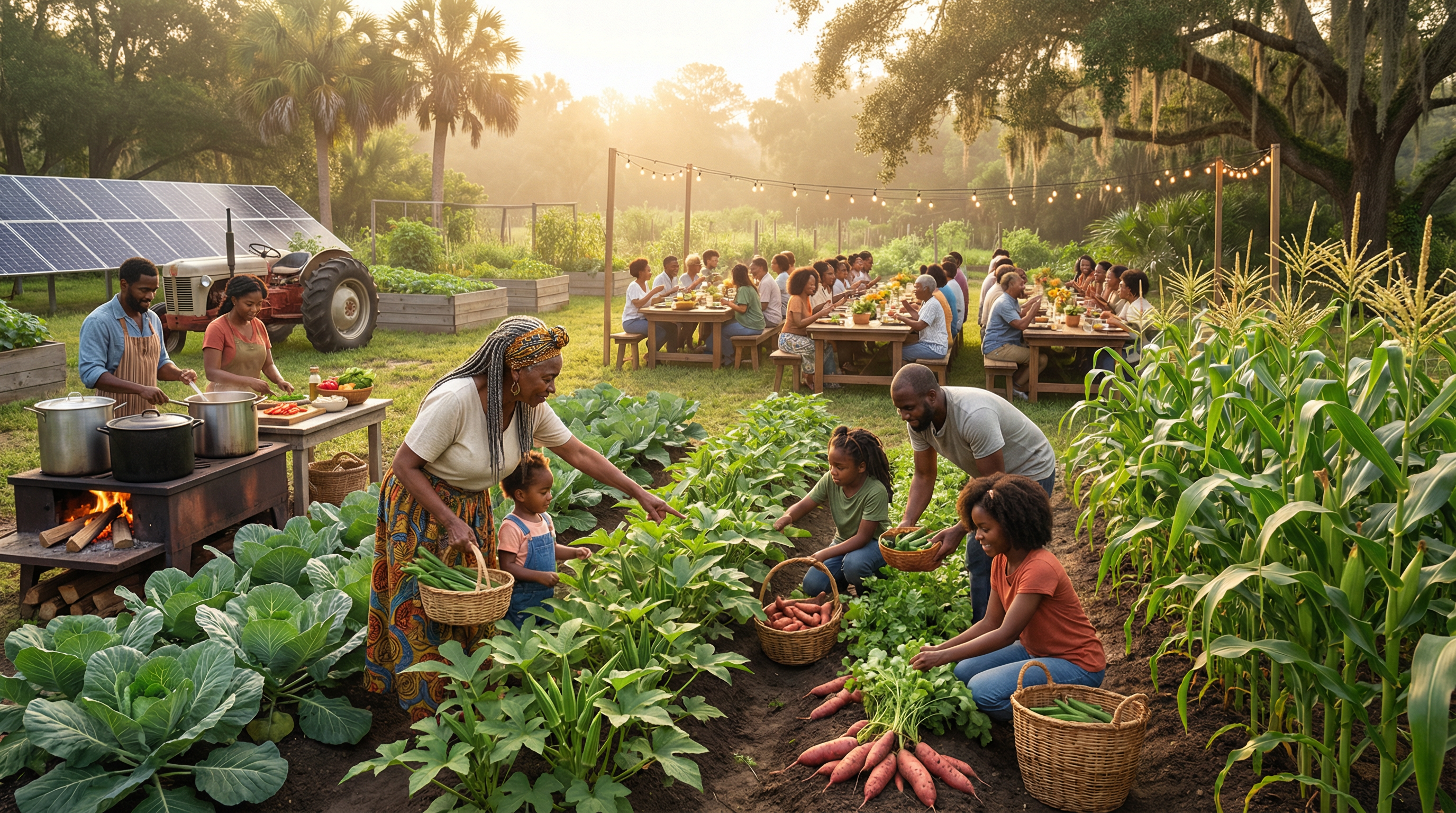
That is why the Ministry is actively working to bring non-GMO products directly from farmers into our communities and to establish a community-rooted grocery store in the Yamasee area of DeLand, Florida. This is not charity. This is infrastructure. This is ownership. This is control over what sustains life.
This is what we mean when we say we are doing our own reparations—or more precisely, restarting Reconstruction.
Reconstruction Was Interrupted—Not Completed
After the so-called Civil War ended in 1865, there was a brief but powerful period—roughly 1865 to 1875—when Black and Indigenous-descended families across the South were building banks, businesses, farms, schools, and self-sustaining communities. This era, known as Reconstruction, represented the first real opportunity for economic independence and political power for formerly enslaved people and marginalized Indigenous communities.
That progress did not fail on its own. It was systematically destroyed.
There was a coordinated campaign to:
- Eliminate Black-owned banks and businesses through economic sabotage and violence
- Push families off land through terror, legal manipulation, and fraudulent title claims
- Criminalize survival and movement through vagrancy laws and Black Codes
- Collapse independent economic systems by cutting off access to capital and markets
Although the war was declared "over" in 1865, the conflict did not end. Soldiers laid down their Union blue uniforms and reorganized under new identities, continuing the same objectives through intimidation, extrajudicial violence, and organized terror. The Ku Klux Klan emerged not as a random hate group, but as a continuation of warfare by other means.
This is why so many families lost land, wealth, and stability after 1865—not before it. The promise of "40 acres and a mule" was not just broken—it was actively reversed through systematic violence and legal theft.
Rebranding the War, Rewriting the Narrative
We are taught that 1865 marked freedom. But few are encouraged to ask deeper questions about what that "freedom" actually meant in practice.
When you examine the legal record closely, many people labeled as "slaves" were in fact prisoners, transported laborers, and criminalized populations, moved under European penal systems—particularly through laws such as the Piracy Act of 1717 and related transportation statutes. The system of forced labor did not begin with chattel slavery as we're taught—it evolved from existing European systems of penal transportation and indentured servitude.
After 1865, what followed was not freedom, but a new legal cage designed to replicate the economic exploitation of slavery under different names:
- Vagrancy laws that criminalized unemployment and "loitering"
- Black Codes that restricted movement, employment, and property rights
- Convict leasing that turned prisons into profit centers using forced labor
- Banking exclusion that prevented wealth accumulation and business formation
- Land title manipulation through fraudulent deeds and tax foreclosures
- Licensing and labor restrictions that limited economic participation
If the war had truly ended, there would have been no immediate need to pass laws designed to limit movement, work, land ownership, and economic participation. The continuity is unmistakable: the war never stopped—it was rebranded.
Food Is the Modern Battlefield
Today, the conflict shows up differently. It no longer requires uniforms, explicit laws, or visible violence. Instead, it operates through systems that appear neutral but produce the same outcomes: wealth extraction, health destruction, and economic dependency.
The modern battlefield is your grocery store. It shows up in:
- Toxic food being normalized as the only affordable option
- Chemicals banned elsewhere allowed in American food products
- Profits placed above public health in food production and distribution
- Medical debt replacing chains as a form of economic control
- Chronic illness replacing open violence as a method of population control
When a system allows poison into the food supply—especially concentrated in specific communities—it is clear that human well-being is not the priority. Profit is. And when that pattern consistently targets the same communities that were targeted during Reconstruction, during Jim Crow, and during urban renewal, the connection becomes impossible to ignore.
That makes food access a health issue, an economic issue, and a sovereignty issue.
What the Ministry of Yamasee Affairs Is Actively Working On
We are not waiting for permission. We are not asking for sympathy. We are not trapped in the past. We are finishing work that was deliberately interrupted.
1. Community Food Infrastructure
- Partnering directly with non-GMO farmers to bypass corporate food distribution systems
- Bringing clean food into underserved areas at prices families can afford
- Establishing a grocery store in the Yamasee area of DeLand as a model for community ownership
- Reducing reliance on corporate food systems that prioritize profit over health
This is not about creating a niche health food store for wealthy consumers. This is about making clean, non-toxic food the default option in communities where it has been systematically unavailable.
2. Restarting Reconstruction
- Supporting land retention and reclamation for families with documented historical claims
- Encouraging family-owned and community-owned businesses that keep wealth circulating locally
- Teaching financial literacy rooted in ownership, not debt to break cycles of economic dependency
- Rebuilding local economic circulation so money spent in the community stays in the community
Reconstruction was not a failed experiment—it was a successful movement that was violently dismantled. We are picking up where it was interrupted and finishing what our ancestors started.
3. Historical & Legal Truth Work
- Documenting post-1865 land and business destruction through archival research and legal records
- Exposing how Reconstruction was deliberately dismantled through coordinated violence and legal manipulation
- Challenging false narratives around freedom and history that obscure ongoing systems of control
- Teaching critical thinking about law, power, and economics so communities can recognize and resist exploitation
Truth is not optional. Without understanding how we got here, we cannot chart a path forward that avoids repeating the same patterns.
4. Health, Education, and Self-Sufficiency
- Connecting health outcomes to food systems so communities understand the link between diet and chronic illness
- Teaching ingredient literacy and label awareness to help families make informed choices
- Restoring practical knowledge around land, food, and trade that was systematically erased
- Replacing dependency with competence through skills training and community education
Self-sufficiency is not about isolation—it's about having the knowledge, resources, and infrastructure to meet your own needs without being forced into exploitative systems.
Closing: Reconstruction, Completed This Time
The Ministry of Yamasee Affairs exists to restore what was broken—not through slogans, but through structure; not through outrage, but through ownership; not through waiting, but through action.
We are not asking for handouts. We are not seeking approval. We are not waiting for the system to fix itself.
We are doing our own reparations.
We are restarting Reconstruction—and this time, we are finishing it.
If you are tired of waiting for change, join us. If you understand that food is sovereignty, support our work. If you know that economic independence is the foundation of freedom, get involved.
The war never ended. But neither did the resistance.