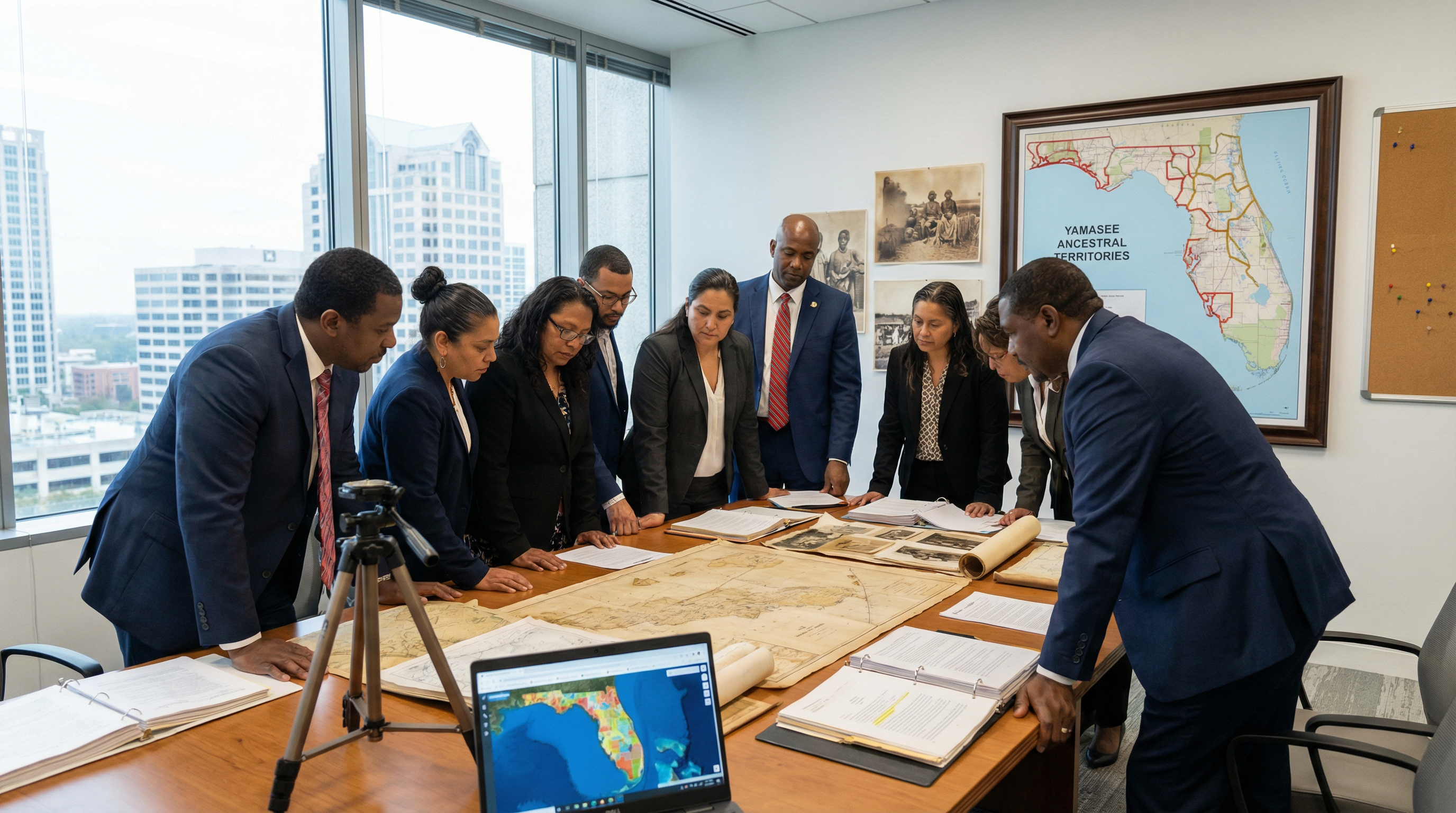
Modern Land Reclamation Strategies: A Roadmap to Yamasee Sovereignty
With Spanish land grants, federal patents, and continuous lineage, the Yamasee possess a legal foundation for sovereignty. This roadmap outlines how to reclaim land—now.
Three centuries of survival. Documented Spanish land grants. Federal homestead patents. Continuous genealogical lineage. The Yamasee have the historical and legal foundation for land reclamation. Now comes the hard part: turning that foundation into actual sovereignty.
This isn't theoretical. Other Indigenous nations have successfully reclaimed land and achieved federal recognition using strategies that the Yamasee can adapt. Here's the roadmap.
Strategy 1: Federal Recognition Through the Office of Federal Acknowledgment (OFA)
What it is: The Bureau of Indian Affairs (BIA) Office of Federal Acknowledgment evaluates petitions from groups seeking recognition as Indian tribes. Federal recognition grants access to tribal sovereignty, federal funding, and legal standing to pursue land claims.
Requirements:
• Proof of continuous community since historical times
• Evidence of political authority and governance
• Genealogical documentation linking current members to historical tribe
• Proof that the group has been identified as "Indian" by external sources
Yamasee advantages:
• Spanish colonial records document Yamasee presence in Florida (1715-1821)
• Federal homestead patents prove continuous occupation (1893-present)
• Genealogical records link modern families to Spanish-era Yamasee landholders
• Academic scholarship identifies Yamasee descendants in Florida and Georgia
Timeline: 7-15 years (the Shinnecock Indian Nation waited 32 years; the Pamunkey Indian Tribe was recognized in 2015 after a 30-year process)
Cost: $500,000-$2 million (legal fees, genealogical research, anthropological studies, administrative costs)
Success rate: Only 18 tribes have achieved federal recognition through the OFA process since 1978, but recent reforms have made the process more accessible.
Strategy 2: Quiet Title Actions to Reclaim Spanish Land Grants
What it is: A quiet title action is a lawsuit that establishes legal ownership of property when the title is disputed or unclear. Yamasee families with documented Spanish land grants that were never properly extinguished could file quiet title actions to reclaim those lands.
Legal basis:
• The Adams-Onís Treaty (1819) required the U.S. to honor valid Spanish land grants
• Many Spanish grants were invalidated through fraudulent or procedural means, not because they were legally invalid
• Quiet title actions can "quiet" competing claims and establish clear ownership
Yamasee advantages:
• Spanish notarial records document land grants to Yamasee families
• Federal homestead patents prove continuous occupation of the same land
• Modern descendants can trace genealogical links to original Spanish grantees
Timeline: 2-5 years per case
Cost: $50,000-$200,000 per lawsuit (depending on complexity and opposition)
Precedent: The Mashpee Wampanoag Tribe successfully used quiet title actions to reclaim ancestral land in Massachusetts.
Strategy 3: Indigenous Land Trusts
What it is: An Indigenous land trust is a nonprofit organization that acquires and holds land for the benefit of Indigenous communities. Unlike individual ownership, land trusts ensure that land remains in Indigenous hands across generations.
How it works:
Establish a nonprofit land trust governed by Yamasee community members
Fundraise to purchase land in ancestral Yamasee territory (North Florida)
Hold land in perpetual trust, with usage rights granted to Yamasee families
Use land for cultural preservation, economic development, and housing
Yamasee advantages:
• Doesn't require federal recognition or lengthy legal battles
• Can begin immediately with community organizing and fundraising
• Creates tangible benefits (housing, agriculture, cultural sites) while building toward sovereignty
Timeline: 1-3 years to establish; ongoing land acquisition
Cost: $10,000-$50,000 to establish trust; $2,000-$10,000 per acre for land acquisition (Florida land prices vary widely)
Precedent: The Sogorea Te' Land Trust (Ohlone people, California) has reclaimed over 2 acres and manages multiple cultural sites.
Strategy 4: State Recognition as a Pathway to Federal Recognition
What it is: Some states offer state-level tribal recognition, which doesn't grant the same rights as federal recognition but can serve as a stepping stone. State recognition can provide:
• Legal standing to pursue land claims in state courts
• Access to state-level grants and programs
• Political legitimacy that strengthens federal recognition petitions
Florida context:
• Florida does not currently have a formal state recognition process for tribes
• However, the Florida Governor's Council on Indian Affairs works with Indigenous communities
• State recognition could be pursued through legislative action
Yamasee advantages:
• Strong historical documentation of Yamasee presence in Florida
• Growing public awareness of Indigenous land rights
• Potential political support from Florida legislators representing North Florida
Timeline: 2-5 years (depends on political climate and legislative priorities)
Cost: $100,000-$500,000 (lobbying, legal fees, public relations)
Strategy 5: Coalition Building with Other Southeastern Tribes
What it is: The Yamasee aren't the only Indigenous people fighting for recognition and land rights in the Southeast. Building coalitions with other tribes (recognized and unrecognized) can amplify political power and share resources.
Potential allies:
• Seminole Tribe of Florida (federally recognized, economically powerful)
• Miccosukee Tribe of Indians of Florida (federally recognized)
• Muscogee (Creek) Nation (Oklahoma-based but with historical ties to Florida)
• Other unrecognized Southeastern tribes (Lumbee, Cheroenhaka, etc.)
Benefits:
• Shared legal and research costs
• Stronger political advocacy
• Cultural and historical solidarity
Timeline: Ongoing relationship-building
Cost: Minimal (primarily time and travel for coalition meetings)
The Integrated Approach: Combining Strategies
The most effective path to Yamasee sovereignty isn't choosing one strategy—it's pursuing multiple strategies simultaneously:
Short-term (1-3 years): Establish an Indigenous land trust and begin acquiring land in North Florida. This creates immediate, tangible benefits for the community.
Medium-term (3-7 years): File quiet title actions for specific Spanish land grants with strong documentation. Even one successful case establishes legal precedent.
Long-term (7-15 years): Pursue federal recognition through the OFA process, using land trust holdings and quiet title victories as evidence of continuous community and political authority.
Throughout: Build coalitions with other Southeastern tribes and pursue state-level recognition to strengthen the federal petition.
What This Requires
Land reclamation isn't free. It requires:
• Legal expertise: Attorneys specializing in Indian law, property law, and federal recognition
• Genealogical research: Professional genealogists to document family lineages
• Historical research: Archival research in Spanish, British, and American records
• Community organizing: Building consensus and governance structures
• Fundraising: Grants, donations, and economic development to fund the effort
But most importantly, it requires collective will. The Yamasee survived three centuries of colonialism through strategic adaptation and fierce determination. Land reclamation is the next chapter in that story.
Conclusion: Restoration Without Permission
The Yamasee don't need permission to reclaim their land—they need resources, strategy, and unity. Every Spanish land grant, every federal homestead patent, every genealogical link is a legal weapon in the fight for sovereignty.
The question isn't whether Yamasee people have a claim to Florida land. The question is whether this generation will be the one to finally make that claim real.
This is Part 4 of a 4-part series on Yamasee land rights in Florida. For more information on Yamasee history, genealogy, and land reclamation efforts, visit the Ministry of Yamasee Affairs.