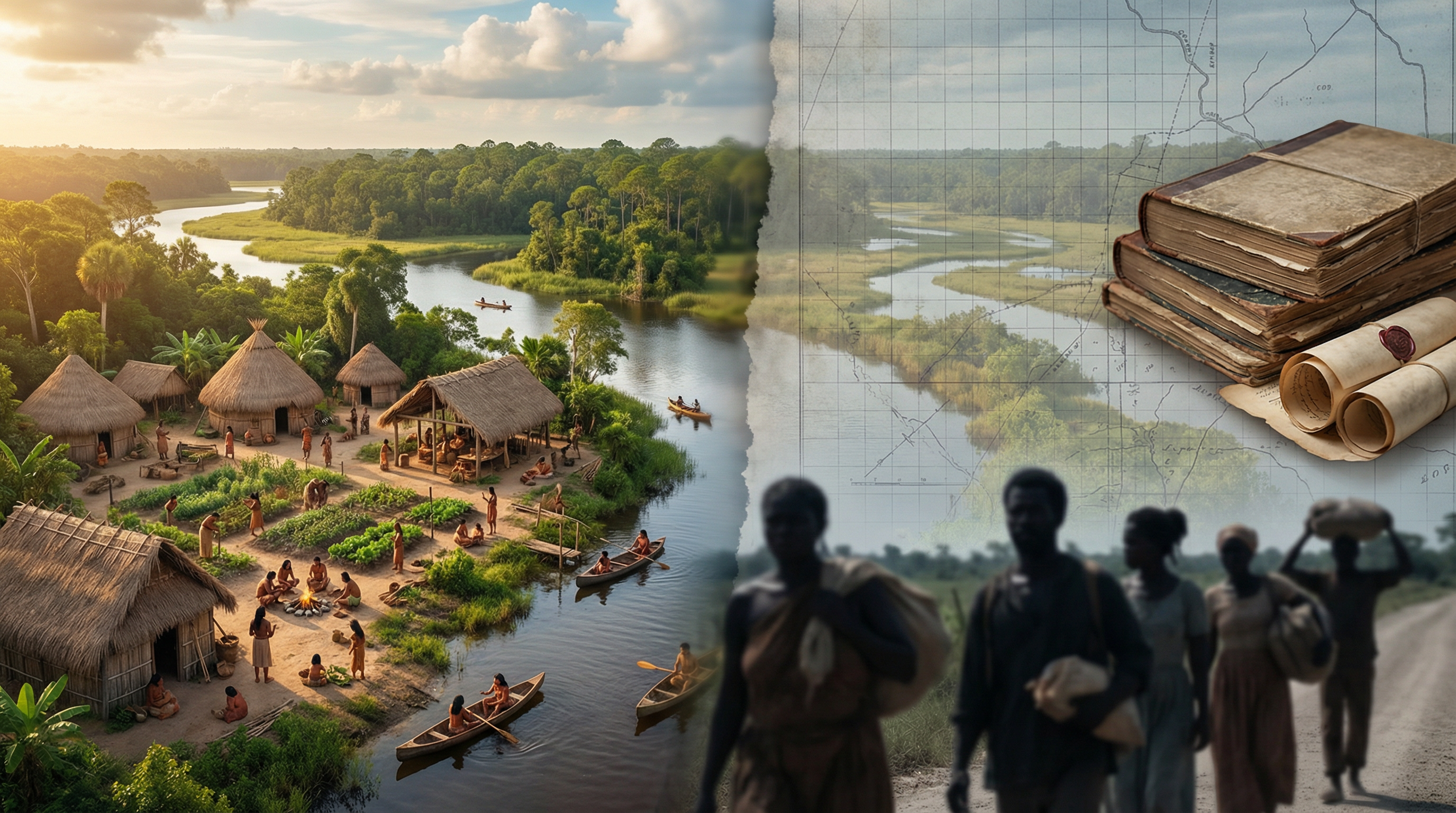
From Homeland to Paper Titles: How the Yamasee Were Economically Displaced
A documented examination of debt, slavery, and the legal mechanisms that transformed sovereign peoples into economic targets. This article traces how trade relationships became debt traps, alliances became dependencies, and economic systems became instruments of removal for the Yamasee people between 1684 and 1717.
The Architecture of Dispossession: How Economic Systems Displaced the Yamasee
A documented examination of debt, slavery, and the legal mechanisms that transformed sovereign peoples into economic targets
Introduction
There is a pattern in how power removes people from land. It does not announce itself as conquest. It arrives as commerce. It presents itself as law. It calls itself progress.
The Yamasee people of the colonial Southeast understood this pattern intimately. Between 1684 and 1717, they watched as trade relationships became debt traps, as alliances became dependencies, and as economic systems became instruments of removal. The tools of their displacement were not primarily military—they were financial, legal, and procedural.
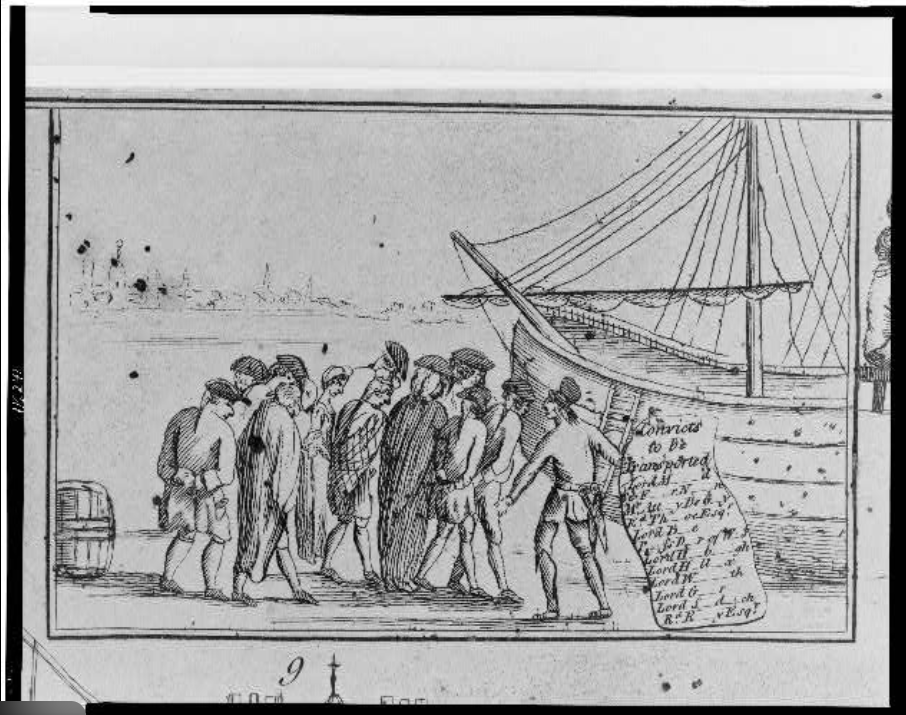 Historical engraving depicting the forced transportation of enslaved people in the colonial era
This examination traces that architecture of dispossession through four interconnected systems: the Indian slave trade that commodified human beings, the debt mechanisms that entrapped communities, the governance structures that resisted these forces, and the legal frameworks that institutionalized extraction. These are not separate stories. They are chapters in a single process—one that continues to echo in how economic power displaces communities today.
The Slave Trade: Commerce as Warfare
The System
When English settlers arrived in the Carolina Lowcountry in the late seventeenth century, they brought with them a model of plantation agriculture dependent on enslaved labor. But they also developed a parallel system: the trade in enslaved Indigenous people. This was not incidental to colonial economics—it was foundational.
Carolina settlers traded guns and manufactured goods to Indigenous groups for deerskins and enslaved captives. The mechanism was deliberate: create dependency on European goods, establish credit relationships, then demand payment in the form of enslaved people when debts could not be satisfied. Barbadian planters, who had experience with Caribbean plantation systems, were especially involved in developing this trade.
The numbers tell the story. By the 1720s, the Carolina census recorded 1,500 enslaved American Indians out of an estimated total colonial population of 17,000. This figure represents only those who remained in Carolina. Many more were shipped to West Indian plantations, where their knowledge of the Lowcountry landscape—which might have enabled escape in Carolina—became irrelevant.
The Yamasee Position
The Yamasee occupied a complex position within this system. As expert hunters and capable traders, they provided deerskins that were integral to Charles Towne's early economy. Their population of approximately 2,000 by 1684 outnumbered the combined English and Scottish colonial settlements. This demographic reality gave them leverage—but it also made them targets.
Colonial traders sought to draw the Yamasee into the slave trade as suppliers, using the same debt mechanisms employed against other Indigenous groups. The Yamasee were offered firearms and manufactured goods on credit, with the expectation that debts would be paid through enslaved captives taken from other tribes or through deerskins. When debts mounted, traders escalated their demands and their abuses.
The Human Cost
The violence of this system was not abstract. Chief Altamaha of Altamaha Towne brought specific grievances to Charles Towne officials: a trader named Alexander Nichols "beat a Woman that he kept as his wife so that she Dyed and the child within her." The same trader beat the wife of another chief and assaulted Altamaha's own sister. These were not isolated incidents—they were the logical outcomes of a system that treated Indigenous people as economic resources rather than sovereign peoples.
English traders also kidnapped Yamasee kin, stole their livestock and weapons, and attempted to control their internal affairs. The trade relationship had become a mechanism of domination.
Debt as Dispossession
The Mechanics
The debt system operated through what appeared to be ordinary commerce. Traders extended credit for guns, ammunition, cloth, and metal goods. Indigenous communities, increasingly dependent on these items for hunting, defense, and daily life, accepted the terms. But the terms were designed to be unsatisfiable.
Traders imposed "maliciously conceived quotas" that left Yamasee communities deeply indebted. Prices were manipulated. Debts were inflated. When communities could not pay, traders demanded land, enslaved people, or military service. The cycle was self-perpetuating: dependency created debt, debt created vulnerability, and vulnerability created further dependency.
This was not a failure of the market—it was the market functioning as designed. The goal was not mutually beneficial exchange but systematic extraction.
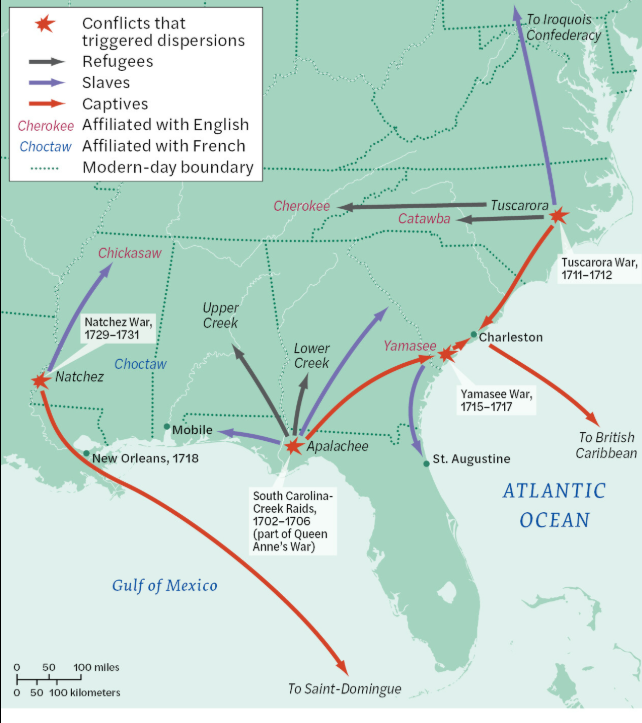 Migration map showing conflicts, dispersions, and displacement patterns during the Yamasee War (1715-1717)
The Threat
Chief Altamaha understood the stakes. When he brought his people's grievances to Charles Towne, he did not plead—he warned. He knew the Yamasee's value as a defensive buffer and trading partner for the English. He threatened to abandon the Port Royal Sound area unless the abuses were addressed.
The threat was not idle. The Yamasee had migrated before to preserve their sovereignty—from the Oconee River Valley to Spanish Florida, then to the Ashepoo and Combahee Rivers, and finally to Port Royal Sound. They had demonstrated their willingness to move rather than submit. But by the 1710s, the options for movement were narrowing. European settlement was expanding. The geopolitical space for Indigenous sovereignty was collapsing.
Governance and Resistance: Altamaha Towne
The Center
Altamaha Towne was not merely a settlement—it was a seat of government and a spiritual center. Established between 1695 and 1707 on a defensible location where Chechesee Creek and the Colleton River converge, it stretched across 125 acres and housed 40 structures with a population of 120 to 135 people.
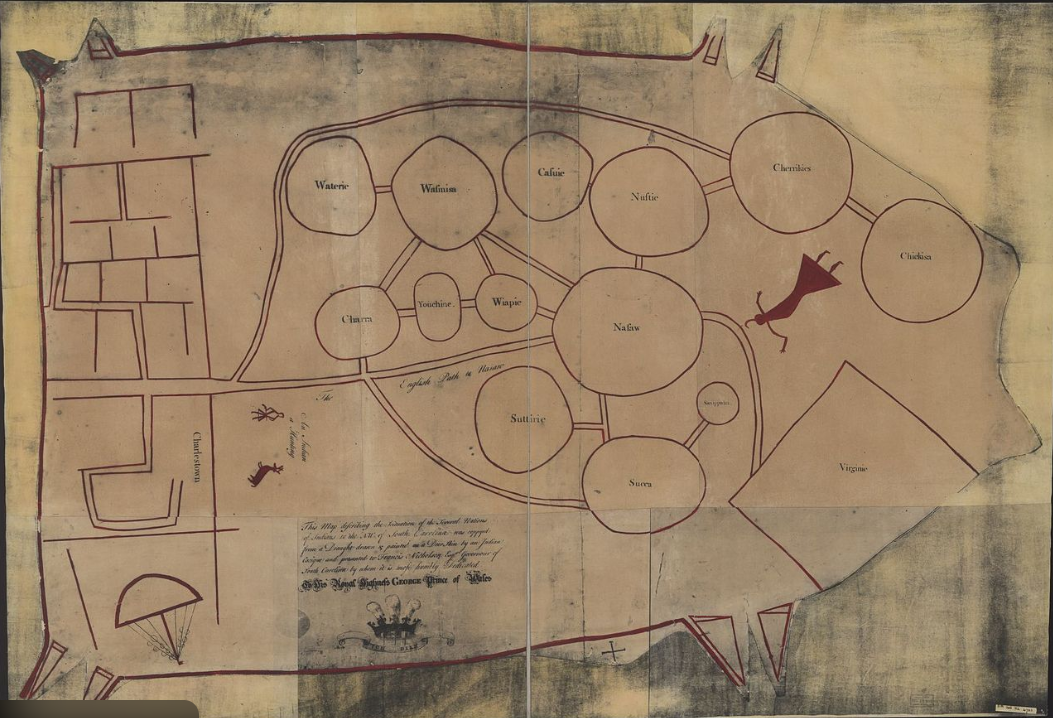 Historical map depicting the organized structure of an indigenous settlement with circular town planning and labeled areas
The town was named after Chief Altamaha, who had led the Yamasee during their years in Florida. It served as the head town of the Lower Yamasee and contained a main council house where leaders hosted visitors and made critical decisions. This was not a village—it was a capital.
The Culture
Altamaha Towne represented something the English found threatening: Indigenous governance that refused assimilation. The Lower Yamasee towns, including Altamaha, were among the most resistant to European cultural influence. They maintained their spiritual practices, their governance structures, and their social organization. They had such a strong aversion to Christianity that English colonists called them "heathens" and "infidels."
This cultural resistance was political resistance. To maintain traditional governance was to assert sovereignty. To refuse Christianity was to refuse the ideological framework that justified colonial domination. The council house at Altamaha Towne was a physical manifestation of that refusal—a space where Yamasee culture could thrive removed from English, Spanish, and other non-native influences.
The Function
The town's governance structure provided space for collective decision-making in an increasingly hostile environment. It allowed the Yamasee to coordinate responses to colonial encroachment, to maintain diplomatic relationships with other Indigenous groups, and to preserve the knowledge systems that sustained their society.
The circular town plan visible in historical maps reflects this organizational sophistication. Towns were not haphazard collections of dwellings but carefully structured communities with designated spaces for governance, ceremony, and daily life. This was land management, resource allocation, and social organization operating at a level that contradicted colonial narratives of Indigenous peoples as lacking civilization.
The Yamasee War: When Resistance Becomes Necessary
The Breaking Point
By 1715, the accumulated grievances had reached a critical mass. Land encroachment, trader abuses, unpayable debts, kidnapping, theft, assault, and the constant threat of enslavement had pushed the Yamasee beyond negotiation. Altamaha's warnings had been ignored. The English had no intention of reforming a system that was profitable.
On Good Friday, April 15, 1715, a confederation of Yamasee and allied Indigenous groups launched coordinated attacks on English settlements and plantations throughout the Carolina Lowcountry. The violence was not random—it was strategic. Traders were targeted first, then settlements that had encroached on Indigenous land.
The Conflict
The Yamasee War (1715-1717) was one of the strongest challenges to European dominance in North America by Indigenous peoples during the colonial period. It nearly destroyed the Carolina colony. English settlers, outnumbered and unprepared, faced the real possibility of complete expulsion from the region.
The war demonstrated what the Yamasee had been trying to communicate through diplomatic channels: they possessed the military capacity to defend their sovereignty. The problem was not capability—it was the arithmetic of colonial expansion. Even a successful military campaign could not reverse the demographic and geopolitical realities that were closing in around them.
The Aftermath
The English eventually established a fragile peace by forming an alliance with the Cherokee in 1716, fracturing the Indigenous coalition. Many Yamasee left the area, moving south to Spanish Florida or deeper into the interior. Altamaha Towne was abandoned. The council house fell silent. The governance structures that had sustained Yamasee sovereignty were displaced.
In the years following the war, Carolina settlers attempted to maintain peace by limiting American Indian slavery—not out of moral conviction, but out of strategic necessity. They shifted their focus to increasing their enslaved African labor force through the port of Charles Town. By the late eighteenth century, as the numbers of African arrivals outnumbered enslaved American Indians, the census stopped differentiating between them. "Negro" increasingly became synonymous with "slave" in the Lowcountry.
The Yamasee had been removed from the economic and demographic calculus. Their displacement was complete—not through military conquest alone, but through the systematic operation of economic and legal mechanisms that made their continued presence incompatible with colonial profit.
The Legal Architecture: From Indian Slavery to the 16th Amendment
The Pattern
The displacement of the Yamasee was not an isolated event. It was an early manifestation of a pattern that would repeat throughout American history: the use of legal and economic frameworks to transfer wealth, land, and power from targeted populations to dominant institutions.
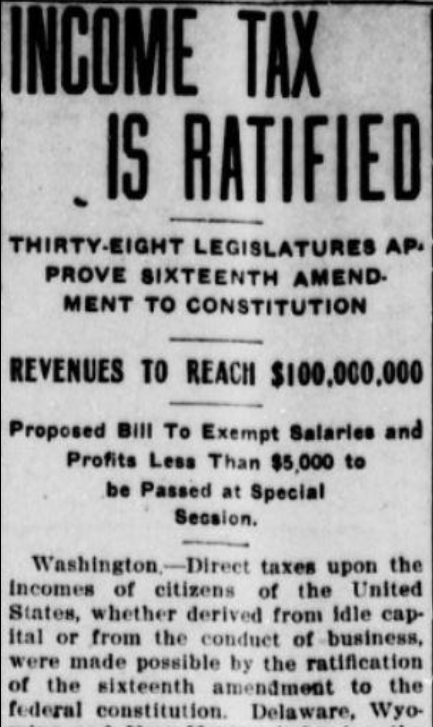 1913 newspaper headline: "Income Tax Is Ratified" - Thirty-eight legislatures approve sixteenth amendment to Constitution
The 16th Amendment to the United States Constitution, ratified in 1913, provides a later example of this pattern. The amendment removed the constitutional requirement that direct taxes be apportioned among states by population, enabling Congress to impose income taxes on individuals without restriction.
The Shift
The original Constitution was designed to restrain federal power, not to maximize it. Direct taxation of individuals was intentionally made difficult through the apportionment requirement. Federal revenue was expected to come primarily from tariffs, duties, and excises tied to commerce—not from the labor of ordinary people.
This design reflected a specific understanding of liberty: freedom was defined by what government was forbidden to do, not by what citizens were permitted to access. The Bill of Rights did not promise benefits—it imposed prohibitions. "Congress shall make no law..." "The right shall not be infringed..." "No person shall be deprived..."
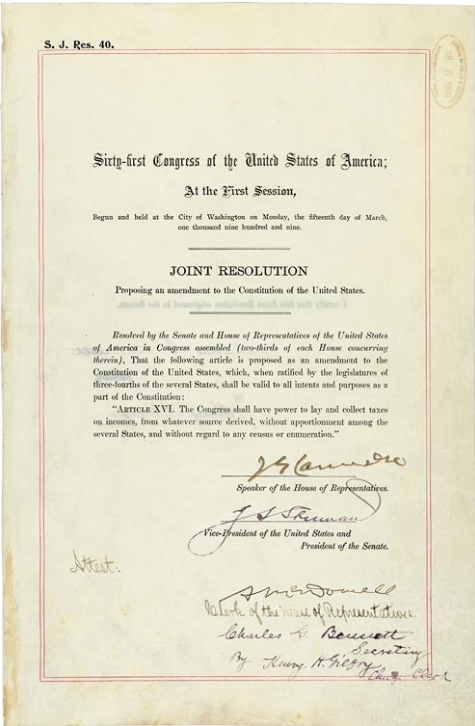 Joint Resolution of the Sixty-first Congress proposing the 16th Amendment to the Constitution
The 16th Amendment fundamentally altered this relationship. It removed a structural restraint that had protected individuals from permanent federal claims on their labor. The first federal income tax in 1861, imposed during the Civil War emergency, had applied only to those earning over $800 annually—a threshold that represented the top 5-8% of society, equivalent to $180,000-$300,000 in modern terms. It was a tax on elites, not workers, and it collapsed once the emergency passed.
The 16th Amendment made such taxation permanent and universal. It redefined the relationship between citizen and state, shifting the Constitution from a document that restrained power to one that managed participation.
The Connection
What connects the displacement of the Yamasee to the ratification of the 16th Amendment? Both represent moments when economic systems were restructured to serve institutional power at the expense of individual and community sovereignty.
The debt mechanisms that entrapped the Yamasee operated on the same principle as modern taxation: the establishment of permanent claims on the productive capacity of people. The difference is one of scale and formalization. What was once accomplished through individual traders and colonial policy is now accomplished through federal law and institutional bureaucracy.
The Yamasee resisted by moving, by negotiating, and ultimately by fighting. But the architecture of dispossession adapted. It became more systematic, more legal, and more difficult to resist through physical means alone.
Conclusion: The Continuity of Extraction
The historical documents examined here—the engravings of enslaved people being transported, the migration maps showing Yamasee displacement, the town plans revealing sophisticated governance, the newspaper headlines announcing the 16th Amendment—are not disconnected artifacts. They are evidence of a continuous process.
That process operates through economic systems that create dependency, legal frameworks that institutionalize extraction, and cultural narratives that justify both. It targets communities that possess resources, land, or labor that can be converted into profit. It presents itself as progress, as law, as the natural order of things.
The Yamasee understood this. Chief Altamaha understood this when he brought his grievances to Charles Towne. The families who were enslaved understood this. The communities who abandoned Altamaha Towne understood this.
The Ministry of Yamasee Affairs exists because that understanding has been preserved. The documentation of Yamasee continuity in Florida, the genealogical records, the land patents, the oral histories—these are not merely historical curiosities. They are evidence that the architecture of dispossession did not succeed completely. Communities survived. Knowledge was transmitted. Sovereignty was maintained, even when it could not be exercised.
This is not a story about the past. It is a story about systems that continue to operate, about legal frameworks that continue to extract, about economic mechanisms that continue to displace. The forms change. The underlying pattern remains.
Understanding that pattern is the first step toward interrupting it.
This article is part of the Ministry of Yamasee Affairs' ongoing documentation of Yamasee history, continuity, and sovereignty. For more information about Yamasee heritage, genealogical research, and enrollment, visit www.ministryofyamaseeaffairs.org.