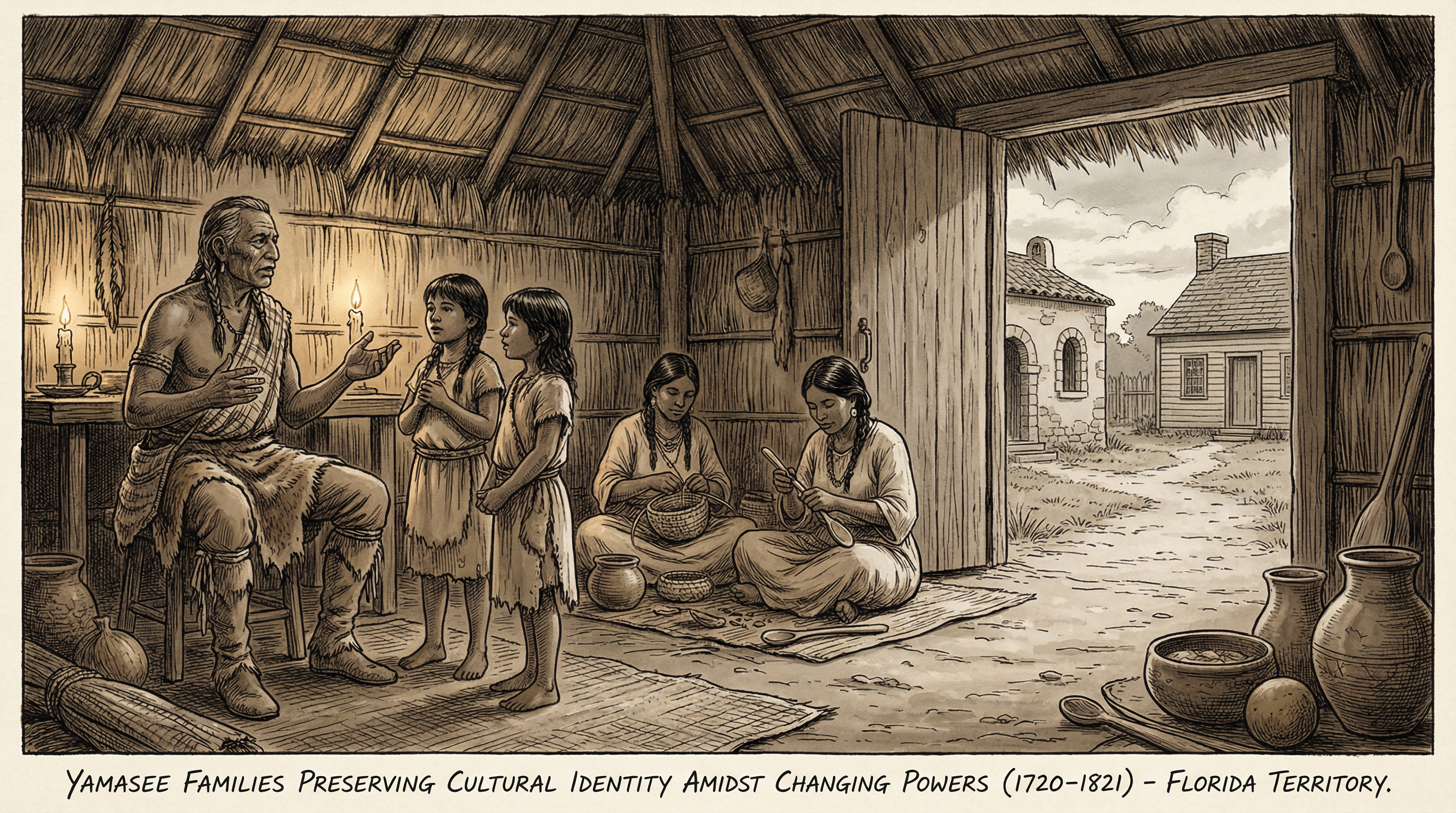
Survival Under Spanish and British Rule: How Yamasee Families Preserved Identity (1720–1821)
Between 1720 and 1821, Yamasee families survived Spanish and British rule through land grants, Catholic records, and strategic invisibility—preserving identity and legal claims to Florida land.
Between 1720 and 1821, Yamasee families in Florida survived two colonial powers, a brief British occupation, and the transition to American rule. They did it through strategic adaptation, Catholic conversion, and meticulous documentation of their land claims—creating the paper trail that makes modern sovereignty possible.
The Spanish Land Grant System
Under Spanish colonial law, Indigenous peoples who converted to Catholicism and swore allegiance to the Spanish Crown could receive land grants (mercedes de tierra). These weren't symbolic gestures—they were legally binding property deeds recognized by Spanish courts.
Yamasee families took full advantage of this system. Between 1738 and 1763, dozens of Yamasee heads of household received Spanish land grants in North Florida, particularly in:
• St. Johns County (around St. Augustine)
• Duval County (Jacksonville area)
• Nassau County (Fernandina Beach region)
• Columbia County (Lake City area)
These grants weren't small plots. Spanish mercedes typically ranged from 40 to 160 acres per family, with larger grants for military officers and community leaders.
The British Interregnum (1763-1783)
In 1763, Spain ceded Florida to Britain in exchange for Havana. Many Yamasee families faced a choice: flee to Cuba with the Spanish or stay and navigate British rule.
Those who stayed adopted a survival strategy that would define Yamasee resilience for the next century: they became legally invisible. British colonial records from 1763-1783 rarely mention "Yamasee" by name. Instead, Yamasee families appear as:
• "Free people of color"
• "Spanish subjects"
• "Catholic landholders"
• "Mulatto farmers"
This wasn't cultural erasure—it was strategic camouflage. By avoiding the "Indian" designation, Yamasee families escaped British policies designed to dispossess Indigenous peoples. They maintained their land, their kinship networks, and their oral traditions while appearing in colonial records as Spanish-descended Catholics.
The Return of Spanish Rule (1783-1821)
When Spain regained Florida in 1783, Yamasee families who had maintained continuous occupation during the British period reasserted their Spanish land grants. Spanish officials, recognizing their loyalty during the British occupation, reconfirmed many of these grants.
This is where the Day, Hayes, Baugh, and Barber families emerge most clearly in the documentary record. Spanish parish registers from St. Augustine, Fernandina, and Picolata show:
• Catholic baptisms of Yamasee children with Spanish godparents
• Marriages between Yamasee families and Spanish-African families
• Land transactions recorded in Spanish notarial records
• Military service records for Yamasee men in Spanish militia units
Why This Period Matters for Land Reclamation
The Spanish colonial period (1720-1821) created the legal foundation for modern Yamasee land claims because:
Continuous Occupation: Yamasee families remained on the same land through three regime changes (Spanish → British → Spanish → American)
Documentary Evidence: Spanish land grants, baptismal records, and notarial documents prove Yamasee presence and land ownership
Legal Precedent: Under the Adams-Onís Treaty of 1819, the United States agreed to honor all valid Spanish land grants in Florida
Genealogical Links: Modern Yamasee descendants can trace their lineage directly to Spanish-era landholders through Catholic parish records
The Transition to American Rule
When the United States acquired Florida in 1821, Spanish land grants became a legal minefield. American land speculators challenged thousands of Spanish grants, forcing Indigenous and Spanish-descended families into lengthy court battles.
Many Yamasee families lost their Spanish grants during this period—not because their claims were invalid, but because they lacked the resources to fight American lawyers in federal court.
But some families held on. And their descendants are still here.
Next in this series: How Mary Day used the Homestead Act of 1862 to reclaim her family's ancestral land in Columbia County, Florida—and why her 1893 land patent is the key to modern Yamasee sovereignty.
This is Part 2 of a 4-part series on Yamasee land rights in Florida. Part 3 reveals the documented proof of Yamasee land reclamation through federal homestead patents.