The Homestead Act Reclamation: Mary Day’s 1893 Land Patent and Yamasee Sovereignty
In 1893, Mary Day reclaimed ancestral Yamasee land through the Homestead Act. Her federal patent proves continuous occupation, legal recognition, and a living foundation for sovereignty.
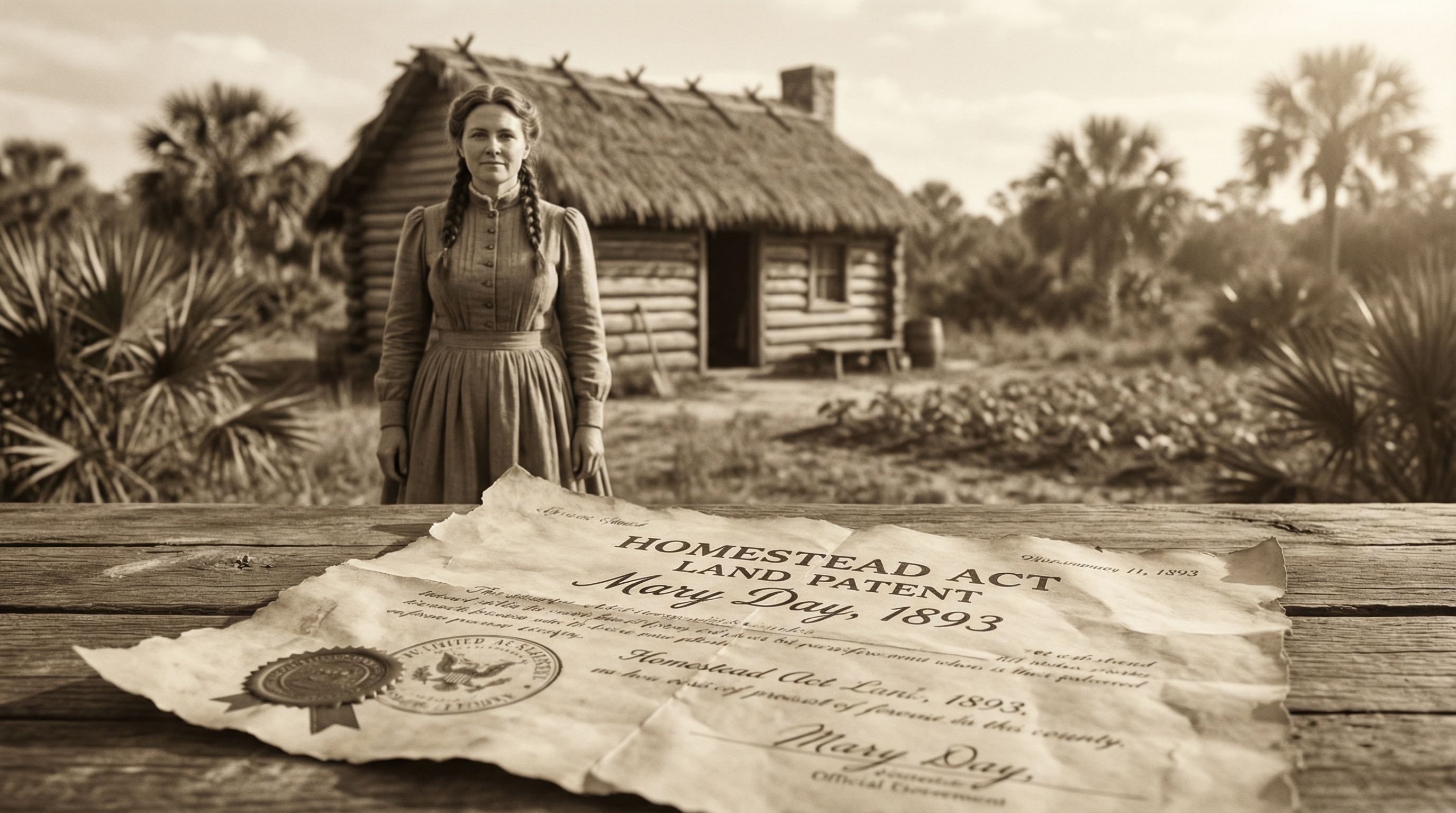
On March 14, 1893, Mary Day walked out of the Gainesville Land Office with Federal Land Patent #9000 for 80 acres in Columbia County, Florida. The Bureau of Land Management recorded her claim as “homesteading virgin land.”
But Mary Day was not settling new territory.
She was reclaiming her family’s ancestral land—taken 72 years earlier when Florida became American territory.
The Homestead Act: A Tool for Indigenous Reclamation
The Homestead Act of 1862 is often remembered solely as a mechanism for Indigenous dispossession, granting Native land to white settlers. For many, that history is accurate.
But for some Indigenous families—including the Yamasee—the Homestead Act became an unexpected legal instrument of reclamation.
Under the Act:
Any U.S. citizen (or person declaring intent to become one) could claim up to 160 acres of “unappropriated public land”
After five years of continuous residence and cultivation, the claimant received a federal land patent
A federal patent is the highest form of land title in American law, superior even to state deeds
For Yamasee families whose Spanish land grants were stripped during the American takeover of Florida (1821–1845), the Homestead Act offered one narrow path back—if they never left the land.
Mary Day met that standard.
The Day Family Land Claim
Mary Day’s 1893 homestead was not accidental or opportunistic. The 80 acres she claimed—Township 5 South, Range 17 East, Section 23, Columbia County—had been occupied by the Day family since at least the late 18th century under Spanish rule.
Spanish colonial records confirm this lineage:
1784 – Baptism of Juan Día (John Day) in Picolata, Florida
1792 – Marriage of María Día (Mary Day Sr.) to José Barber in St. Augustine
1803 – Land transaction recorded for “Juan Día, farmer” in Columbia County
When Florida became a U.S. territory in 1821, the Day family’s Spanish land grant was challenged by American speculators. Lacking the capital to litigate in federal court, the family lost formal title.
They did not abandon the land.
For 72 uninterrupted years (1821–1893), the Day family maintained continuous occupation—farming, raising children, and preserving kinship ties—waiting for a lawful means to reclaim ownership.
The Homestead Act provided that opening.
Why Mary Day’s Patent Matters Today
Mary Day’s 1893 federal land patent is not a historical footnote. It is legal proof with modern implications.
- Continuous Occupation (1780s–1893)
To qualify for a homestead patent, Mary Day had to prove five years of continuous residence. In reality, her family had occupied the land for over a century.
This satisfies the doctrine of aboriginal title—the principle that Indigenous land rights derive from long-term occupation, not colonial paperwork.
- Federal Recognition of Indigenous Land Claims
By issuing a federal land patent to Mary Day, the U.S. government implicitly acknowledged her family’s prior claim. The patent did not create a new right—it restored one that had been unlawfully stripped in 1821.
- Genealogical Continuity
Mary Day’s descendants are alive today. Through parish records, land patents, and census data, modern Yamasee families can trace a direct lineage from present-day descendants to the Spanish-era Día family.
This creates a three-century chain of title.
- Precedent for Additional Claims
If Mary Day successfully reclaimed land through the Homestead Act, others likely did as well. Systematic review of federal patents issued between 1862 and 1934 to Yamasee surnames could reveal dozens of similar reclamation cases.