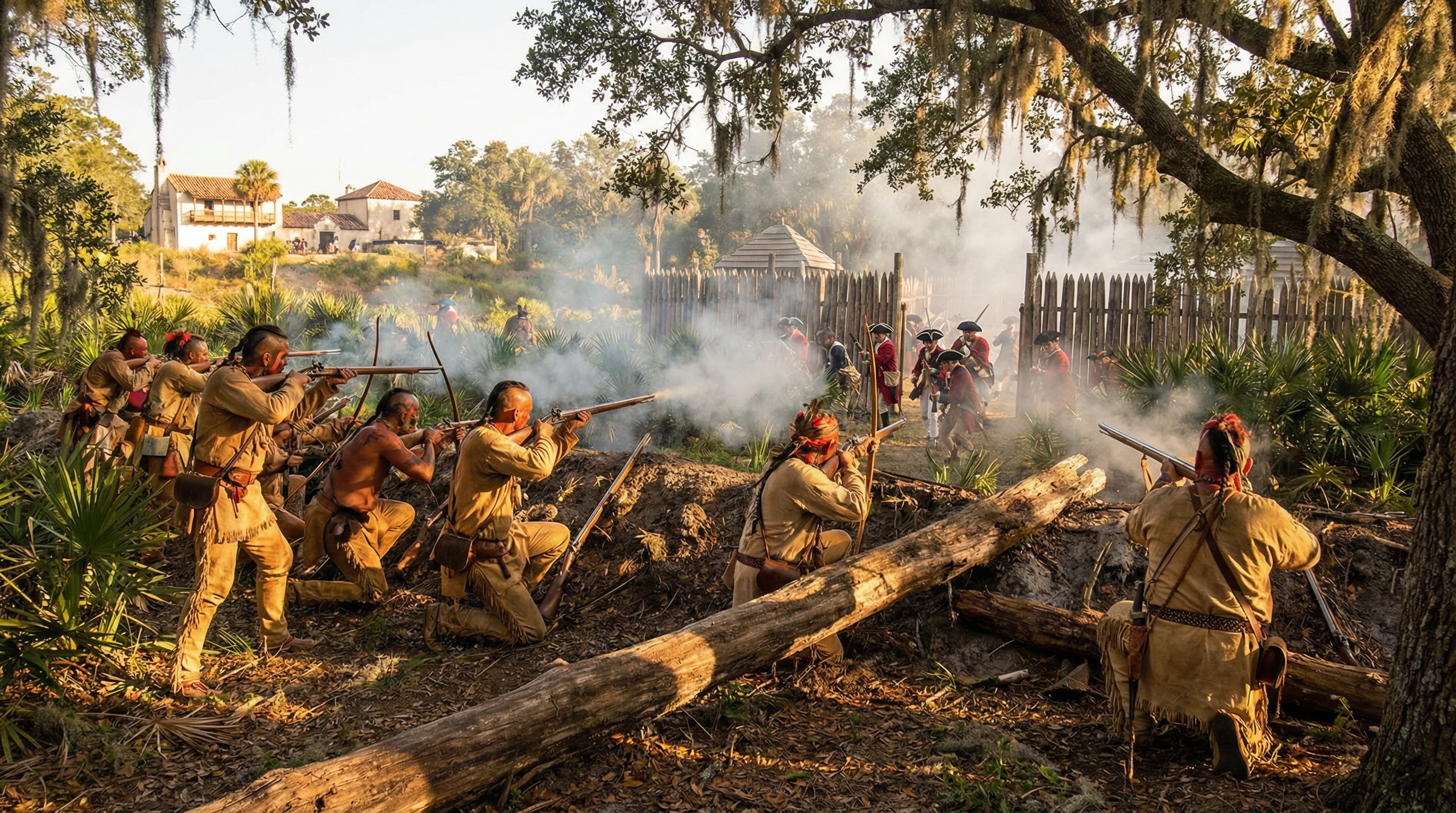
The Yamasee War (1715-1717): Florida's First Freedom Fight
The Yamasee War of 1715-1717 stands as one of the most significant yet misunderstood conflicts in early American history. Discover the sophisticated resistance movement that nearly ended British colonization in the Southeast.
The Yamasee War (1715-1717): Florida's First Freedom Fight
Author: Ministry of Yamasee Affairs
Published: January 21, 2026
Reading Time: 8 minutes
The Yamasee War of 1715-1717 stands as one of the most significant yet misunderstood conflicts in early American history. While mainstream narratives frame it as a failed Indigenous uprising, the truth reveals a sophisticated resistance movement that nearly ended British colonization in the Southeast and fundamentally reshaped the political landscape of what would become the United States.
The Breaking Point: Colonial Exploitation
By 1715, the Yamasee people faced systematic exploitation that threatened their very existence. British traders in Carolina had developed a predatory economic system built on three pillars: the Indigenous slave trade, manufactured debt, and territorial encroachment. Yamasee communities found themselves trapped in a cycle where colonial traders would extend credit for goods at inflated prices, then demand payment in enslaved captives from rival tribes or in land when debts became unpayable.
This was not simple commerce but calculated economic warfare designed to dispossess Indigenous peoples of their territories and autonomy. The debt trap system forced Yamasee men to participate in slave raids against neighboring communities, destroying traditional alliances and creating cycles of violence that served British colonial interests. When Yamasee leaders attempted to negotiate fair terms or protest abusive practices, colonial authorities responded with threats of military action and demands for additional territorial concessions.
The breaking point came when British traders began seizing Yamasee women and children as payment for manufactured debts. This violation of fundamental cultural values and family integrity made continued coexistence impossible. Yamasee leaders recognized that accommodation had failed and that survival required decisive action.
Strategic Alliances: Unity Across Nations
What made the Yamasee War remarkable was not just Yamasee courage but the sophisticated diplomatic effort that preceded military action. Yamasee leaders spent months building a coalition that included Creek, Catawba, Cherokee, and other Southeastern nations. This alliance represented one of the most successful pan-Indigenous diplomatic efforts in colonial American history, bringing together peoples with different languages, cultures, and historical relationships.
The coordination required to launch simultaneous attacks across hundreds of miles of territory demonstrated extraordinary organizational capability and political sophistication. On Good Friday 1715, Yamasee warriors struck British settlements throughout Carolina in coordinated assaults that caught colonial authorities completely unprepared. The timing was deliberate—Good Friday represented a moment when British colonists would be focused on religious observance rather than military readiness.
The Deadliest Conflict in Colonial History
The Yamasee War inflicted casualties that exceeded even King Philip's War in New England, making it proportionally the deadliest conflict in colonial American history. Hundreds of British colonists died in the initial attacks, and thousands more fled to Charleston, abandoning plantations and settlements across the Carolina backcountry. The British colony teetered on the edge of complete collapse, with colonial authorities seriously considering evacuation.
British military responses proved largely ineffective against Yamasee tactics that combined traditional Indigenous warfare with strategic understanding of colonial vulnerabilities. Yamasee warriors targeted supply lines, isolated settlements, and economic infrastructure rather than engaging in conventional battles that would favor British numerical and technological advantages. This guerrilla strategy maximized Indigenous strengths while minimizing exposure to British firepower.
Strategic Withdrawal, Not Defeat
Mainstream historical narratives describe the Yamasee War as ending in Indigenous defeat, but this interpretation misunderstands both Yamasee objectives and outcomes. The Yamasee goal was not to permanently destroy British colonization but to make continued exploitation untenable and to secure safe territory beyond British control. When continued resistance in Carolina became unsustainable due to British reinforcements and the collapse of some alliance relationships, Yamasee communities executed a strategic withdrawal to Spanish Florida.
This migration to Florida was not desperate flight but calculated relocation to territory where Spanish colonial policy offered greater autonomy and protection. Spanish authorities in St. Augustine welcomed Yamasee refugees as valuable military allies and buffer populations against British expansion. The establishment of Fort Mose in 1738 as the first free Black settlement in North America emerged directly from relationships established during this period, demonstrating the long-term strategic success of Yamasee resistance.
The Transportation Act Connection
The Yamasee War's impact extended far beyond immediate military outcomes. The conflict so devastated Carolina's labor force and economic infrastructure that British authorities faced a crisis in maintaining colonial viability. The solution came through the Transportation Act of 1717, which systematized the deportation of British convicts to American colonies as indentured laborers.
This legislation represented demographic engineering designed to replace Indigenous populations with controllable European labor. Thousands of British convicts were transported to Carolina and other colonies specifically to fill the labor shortage created by Yamasee resistance and to establish a European population buffer between coastal plantations and Indigenous territories. The "Golden Age of Piracy" ended abruptly in 1717-1718 not through moral awakening but because British authorities needed secure Atlantic shipping lanes for this massive population transfer.
Legacy and Lessons
The Yamasee War demonstrates that Indigenous resistance was neither futile nor irrational but represented sophisticated political and military strategy in response to existential threats. Yamasee leaders understood that accommodation with an exploitative colonial system meant gradual destruction, while resistance offered the possibility of survival on more favorable terms.
The migration to Florida and the establishment of communities under Spanish protection proved remarkably successful. Yamasee descendants maintained cultural identity, political autonomy, and territorial control in Florida for generations, participating in later conflicts like the Seminole Wars as "the Unconquered People." The narrative of defeat obscures the reality of adaptation, survival, and continued resistance that characterized Yamasee history for the next century.
Modern discussions of Indigenous history often focus on victimization and loss, but the Yamasee War reveals a different story—one of strategic intelligence, diplomatic sophistication, military effectiveness, and long-term survival through adaptation. These qualities deserve recognition not as romantic mythology but as historical fact that challenges simplistic narratives of inevitable Indigenous defeat.
Discover the Complete Story
This article draws from Keepers of Florida: The Hidden Yamasee Legacy, a comprehensive 271-page scholarly work documenting 1,300 years of Yamasee history from Moorish Spain to modern Florida. The book includes detailed analysis of the Yamasee War, primary source documentation, and genealogical evidence tracing Yamasee families through ten generations.
About the Ministry of Yamasee Affairs
The Ministry of Yamasee Affairs is dedicated to documenting, preserving, and sharing the true history of Yamasee people in Florida. Through rigorous historical research and genealogical documentation, we work to correct the historical record and support Yamasee descendants in reclaiming their heritage.
Learn more about our mission | Join our community | Support our work