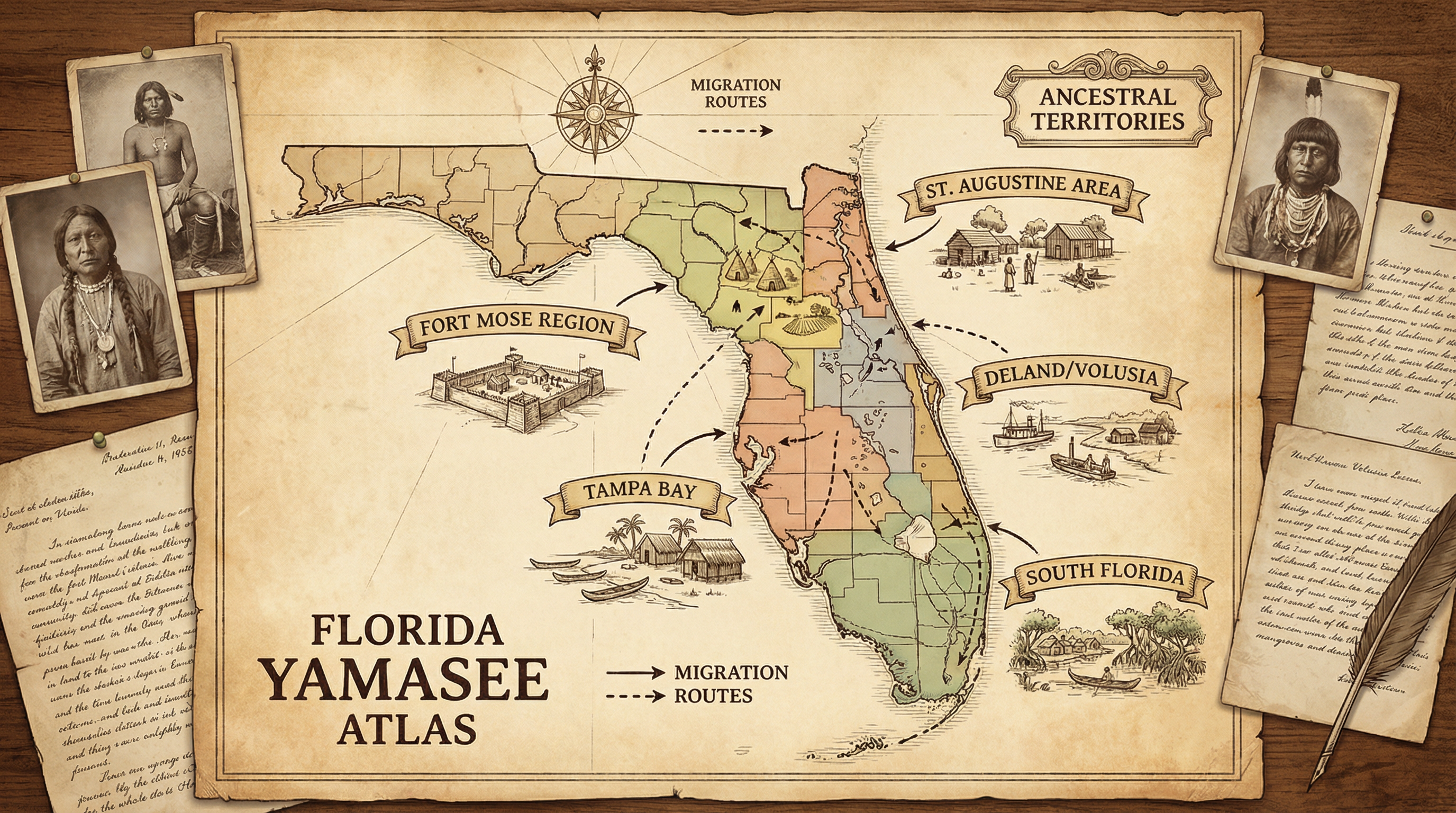
Florida Yamasee Atlas: Discovering Your Ancestors in 6 Anchor Regions
If you have deep roots in Florida, you may be descended from Yamasee people. The Florida Yamasee Atlas identifies six anchor regions and provides city-specific heritage guides to help you discover your connection.
Florida Yamasee Atlas: Discovering Your Ancestors in 6 Anchor Regions
Author: Ministry of Yamasee Affairs
Published: January 21, 2026
Reading Time: 12 minutes
If you have deep roots in Florida—particularly if your family has been here for generations and carries surnames like Day, Hayes, Baugh, Barber, Johnson, Williams, or dozens of others—you may be descended from Yamasee people who made Florida their home long before it became the 27th state. But how do you discover this connection? Where do you start looking? And what evidence might reveal your Yamasee heritage?
The Florida Yamasee Atlas provides a roadmap for this journey of discovery, identifying six anchor regions where Yamasee communities established themselves between 1702 and 1858, and providing city-specific heritage guides for ten major Florida metropolitan areas. This is not speculative history but documented presence based on Spanish colonial records, federal land patents, census data, military records, and genealogical evidence.
Understanding the Six Anchor Regions
Yamasee presence in Florida was not random or scattered but concentrated in specific regions that offered strategic advantages, economic opportunities, and relative safety from American expansion. These six anchor regions represent the geographic foundation of Yamasee Florida:
1. St. Augustine and the Northeast Coast
Timeline: 1702-present
Key Locations: St. Augustine, Fort Mose, Palatka, Green Cove Springs
St. Augustine served as the primary destination for Yamasee refugees fleeing British Carolina after the Yamasee War of 1715-1717. Spanish colonial authorities welcomed Yamasee communities as military allies and buffer populations against British expansion. The establishment of Fort Mose in 1738 as the first free Black settlement in North America emerged directly from these Yamasee-Spanish relationships.
Spanish colonial records from St. Augustine's Cathedral Parish provide extensive documentation of Yamasee families through baptismal records, marriage registers, and burial records. These documents often identify individuals as "Yamasee" or "Indio" even when later American records would reclassify them as "Mulatto" or "Colored."
What to look for in your family history:
- Ancestors living in St. Johns County before 1821 (Spanish period)
- Baptismal records from Cathedral Parish in St. Augustine
- Land grants in the St. Augustine area from Spanish colonial period
- Military service in Spanish colonial militia units
- Family stories about "Spanish" or "Minorcan" heritage (often code for Indigenous ancestry)
2. Pensacola and the Western Panhandle
Timeline: 1718-present
Key Locations: Pensacola, Milton, Crestview, Fort Walton Beach
The Pensacola region served as western Florida's primary Spanish colonial outpost and attracted Yamasee families seeking distance from British colonial pressure. The area's proximity to French Louisiana and later American territory made it a complex borderland where multiple colonial powers competed for Indigenous alliances.
Pensacola's strategic importance as a deep-water port and military installation meant that Spanish authorities particularly valued Indigenous allies with military expertise. Yamasee families in this region often served in Spanish colonial military units and received land grants in recognition of their service.
What to look for in your family history:
- Ancestors in Escambia or Santa Rosa counties before 1821
- Spanish land grants in the Pensacola area
- Military service in Spanish colonial forces
- Connections to Creek or Seminole communities in adjacent Alabama
- Family stories about "Creole" heritage (often indicating mixed Indigenous-European-African ancestry)
3. The Big Bend (Apalachee Territory)
Timeline: 1704-present
Key Locations: Tallahassee, Wakulla, Apalachicola, Quincy
The Big Bend region, historically known as Apalachee territory, experienced devastating population losses during Queen Anne's War (1702-1713) when British-allied forces destroyed the Spanish mission system and enslaved thousands of Apalachee people. Yamasee families moved into this depopulated region during the 18th century, establishing communities that blended Yamasee and surviving Apalachee cultural elements.
This region's rich agricultural land and access to both Gulf Coast resources and inland forests made it attractive for families seeking to maintain traditional subsistence practices. The area's relative isolation from major colonial centers provided some protection from the most intense forms of colonial control.
What to look for in your family history:
- Ancestors in Leon, Wakulla, Jefferson, or Franklin counties in the 19th century
- Land ownership in areas described as former "Indian lands" or mission territories
- Family connections to both coastal and inland communities
- Agricultural practices emphasizing corn, beans, and squash (traditional Indigenous crops)
- Family stories about connections to "old Spanish missions"
4. Alachua Prairie and North-Central Florida
Timeline: 1750-present
Key Locations: Gainesville, Ocala, Newberry, Micanopy, Palatka
The Alachua Prairie region became the heartland of Seminole resistance during the 19th century, but "Seminole" was largely a colonial term for diverse Indigenous peoples—including substantial Yamasee populations—who refused removal to Oklahoma. This region's combination of fertile prairie land, dense forests, and numerous lakes and rivers made it ideal for communities seeking to maintain autonomy from colonial control.
The Seminole Wars (1816-1858) devastated this region, but not all Indigenous families were removed. Some remained by accepting reclassification as "free people of color" or by retreating into remote areas where they maintained low profiles. Census records and land documents reveal the continued presence of families with Indigenous heritage throughout the 19th and 20th centuries.
What to look for in your family history:
- Ancestors in Alachua, Marion, or Putnam counties before 1860
- Family stories about "hiding out" during the Seminole Wars
- Land ownership in areas described as former Seminole territory
- Reclassification from "Indian" to "Mulatto" or "Colored" in census records between 1850-1880
- Connections to families with clearly Seminole surnames (Jumper, Tiger, Osceola, etc.)
5. Tampa Bay and the Central Gulf Coast
Timeline: 1757-present
Key Locations: Tampa, St. Petersburg, Clearwater, Bradenton, Sarasota
The Tampa Bay region served as a refuge for Indigenous families throughout the Spanish and early American periods. The area's complex geography of bays, rivers, and coastal islands provided numerous locations where communities could maintain autonomy while engaging in trade with Spanish, Cuban, and later American merchants.
Tampa's development as a major port in the late 19th century created economic opportunities for families with Indigenous heritage, though it also increased pressure for racial conformity and land alienation. Some families maintained fishing and agricultural livelihoods in less developed areas of the bay while others moved into urban Tampa's emerging economy.
What to look for in your family history:
- Ancestors in Hillsborough, Pinellas, or Manatee counties before 1880
- Fishing or maritime occupations spanning multiple generations
- Land ownership along rivers, bays, or coastal areas
- Connections to Cuban or Spanish merchant families
- Family stories about "Spanish fishermen" or "Cuban" heritage
6. Southeast Florida and the Everglades Frontier
Timeline: 1821-present
Key Locations: Miami, Fort Lauderdale, West Palm Beach, Fort Pierce, Stuart
Southeast Florida remained frontier territory well into the 20th century, providing refuge for Indigenous families seeking to avoid the racial control systems that dominated northern Florida. The region's challenging environment—dense sawgrass marshes, tropical forests, and seasonal flooding—deterred large-scale American settlement until drainage projects and railroad development in the late 19th and early 20th centuries.
Yamasee families in this region often maintained close relationships with Seminole communities who had retreated into the Everglades during the Seminole Wars. The boundary between "Seminole" and other Indigenous identities remained fluid in this frontier environment, with families sometimes shifting between identities based on political circumstances.
What to look for in your family history:
- Ancestors in Dade, Broward, or Palm Beach counties before 1920
- Occupations related to fishing, hunting, or guiding (utilizing traditional environmental knowledge)
- Land ownership in areas later developed but previously considered "wasteland"
- Family stories about living "in the Glades" or "in the hammocks"
- Connections to Seminole families or communities
War-Pressure Timeline: Understanding Migration Patterns
Yamasee presence in Florida was not static but evolved in response to military conflicts, political changes, and economic pressures. Understanding this timeline helps explain why your ancestors might have moved between regions or why family stories describe multiple relocations:
1702-1715: Queen Anne's War and Yamasee War create first major wave of migration from Carolina to Florida
1715-1740: Establishment of Yamasee communities under Spanish protection in St. Augustine, Pensacola, and Apalachee regions
1740-1763: King George's War and Seven Years' War create instability; some families relocate to interior regions for greater security
1763-1783: British control of Florida (1763-1783) forces some families to evacuate to Cuba; others retreat to interior regions and maintain low profiles
1783-1821: Second Spanish period sees return of some families from Cuba and expansion into central Florida regions
1821-1835: American acquisition of Florida increases pressure on Indigenous communities; some families accept reclassification to maintain land ownership
1835-1858: Seminole Wars force massive relocations; families choose between removal to Oklahoma, retreat to Everglades, or acceptance of non-Indigenous racial classifications
1858-1900: Post-war period sees families gradually emerging from hiding, purchasing land, and establishing documented presence under various racial classifications
1900-1950: Jim Crow era forces universal reclassification as "Colored" or "Black"; Indigenous identity goes underground but persists in family knowledge and cultural practices
City Roots Guides: Where to Start Your Research
The Florida Yamasee Atlas includes detailed heritage guides for ten major Florida cities, identifying specific neighborhoods, churches, cemeteries, and institutions where Yamasee families concentrated. Here are highlights for each city:
Jacksonville
Key Neighborhoods: LaVilla, Springfield, Durkeeville
Research Resources: Jacksonville Public Library Florida Collection, Eartha M.M. White Collection, Old City Cemetery records
Family Clusters: Day, Hayes, Johnson, Williams, Brown families
Orlando
Key Neighborhoods: Parramore, Callahan, Holden Heights
Research Resources: Orange County Regional History Center, Greenwood Cemetery, Historic Eatonville (first incorporated Black municipality)
Family Clusters: Baugh, Barber, Robinson, Washington families
Tampa
Key Neighborhoods: Ybor City, West Tampa, The Scrub
Research Resources: Tampa-Hillsborough County Public Library System, University of South Florida Special Collections, Oaklawn Cemetery
Family Clusters: Garcia, Rodriguez (Spanish surnames often indicating Indigenous heritage), Johnson, Williams families
Miami
Key Neighborhoods: Overtown, Liberty City, Coconut Grove
Research Resources: HistoryMiami Museum, Black Archives History and Research Foundation, Miami-Dade Public Library Florida Collection
Family Clusters: Families with Bahamian connections often have earlier Indigenous Florida roots
Pensacola
Key Neighborhoods: Belmont-DeVilliers, Warrington, Brownsville
Research Resources: University of West Florida Historic Trust, Pensacola Historical Society, St. Michael's Cemetery
Family Clusters: Families with Spanish or Creole surnames, military service records
Tallahassee
Key Neighborhoods: Frenchtown, Smokey Hollow, Griffin Heights
Research Resources: Florida State Archives, State Library of Florida, Leon County Genealogical Society
Family Clusters: Families with connections to former plantation properties, particularly those with documented Indigenous presence
Gainesville
Key Neighborhoods: Pleasant Street Historic District, Porters Quarters, Fifth Avenue
Research Resources: Matheson History Museum, University of Florida Special Collections, Evergreen Cemetery
Family Clusters: Families with connections to Alachua Prairie region, former Seminole territories
Fort Lauderdale
Key Neighborhoods: Sistrunk Boulevard corridor, Dillard, Collier City
Research Resources: Broward County Historical Commission, African American Research Library and Cultural Center
Family Clusters: Families with connections to Everglades region, fishing and maritime occupations
Palm Beach
Key Neighborhoods: West Palm Beach Northwood Historic District, Riviera Beach
Research Resources: Historical Society of Palm Beach County, Norton Museum of Art (local history collections)
Family Clusters: Families with agricultural backgrounds, particularly in areas later developed for wealthy estates
DeLand (Volusia County)
Key Neighborhoods: Historic Springfield, West DeLand
Research Resources: West Volusia Historical Society, Stetson University Archives, Oakdale Cemetery
Family Clusters: Day family branches, families with connections to Lake County
How to Begin Your Research
If you suspect Yamasee heritage based on family stories, geographic origins, or surname patterns, here's how to begin systematic research:
Step 1: Document what you know
Create a family tree going back as far as possible using information from living relatives. Pay special attention to:
- Counties where ancestors lived before 1900
- Racial classifications that changed between census records
- Family stories about Indigenous, Spanish, or "mixed" heritage
- Occupations related to land, fishing, or traditional skills
Step 2: Search census records systematically
Use Ancestry.com, FamilySearch.org, or similar resources to locate ancestors in every available census from 1850-1940. Look for:
- Changes in racial classification over time
- Geographic clustering with other families
- Unusual property ownership for people classified as "Colored"
- Notation of "Indian" even in single census records
Step 3: Locate land records
Search Bureau of Land Management General Land Office records for federal land patents. Search county property records for deeds, particularly those from the 19th century. Indigenous families often maintained land ownership even when other records obscured their identity.
Step 4: Research church and cemetery records
Churches serving African American communities often have records that predate official vital statistics. Cemetery records sometimes preserve information about Indigenous heritage that official documents obscured.
Step 5: Connect with other researchers
The Ministry of Yamasee Affairs maintains a research network connecting families investigating Yamasee heritage. Collaboration often reveals connections that individual research misses.
Discover the Complete Atlas
This article provides an overview of the Florida Yamasee Atlas, but the complete resource includes:
- Detailed maps of the six anchor regions with specific locations
- Comprehensive surname lists for each region
- County-by-county heritage guides for all 67 Florida counties
- Research methodology and documentary evidence standards
- Genealogical charts for documented Yamasee families
- Spanish surname conversion tables
- Federal recognition pathway guidance
Keepers of Florida: The Hidden Yamasee Legacy includes the complete Florida Yamasee Atlas along with historical context, genealogical documentation, and practical guidance for descendants seeking to reclaim their heritage.
About the Ministry of Yamasee Affairs
The Ministry of Yamasee Affairs is dedicated to documenting, preserving, and sharing the true history of Yamasee people in Florida. Through rigorous historical research and genealogical documentation, we work to correct the historical record and support Yamasee descendants in reclaiming their heritage.
Learn more about our mission | Join our community | Support our work